• HOME
  • NEWS
  • EXPLORE
    • CAREER
      • Companies
      • Jobs
    • EVENTS
    • iGEM
      • News
      • Team
    • PHOTOS
    • VIDEO
    • WIKI
  • BLOG
  • COMMUNITY
    • FACEBOOK
    • INSTAGRAM
    • TWITTER
Saturday, February 7, 2026
BIOENGINEER.ORG
No Result
View All Result
  • Login
  • HOME
  • NEWS
  • EXPLORE
    • CAREER
      • Companies
      • Jobs
        • Lecturer
        • PhD Studentship
        • Postdoc
        • Research Assistant
    • EVENTS
    • iGEM
      • News
      • Team
    • PHOTOS
    • VIDEO
    • WIKI
  • BLOG
  • COMMUNITY
    • FACEBOOK
    • INSTAGRAM
    • TWITTER
  • HOME
  • NEWS
  • EXPLORE
    • CAREER
      • Companies
      • Jobs
        • Lecturer
        • PhD Studentship
        • Postdoc
        • Research Assistant
    • EVENTS
    • iGEM
      • News
      • Team
    • PHOTOS
    • VIDEO
    • WIKI
  • BLOG
  • COMMUNITY
    • FACEBOOK
    • INSTAGRAM
    • TWITTER
No Result
View All Result
Bioengineer.org
No Result
View All Result
Home NEWS Science News Cancer

New drug discovery could halt spread of brain cancer

Bioengineer by Bioengineer
November 19, 2018
in Cancer
Reading Time: 2 mins read
0
Share on FacebookShare on TwitterShare on LinkedinShare on RedditShare on Telegram
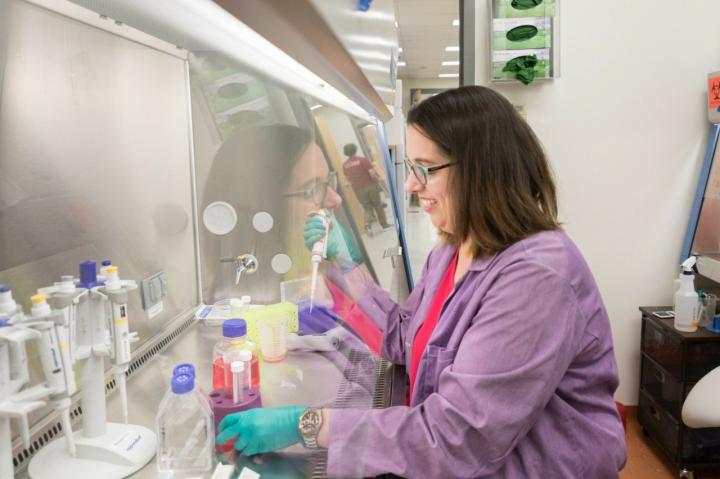
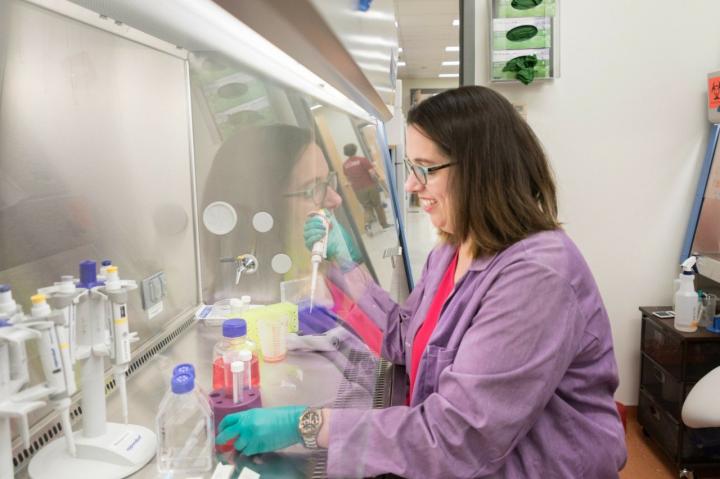
IMAGE

Credit: Virginia Tech

The tissues in our bodies largely are made of fluid. It moves around cells and is essential to normal body function.

But in some cases, this fluid may be doing more harm than good.

In people who have glioblastoma, the deadliest form of brain cancer, this fluid has a much higher pressure, causing it to move fast and forcing cancer cells to spread. And a common cancer therapy, which inserts a drug directly into the tumor with a catheter, can make this fluid move even faster.

A team of researchers at Virginia Tech, led by Jennifer Munson, an assistant professor in the Department of Biomedical Engineering and Mechanics in the College of Engineering, may have found a solution to stopping this inevitable cancer cell spread.

In an article published on Nov. 19 in Scientific Reports, Chase Cornelison, lead author and a postdoctoral researcher at Virginia Tech, details the use of a drug that Munson's team found can block the way cancer cells respond to fluid flow. This work is part of a Munson-led five-year research grant project across multiple universities, examining the role of interstitial fluid flow in the spread of glioma cells. Interstitial fluid is the fluid that surrounds cells in the body.

In labs, Cornelison and others on Munson's team used mice with glioblastoma to test how a particular approach to delivering cancer treatment, called convection enhanced delivery, caused glioma cells to invade the rest of the brain. To block the fluid's rapid movement and the spread of cancer cells, they tested a drug called AMD3100. The drug, which already has been used in clinics, appeared to be a game changer, Cornelison said.

The majority of this research happened at the University of Virginia, where Munson previously worked before she came to Virginia Tech in 2017.

This finding could lead to stopping glioblastoma from spreading, Cornelison said.

"I am hopeful that since the drug that we used to block flow stimulation is currently used in patients that maybe clinicians, when they do consider using convection enhanced delivery, will combine that with this drug," he said.

Munson has been studying glioblastoma for more than 10 years, with a more recent focus on the role of interstitial fluid flow on cancer cells and the brain.

"It [glioblastoma] is so deadly, and there hasn't been a shift in treatment response in decades. Something needs to change," she said. "With my expertise and looking at fluid flow, maybe there's an answer there that we haven't seen."

Raising awareness of interstitial fluid flow throughout the body is Munson's aim in her research.

"This is a force that isn't accounted for much in brain tissues," she said. "My goal is to have more people thinking about this force and that it can actually have effects on cells that we don't intend."

###

Media Contact

Lindsey Haugh
[email protected]
540-231-2476
@vtnews

http://www.vtnews.vt.edu

Share12Tweet8Share2ShareShareShare2

Related Posts

Deep Learning Uncovers Tetrahydrocarbazoles as Potent Broad-Spectrum Antitumor Agents with Click-Activated Targeted Cancer Therapy Approach

February 7, 2026

Newly Discovered Limonoid DHL-11 from Munronia henryi Targets IMPDH2 to Combat Triple-Negative Breast Cancer

February 7, 2026

New Discovery Reveals Why Ovarian Cancer Spreads Rapidly in the Abdomen

February 6, 2026

New Study Finds Americans Favor In-Clinic Screening Over At-Home Tests for Cervical Cancer

February 6, 2026
Please login to join discussion

POPULAR NEWS

  • Robotic Ureteral Reconstruction: A Novel Approach

    Robotic Ureteral Reconstruction: A Novel Approach

    82 shares
    Share 33 Tweet 21
  • Digital Privacy: Health Data Control in Incarceration

    63 shares
    Share 25 Tweet 16
  • Study Reveals Lipid Accumulation in ME/CFS Cells

    57 shares
    Share 23 Tweet 14
  • Breakthrough in RNA Research Accelerates Medical Innovations Timeline

    53 shares
    Share 21 Tweet 13

About

We bring you the latest biotechnology news from best research centers and universities around the world. Check our website.

Follow us

Recent News

Evaluating Pediatric Emergency Care Quality in Ethiopia

TPMT Expression Predictions Linked to Azathioprine Side Effects

Improving Dementia Care with Enhanced Activity Kits

Subscribe to Blog via Email

Success! An email was just sent to confirm your subscription. Please find the email now and click 'Confirm' to start subscribing.

Join 73 other subscribers
  • Contact Us

Bioengineer.org © Copyright 2023 All Rights Reserved.

Welcome Back!

Login to your account below

Forgotten Password?

Retrieve your password

Please enter your username or email address to reset your password.

Log In
No Result
View All Result
  • Homepages
    • Home Page 1
    • Home Page 2
  • News
  • National
  • Business
  • Health
  • Lifestyle
  • Science

Bioengineer.org © Copyright 2023 All Rights Reserved.