Credit: EAST Team
The Experimental Advanced Superconducting Tokamak (EAST), nicknamed the "Chinese artificial sun", achieved an electron temperature of over 100 million degrees in its core plasma during a four-month experiment this year. That's about seven times more than the interior of the Sun, which is about 15 million degrees C.
The experiment shows China is making significant progress towards tokamak-based fusion energy production.
The experiment was conducted by the EAST team at the Hefei Institutes of Physical Science of the Chinese Academy of Sciences (CASHIPS) in collaboration with domestic and international colleagues.
The plasma current density profile was optimized through the effective integration and synergy of four kinds of heating power: lower hybrid wave heating, electron cyclotron wave heating, ion cyclotron resonance heating and neutral beam ion heating.
Power injection exceeded 10 MW, and plasma stored energy boosted to 300 kJ after scientists optimized the coupling of different heating techniques. The experiment utilized advanced plasma control and theory/simulation prediction.
Scientists carried out experiments on plasma equilibrium and instability, confinement and transport, plasma-wall interaction and energetic particle physics to demonstrate long-time scale, steady-state H-mode operation with good control of impurity, core/edge MHD stability, and heat exhaust using an ITER-like tungsten divertor.
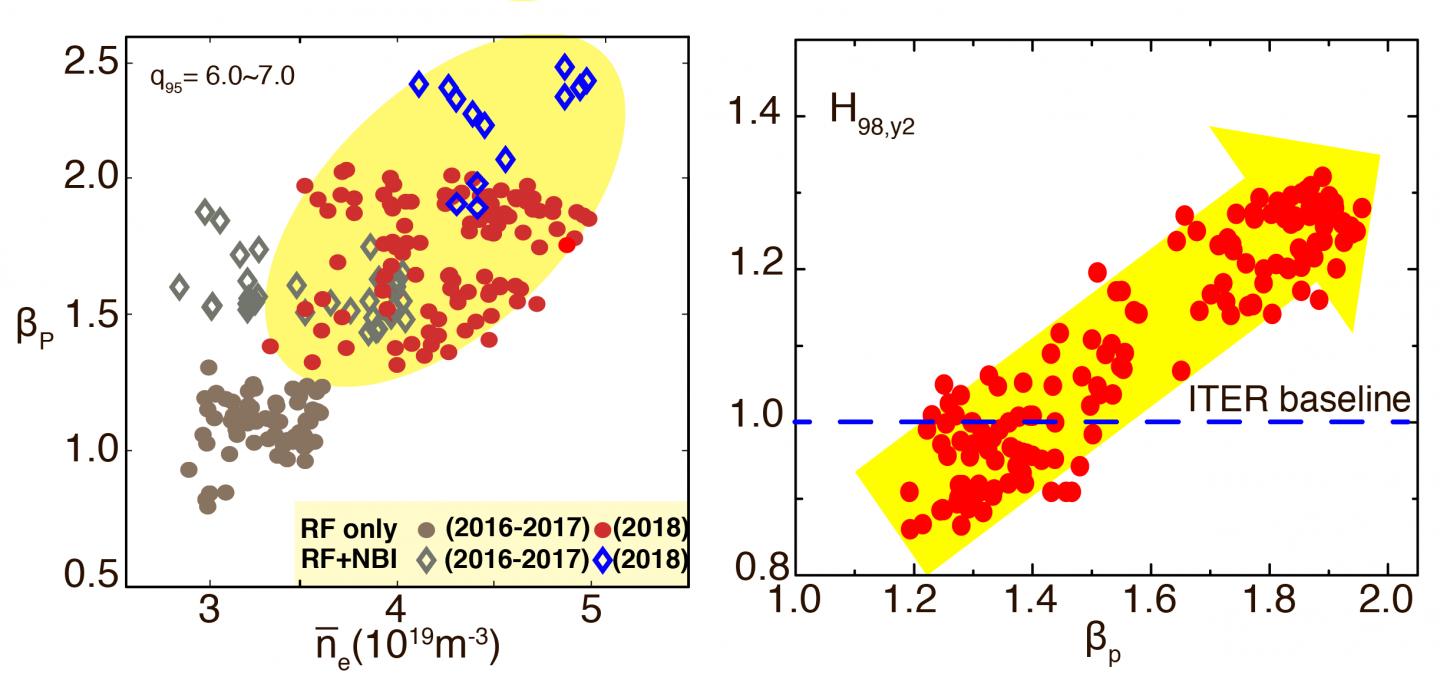
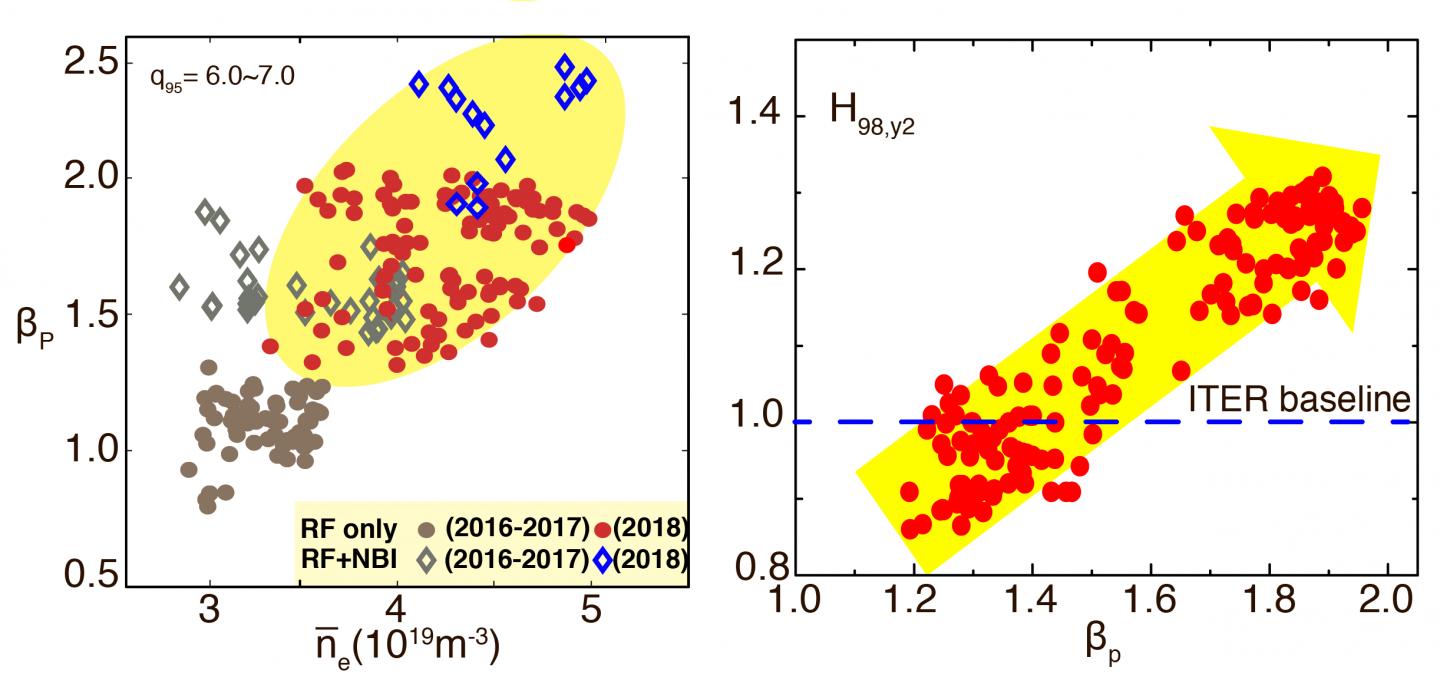
With ITER-like operating conditions such as radio frequency wave-dominant heating, lower torque, and a water-cooling tungsten divertor, EAST achieved a fully non-inductive steady-state scenario with extension of fusion performance at high density, high temperature and high confinement.
Meanwhile, to resolve the particle and power exhaust, which is crucial for high-performance steady-state operations, the EAST team employed many techniques to control the edge-localized modes and tungsten impurity with metal walls, along with active feedback control of the divertor heat load.
Operating scenarios including the steady-state high-performance H-mode and electron temperatures over 100 million degrees on EAST have made unique contributions towards ITER, the Chinese Fusion Engineering Test Reactor (CFETR) and DEMO.
These results provide key data for validation of heat exhaust, transport and current drive models. They also increase confidence in fusion performance predictions for CFETR.
At present, the CFETR physics design focuses on optimization of a third-evolution machine with large radium at 7 m, minor radium at 2 m, a toroildal magnet field of 6.5-7 Tesla and a plasma current of 13 MA.
In support of the engineering development of CFETR and the future DEMO, a new National Mega Science Project – the Comprehensive Research Facility – will be launched at the end of this year.
This new project will advance the development of tritium blanket test modules, superconducting technology, reactor-relevant heating and current drive actuators and sources, and divertor materials.
EAST is the first fully superconducting tokamak with a non-circular cross section in the world. It was designed and constructed by China with a focus on key science issues related to the application of fusion power. Since it began operating in 2006, EAST has become a fully open test facility where the world fusion community can conduct steady-state operations and ITER-related physics research.
###
Media Contact
ZHOU Shu
[email protected]
http://english.cas.cn/
Original Source
http://english.cas.cn/newsroom/news/201811/t20181113_201191.shtml