


Credit: ©Science China Press
The Late Mesozoic breakup of Gondwana triggered major biotic exchanges between Laurasia and Gondwanan landmasses that continue to influence modern distributions of many taxa. Concerning tectonic drifting of the Indian Plate, the traditional view was that this landmass acted as an isolated biotic ferry in the Indian Ocean, carrying Gondwanan biodiversity to Asia in the Early Tertiary; many biogeographic studies have relied on this assumption.
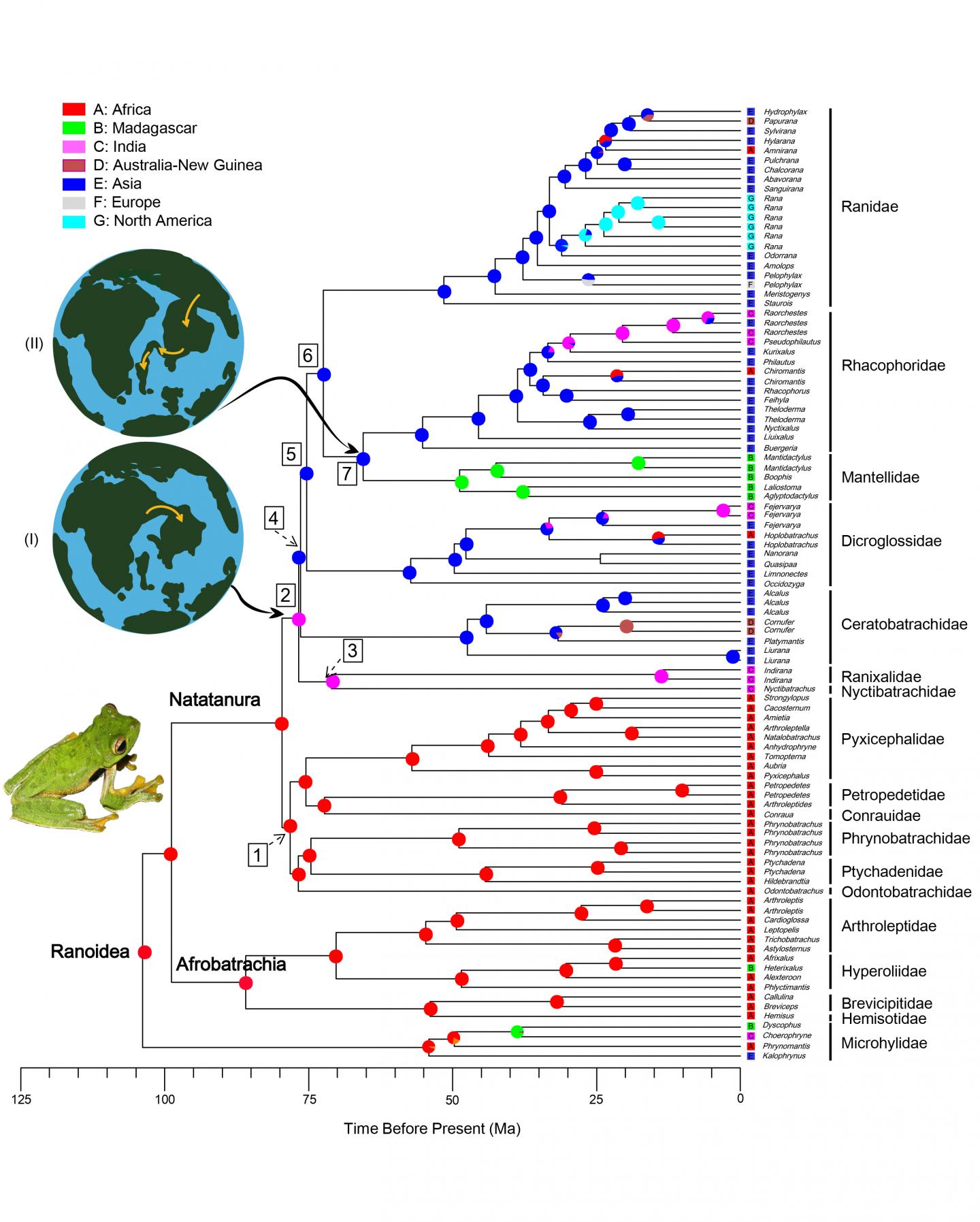
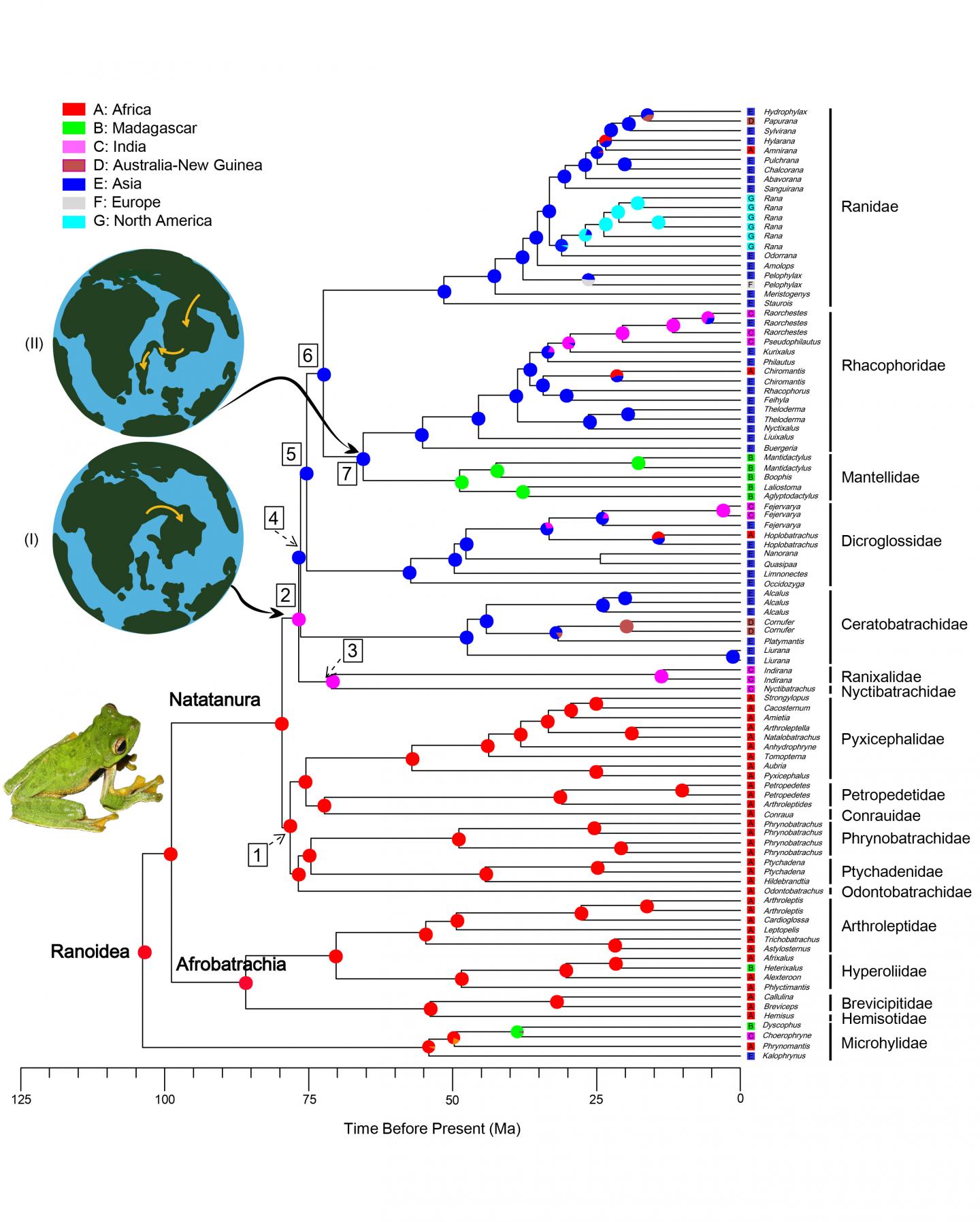
This study, led by Dr. Che, together with an international team, published recently in the National Science Review comprehensively rejects this traditional view. Using the near-cosmopolitan distributed Natatanuran frogs, they integrated phylogenomic data, biogeographic reconstruction, and molecular dating methods to resolve the spatiotemporal diversification of ranoid frogs between Laurasia and Gondwana, and examine support for alternative biogeographic hypotheses. Unexpectedly, no biotic exchanges dated between 88 and 55 Ma, the time period during which the Indian Plate broke away from other Gondwanan landmasses, and ultimately collided with Asia. In contrast, results found two major stepping-stone dispersals between 88-55 Ma via the Indian Plate: 1) dispersal from Africa into Asia, and 2) dispersal from Asia into Madagascar. This is the first demonstrated case of extant taxa having using the Indian Plate as a stepping stone to disperse between Africa, Asia and Madagascar (Fig. 1); the results point to a close biogeographic association between Africa and the Indian Plate in the Late Cretaceous. Further, no evidence supported Natatanuran exchanges between Antarctica-Australia-New Guinea and either India or Madagascar before the Eocene, arguing against hypothetical landbridges. In contrast, two lineages appeared to have dispersed independently from Asia to Australia-New Guinea much later during the Neogene. In the late Miocene, three lineages dispersed from Asia to Africa before aridification expanded across North Africa. This study not only identifies clear routes for these frogs' dispersals around the Indian Ocean, but also provides novel insights into the Earth's geological history, especially regarding the Indian and Australian plates.
###
This work was supported by the programs of the Strategic Priority Research Program of Chinese Academy of Sciences (CAS) (XDB31000000), National Natural Science Foundation of China (NSFC 31672268, 31622052), the International Partnership Program of Chinese Academy of Sciences (152453KYSB20170033), and the Animal Branch of the Germplasm Bank of Wild Species, CAS (Large Research Infrastructure Funding) to J.C.; the National Science Foundation (USA) BIO-DEB 1021247 to E.S.P. and C.J.R., BIO-DEB 135500 to D.W.W., BIO-GRFP 3048109801 to P.M.H., BIO-DEB 1021299 to K.M. Kjer; BIO-DEB 1120516 to E.M.L., and NSF-IIP to A.R.L. and E.M.L.; the Strategic Priority Research Program, CAS (XDPB020406), the National Key Research and Development Program of China (2017YFC0505202), Southeast Asia Biodiversity Research Institute, CAS (Y4ZK111B01: 2017CASSEABRIQG002) to W.-W.Z.; the Sino-Africa Joint Research Center, CAS (SAJC201611) to M.-S.P.; NSFC (31501843, 31702008) to Z.-Y.Y.; J.C and M.-S.P are supported by the Youth Innovation Promotion Association CAS.
The research was published in the National Science Review.
Title: Natatanuran frogs used the Indian Plate to step-stone disperse and radiate across the Indian Ocean
Authors: Zhi-Yong Yuan#, Bao-Lin Zhang#, Christopher J. Raxworthy, David W. Weisrock, Paul M. Hime, Jie-Qiong Jin, Emily M. Lemmon, Alan R. Lemmon, Sean D. Holland, Michelle L. Kortyna, Wei-Wei Zhou, Min-Sheng Peng, Jing Che*, and Elizabeth Prendini (#equal contribution *corresponding author)
https://doi.org/10.1093/nsr/nwy092
Media Contact
Jing Che
[email protected]
http://www.scichina.com/
Related Journal Article
http://dx.doi.org/10.1093/nsr/nwy092

