Credit: Water Scarcity Atlas
The average person in Europe uses 3000-5000 litres of water per day, of which the lion's share is spent on food production – a considerable part on the other side of the globe. The world's limited water resources are becoming an even more pressing issue as populations grow and climate change causes droughts in the global South and North. While studies have already provided a number of ways to reduce our consumption of water, this valuable information is often left unused.
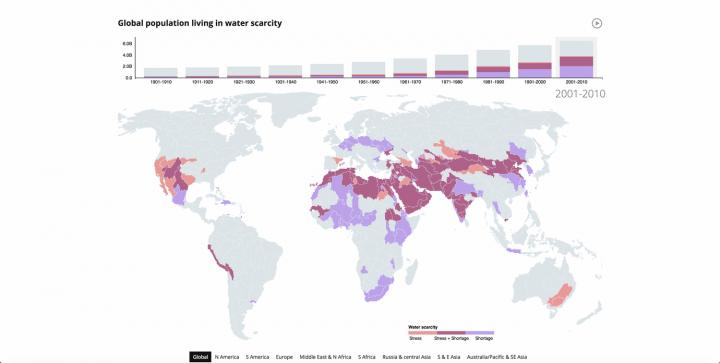
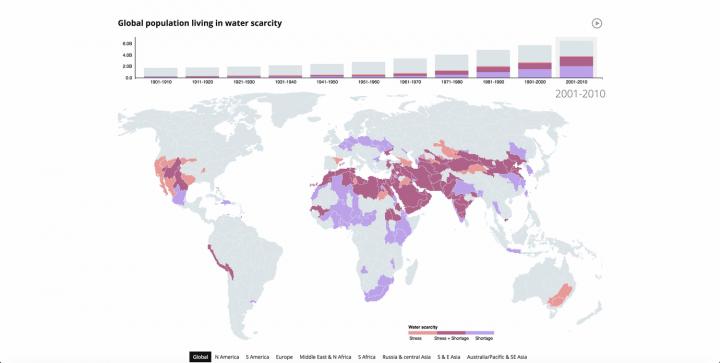
Water researchers at Aalto University wanted to better communicate research findings to a broader audience. The Water Scarcity Atlas, a web application created by Postdoctoral Researcher Joseph Guillaume and Assistant Professor Matti Kummu, uses interactive global maps to provide an introduction to the problems that arise with limited water – water scarcity – and ways to fight them.
'Choices that consumers make here in the North have an effect on the other side of the world. Understanding water scarcity and the impact of your actions is the first step to shaping the future. We wanted to create a capacity building tool so that people can better understand what makes their choices sustainable or not,' explains Dr Guillaume.
The Atlas visualizes how water scarcity has evolved over the past 100 years and presents potential scenarios for the rest of this century. The user can explore how different factors such as changes in diet and food losses affect water resources all over the world.
'As water use increases, it becomes more difficult to access the resource sustainably. Eating less meat and avoiding food waste can reduce water use. We need to support initiatives by governments, NGOs, and companies with water stewardship programmes. It's hard to strike a balance between environmental and human needs, especially when there isn't enough water to go around. We can work together to help farmers and other water users adopt new techniques, and establish effective management arrangements,' says Dr Guillaume.
The Water Scarcity Atlas is built on cutting-edge research. It is created in collaboration with the International Institute for Applied Systems Analysis (IIASA), which has contributed future scenarios for household and industry water use. Aalto combined analyses of the potential for reducing water use, and global data on water use and availability, modelled by several research groups world-wide as part of the Inter-Sectoral Impact Model Intercomparison Project (ISIMIP). The visualisations were developed with Finnish startup company Lucify.
The Atlas also functions as a platform for researchers working on water scarcity at global scale. The Atlas features a publication database and a dataset database.
'We encourage researchers to contribute their own work to the Atlas. Most of the data exists in scattered journal articles. Our platform really allows anyone interested in global water scarcity to stay up to date on the latest research – in an accessible way.'
Initial development of the Atlas was funded by the Academy of Finland in the project 'Global Water Scarcity Atlas: understanding resource pressure, causes, consequences, and opportunities (WASCO)', for the period 01.10.2016 – 30.09.2018.
Which parts of the world suffer from water shortage and how can you help alleviate water scarcity? Explore the Water Scarcity Atlas: waterscarcityatlas.org
###
Media Contact
Joseph Guillaume
[email protected]
358-504-072-906
@aaltouniversity
http://www.aalto.fi/en/
Original Source
https://www.aalto.fi/news/will-there-be-enough-water-in-the-future-interactive-world-map-visualises-water-scarcity