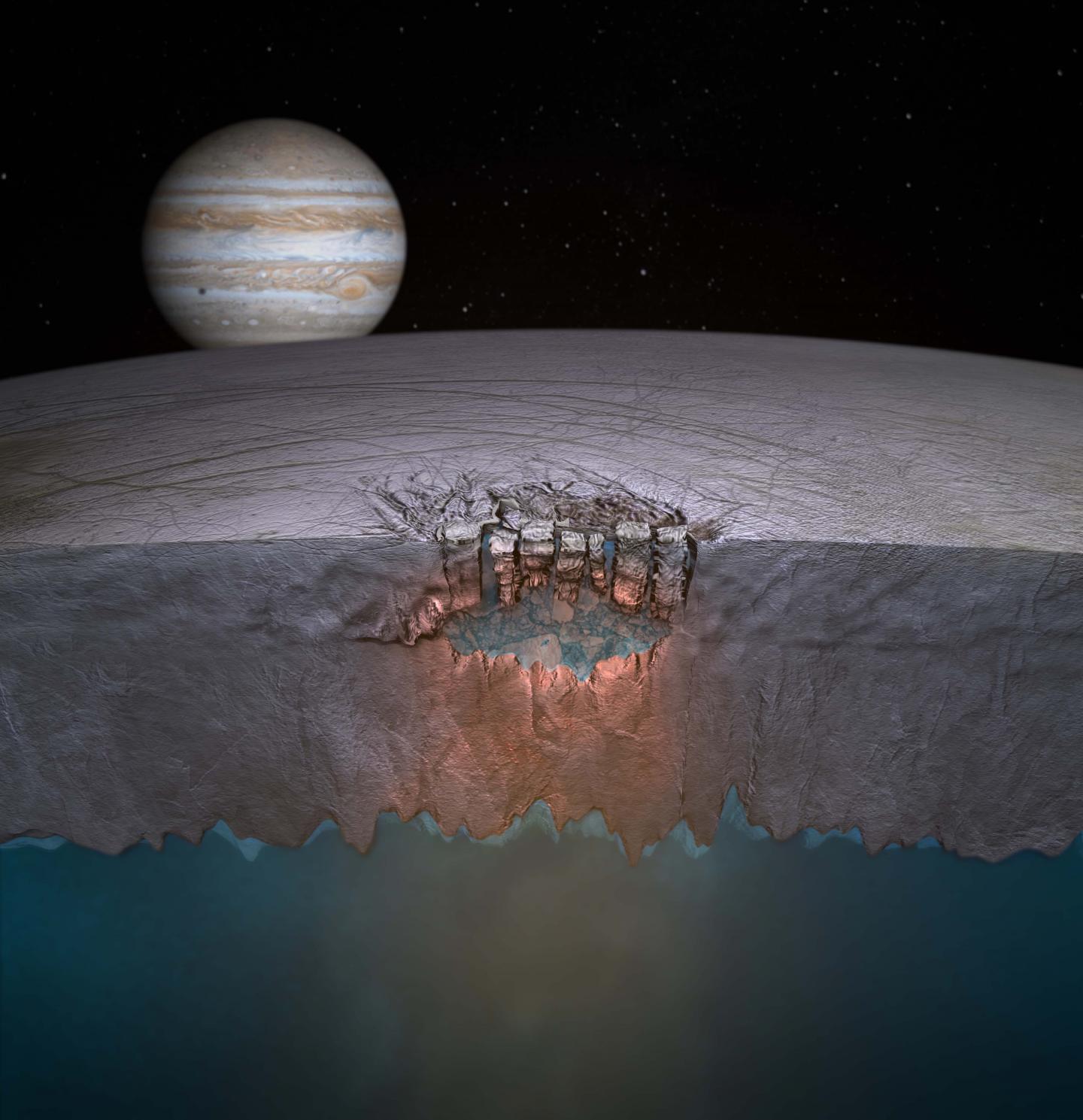
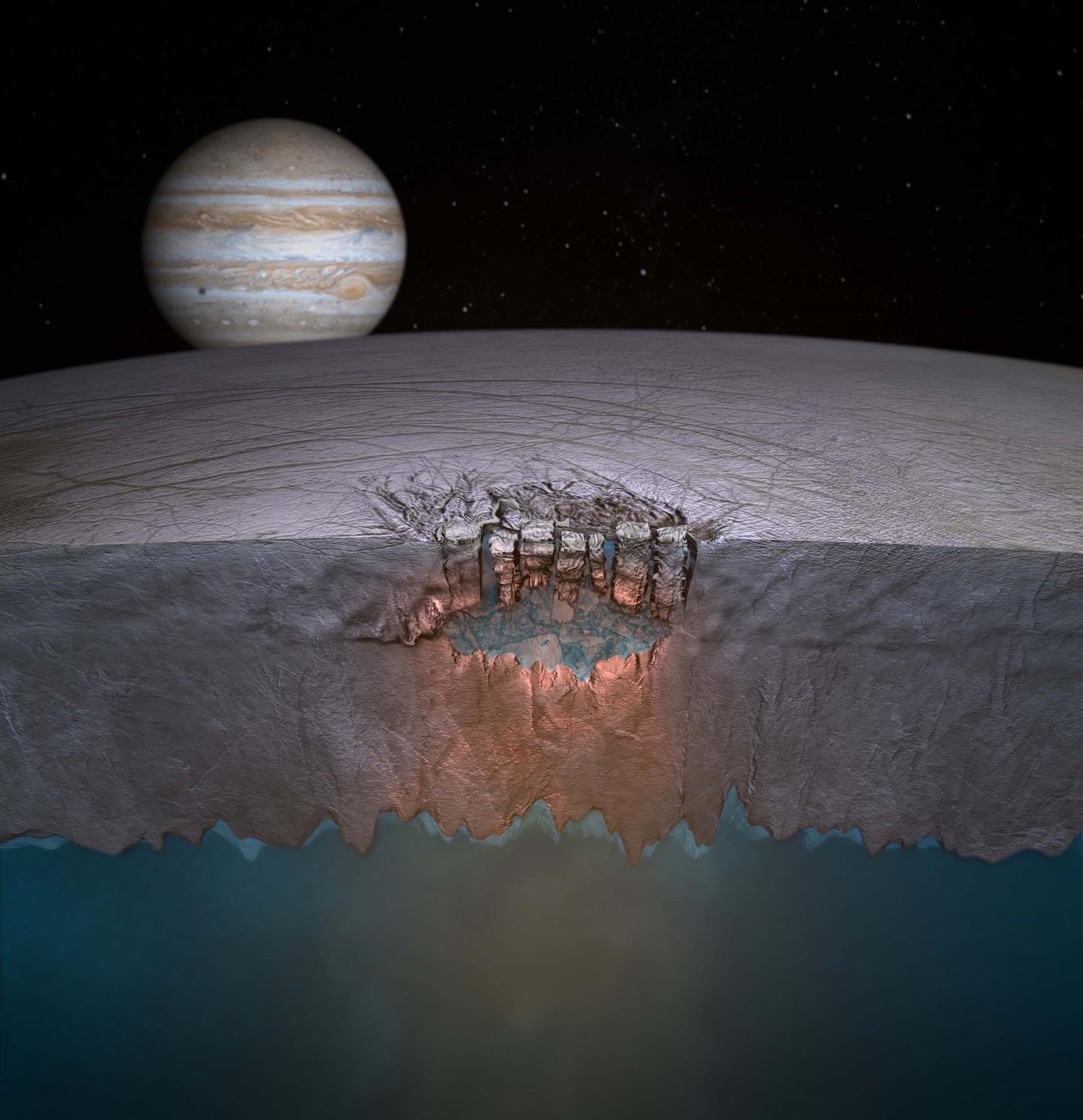
Credit: NASA handout/Britney Schmidt/Dead Pixel VFX/Univ. of Texas at Austin
NASA has navigated our solar system with spacecraft and landers, but still, our celestial neighbors remain vast frontiers, particularly in the search for life. Now, an alliance of researchers will accelerate the quest to find it.
The NASA Astrobiology Program has announced the establishment of the Network for Life Detection, NFoLD, which connects researchers to pursue the detection of life and clues thereof on our neighboring planets and their moons. NFoLD includes an oceanic research alliance led by the Georgia Institute of Technology.
It is called Oceans Across Space and Time, OAST, and has received a $7 million NASA Astrobiology grant with the long-range goal of extracting secrets from present and past oceans on Mars, Jupiter's icy moon Europa, and Saturn's moon Enceladus. But OAST will also ramp up the study of the conditions that spawned first life in Earth's oceans.
"With OAST, we finally hit the perfect mix of people, science questions, and supporting activities to really go after some of the most important unknowns in astrobiology," said Britney Schmidt, OAST's principal investigator and an assistant professor in Georgia Tech's School of Earth and Atmospheric Sciences.
NFoLD is one of five new Research Coordination Networks that the NASA Astrobiology Program has announced. The other RCNs pull together research communities that include the study of early Earth and its chemistry, evolution, distant habitable worlds, and exoplanet systems.
Yellow submarine on Europa
Oceans Across Space and Time could one day help NASA put a submarine on a rocket to Europa to look for life in the ocean beneath its ice crust. Or OAST could join NFoLD colleagues to help NASA explore parched Martian landscapes that once were oceans.
But the path to our space neighbors leads through studying Earth. Field and lab experiments on our planet will divulge more knowledge about chemical and biological evolutionary strategies so that researchers can develop instruments and methodology that reliably detect signs of life on other planets and moons.
"We don't yet have a slam-dunk measurement that we could make on another planet to definitively say 'this is life,'" said Schmidt, who coordinates OAST and led the application efforts to establish it. "OAST's main goal is to take a suite of technologies into the field on Earth to make measurements side-by-side while returning samples to the lab to understand."
Then, when that is very finely honed, send it aloft.
Crucial target practice
One of NFoLD's goals is to participate in future astrobiology space missions from the start so that they can successfully identify target spots on other planets or moons where signs of life could actually be detected if present.
"A major challenge for life detection is where on a given planet or moon to look for life," said Jeff Bowman, deputy principal investigator of OAST and an assistant professor at Scripps Institution of Oceanography at UC San Diego. "The density of life on our own planet extends across several orders of magnitude. Look for life in the wrong place and Earth could appear lifeless."
OAST's team has the expertise to bridge earthly data and celestial goals.
Many of its 18 co-investigators and their teams have already explored biogeochemistry in our own planet's eons-old rock record, in the atmosphere, the oceans, and the icecaps with an eye to extrapolating the data to other worlds. Other OAST researchers have helped design Mars probes or build robotic submarines intended to one day dive into Europa's subsurface ocean to detect life or at least a hint of it.
"OAST researchers have expertise in detecting and characterizing life in a variety of harsh environments like the Antarctic, the deepest ocean trenches, and lakes with extreme chemistry and salinity," Bowman said. "We will leverage this expertise to understand how life may be distributed in different ocean environmental extremes around the solar system."
Diverse member institutions
OAST includes investigators from Scripps Institution of Oceanography at the University of California San Diego; the University of Kansas; Louisiana State University; the Massachusetts Institute of Technology; Stanford University; the Blue Marble Space Institute of Science; the University of Texas; Colgate University; the University of California, the University of Central Florida; the University of Auckland; York University; the University of Otago, and the New Zealand National Institute of Water and Atmospheric Research.
"I'm particularly proud of the high number of women and pre-tenure scientists we've engaged through our project," said Schmidt. Five leaders in OAST are women, and 12 researchers are early career or pre-tenure. The project will also support graduate and undergraduate students as well as postdoctoral researchers through the NASA Postdoctoral Program.
###
Media Contact
Ben Brumfield
[email protected]
404-660-1408
@GeorgiaTech
http://www.gatech.edu