• HOME
  • NEWS
  • EXPLORE
    • CAREER
      • Companies
      • Jobs
    • EVENTS
    • iGEM
      • News
      • Team
    • PHOTOS
    • VIDEO
    • WIKI
  • BLOG
  • COMMUNITY
    • FACEBOOK
    • INSTAGRAM
    • TWITTER
Saturday, February 7, 2026
BIOENGINEER.ORG
No Result
View All Result
  • Login
  • HOME
  • NEWS
  • EXPLORE
    • CAREER
      • Companies
      • Jobs
        • Lecturer
        • PhD Studentship
        • Postdoc
        • Research Assistant
    • EVENTS
    • iGEM
      • News
      • Team
    • PHOTOS
    • VIDEO
    • WIKI
  • BLOG
  • COMMUNITY
    • FACEBOOK
    • INSTAGRAM
    • TWITTER
  • HOME
  • NEWS
  • EXPLORE
    • CAREER
      • Companies
      • Jobs
        • Lecturer
        • PhD Studentship
        • Postdoc
        • Research Assistant
    • EVENTS
    • iGEM
      • News
      • Team
    • PHOTOS
    • VIDEO
    • WIKI
  • BLOG
  • COMMUNITY
    • FACEBOOK
    • INSTAGRAM
    • TWITTER
No Result
View All Result
Bioengineer.org
No Result
View All Result
Home NEWS Science News Cancer

UC researchers developing test for early breast lesions

Bioengineer by Bioengineer
October 30, 2018
in Cancer
Reading Time: 2 mins read
0
Share on FacebookShare on TwitterShare on LinkedinShare on RedditShare on Telegram
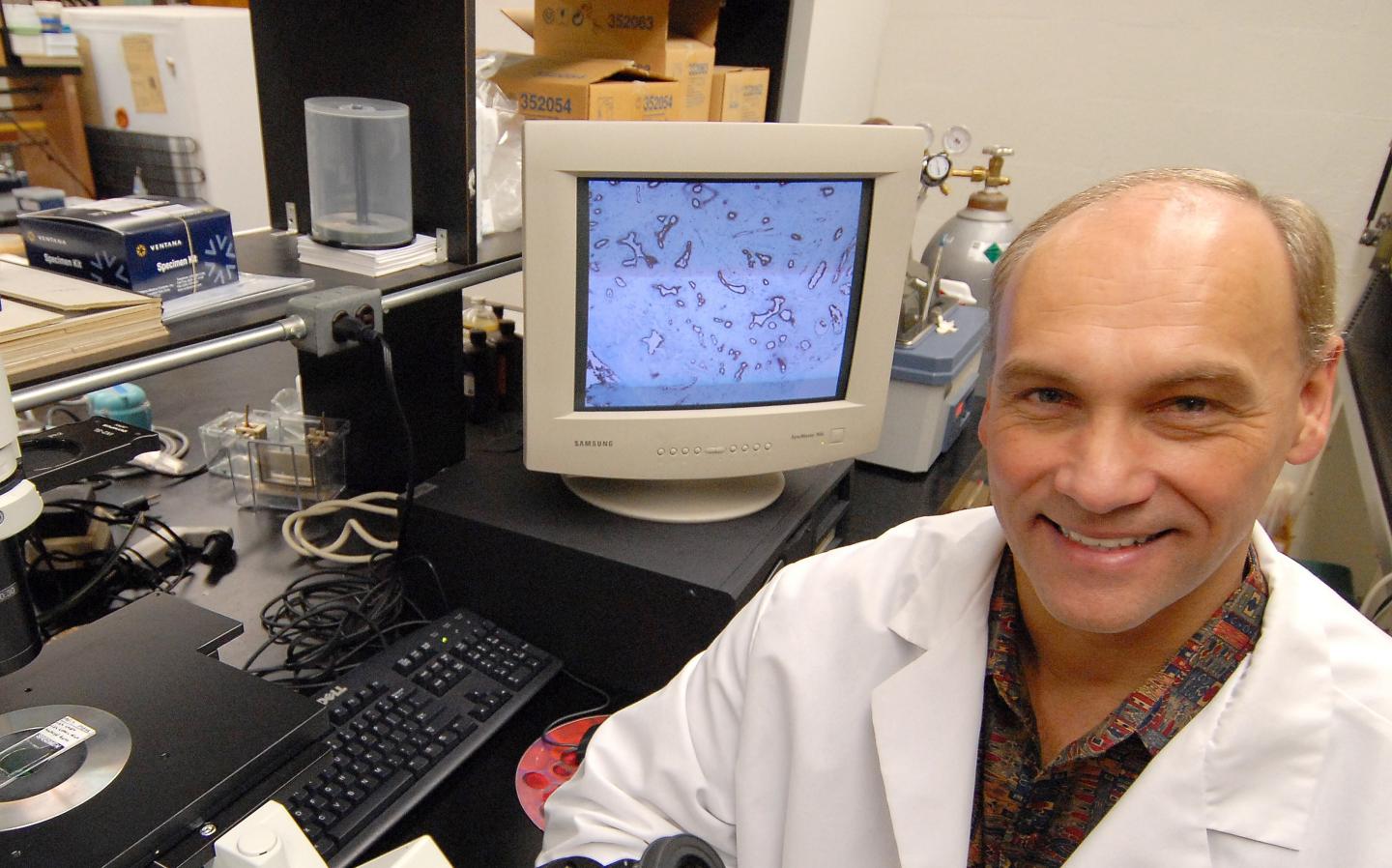
IMAGE

Credit: University of Cincinnati/Colleen Kelley

CINCINNATI–Currently, with a pre-malignant breast cancer diagnosis from a biopsy, there are three options: observation, chemoprevention or surgery, all of which require a patient to make decisions while operating from a place of fear and unknown outcomes. Some patients, for example, with early breast cancer indications, might choose to have mastectomies, rather than live in uncertainty, when the disease state may not have progressed.

That is why researchers at the University of Cincinnati (UC) are investigating a molecular diagnostic test to determine whether, after biopsy, someone is at high or low risk for actually developing malignant breast cancer.

"The test aids in the decision whether to treat aggressively or wait," says cancer researcher and principal investigator Georg Weber, MD, PhD, a professor at UC's James L. Winkle College of Pharmacy.

The study, "Osteopontin and Premalignant Breast Lesions," appears in the Oct. 24, 2018 issue of the British Journal of Cancer. In the study, Weber, co-author Elyse Lower, MD, professor of medicine at the UC College of Medicine, director of the UC Cancer Institute's Breast Cancer Center and UC Health oncologist, and colleagues at Wroclaw Medical University in Poland, analyzed variants of the biomarker Osteopontin (OPN) in 434 women with premalignant breast lesions.

From the sample, they determined that the presence of Osteopontin variants can very reliably assess the risk group a patient belongs to, thus aiding in the decision on how to proceed. "The value lies in being able to examine invasive potential," says Weber, adding that prognostic biomarkers inform on the probable disease course while predictive biomarkers provide upfront information regarding how likely a patient is to benefit from a specific treatment, and hence may guide the choice of available therapies.

Weber attended medical school in Würzburg, Germany. He worked at the Dana-Farber Cancer Institute, Harvard Medical School from 1990 through 2000. He has published over 100 scientific reports, including many in the most respected professional journals, plus various monographs, including textbooks on molecular oncology and anti-cancer drugs. He holds eight patents and has additional applications pending. His research has made key contributions to understanding the molecular mechanisms of metastasis.

###

This research was funded by the Marlene Harris-Ride Cincinnati/Pilot Program. Biostatical support was provided by the University of Cincinnati Center for Clinical and Translational Science and Training (CCTST) with funding from the National Center for Advancing Translational Sciences of the National Institutes of Health (Award # 5UL1TR))1425-03).

The authors cite no conflict of interest.

Media Contact

Angela Koenig
[email protected]
513-558-4625
@UCHealthNews

http://www.healthnews.uc.edu

Original Source

http://healthnews.uc.edu/news/?/30292/
Share12Tweet8Share2ShareShareShare2

Related Posts

Deep Learning Uncovers Tetrahydrocarbazoles as Potent Broad-Spectrum Antitumor Agents with Click-Activated Targeted Cancer Therapy Approach

February 7, 2026

Newly Discovered Limonoid DHL-11 from Munronia henryi Targets IMPDH2 to Combat Triple-Negative Breast Cancer

February 7, 2026

New Discovery Reveals Why Ovarian Cancer Spreads Rapidly in the Abdomen

February 6, 2026

New Study Finds Americans Favor In-Clinic Screening Over At-Home Tests for Cervical Cancer

February 6, 2026
Please login to join discussion

POPULAR NEWS

  • Robotic Ureteral Reconstruction: A Novel Approach

    Robotic Ureteral Reconstruction: A Novel Approach

    82 shares
    Share 33 Tweet 21
  • Digital Privacy: Health Data Control in Incarceration

    63 shares
    Share 25 Tweet 16
  • Study Reveals Lipid Accumulation in ME/CFS Cells

    57 shares
    Share 23 Tweet 14
  • Breakthrough in RNA Research Accelerates Medical Innovations Timeline

    53 shares
    Share 21 Tweet 13

About

We bring you the latest biotechnology news from best research centers and universities around the world. Check our website.

Follow us

Recent News

Personalized Guide to Understanding and Reducing Chemicals

Inflammasome Protein ASC Drives Pancreatic Cancer Metabolism

Phage-Antibiotic Combo Beats Resistant Peritoneal Infection

Subscribe to Blog via Email

Enter your email address to subscribe to this blog and receive notifications of new posts by email.

Join 73 other subscribers
  • Contact Us

Bioengineer.org © Copyright 2023 All Rights Reserved.

Welcome Back!

Login to your account below

Forgotten Password?

Retrieve your password

Please enter your username or email address to reset your password.

Log In
No Result
View All Result
  • Homepages
    • Home Page 1
    • Home Page 2
  • News
  • National
  • Business
  • Health
  • Lifestyle
  • Science

Bioengineer.org © Copyright 2023 All Rights Reserved.