• HOME
  • NEWS
  • EXPLORE
    • CAREER
      • Companies
      • Jobs
    • EVENTS
    • iGEM
      • News
      • Team
    • PHOTOS
    • VIDEO
    • WIKI
  • BLOG
  • COMMUNITY
    • FACEBOOK
    • INSTAGRAM
    • TWITTER
Thursday, June 25, 2026
BIOENGINEER.ORG
No Result
View All Result
  • Login
  • HOME
  • NEWS
  • EXPLORE
    • CAREER
      • Companies
      • Jobs
        • Lecturer
        • PhD Studentship
        • Postdoc
        • Research Assistant
    • EVENTS
    • iGEM
      • News
      • Team
    • PHOTOS
    • VIDEO
    • WIKI
  • BLOG
  • COMMUNITY
    • FACEBOOK
    • INSTAGRAM
    • TWITTER
  • HOME
  • NEWS
  • EXPLORE
    • CAREER
      • Companies
      • Jobs
        • Lecturer
        • PhD Studentship
        • Postdoc
        • Research Assistant
    • EVENTS
    • iGEM
      • News
      • Team
    • PHOTOS
    • VIDEO
    • WIKI
  • BLOG
  • COMMUNITY
    • FACEBOOK
    • INSTAGRAM
    • TWITTER
No Result
View All Result
Bioengineer.org
No Result
View All Result
Home NEWS Bioengineering

Stem cell clues uncovered

Bioengineer by Bioengineer
September 18, 2013
in Bioengineering, Science News
Reading Time: 2 mins read
0
Share on FacebookShare on TwitterShare on LinkedinShare on RedditShare on Telegram

Proper tissue function and regeneration is supported by stem cells, which reside in so-called niches. New work from Carnegie’s Yixian Zheng and Haiyang Chen identifies an important component for regulating stem cell niches, with impacts on tissue building and function. The results could have implications for disease research. It is published by Cell Stem Cell.

Lamins are proteins that the major structural component of the material that lines the inside of a cell’s nucleus. Lamins have diverse functions, including suppressing gene expression. It has been difficult to understand how mutations in lamins cause diseases in specific tissues and organs, such as skeletal muscles, heart muscle, and fat.

A group of human diseases called laminopathies, which include premature aging, are caused by defects in proteins called lamins. Zheng and her team, which included Xin Chen of Johns Hopkins University, decided to examine whether lamins would link stem cell niche function to healthy tissue building and maintenance.

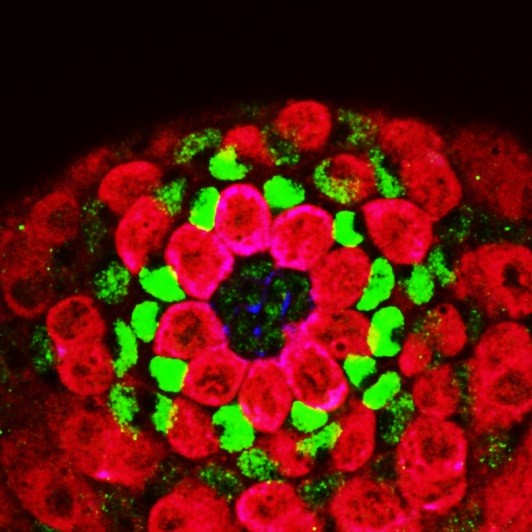
To understand the tissue-specific effects of lamin mutations, the team focused on fruit fly testis, one of the best-studied stem cell niche systems. In the fruit fly testis, biochemical cross-signaling between the different types of cells that make up the niche environment ensures proper maintenance and differentiation of the testis system’s stem cells.

Using an advanced array of techniques available in fruit fly studies, the team demonstrated that lamins were a necessary component of supporting niche organization, which in turn regulates proper proliferation and differentiation of germline stem cells in fruit fly testis.

“These results could have implications for the role of lamins in other types of stem cell niches,” Zheng said. “These findings could contribute to the study of diseases caused by lamina-based tissue degeneration. For example, different lamin mutations could disrupt the organization of different niches in the body, which then leads to degeneration in tissues.”

Story Source:

The above story is reprinted from materials provided by Carnegie Institution of Washington.
Share12Tweet8Share2ShareShareShare2

Related Posts

Tracking Lanthanide-Labeled Microplastics in Plants

June 25, 2026

POSTECH Researchers Slash Cost of Reconstituted Cell-Free Systems by 95%

June 25, 2026

AI and Physics Collaborate to Design Advanced Hydrogen Storage Materials

June 25, 2026

Natural Hallucinogens: Evolution’s Ecological Tools, Not Mere Chemical Byproducts

June 25, 2026
Please login to join discussion

POPULAR NEWS

  • Saying Goodbye to PGY-6: Pediatric Fellowship Realities

    103 shares
    Share 41 Tweet 26
  • Multi-Hospital Study Reveals Long Covid Burden Is Twice as High as Current Estimates

    92 shares
    Share 36 Tweet 23
  • Detection of EDCs in Breast Milk and Infant Urine Up to Six Months Highlights Early Exposure Risks

    77 shares
    Share 31 Tweet 19
  • New Drug Candidate Developed at McMaster Shows Potential for Treating Brain Cancer

    58 shares
    Share 23 Tweet 15

About

We bring you the latest biotechnology news from best research centers and universities around the world. Check our website.

Follow us

Recent News

Tracking Lanthanide-Labeled Microplastics in Plants

POSTECH Researchers Slash Cost of Reconstituted Cell-Free Systems by 95%

AI and Physics Collaborate to Design Advanced Hydrogen Storage Materials

Subscribe to Blog via Email

Success! An email was just sent to confirm your subscription. Please find the email now and click 'Confirm' to start subscribing.

Join 82 other subscribers
  • Contact Us

Bioengineer.org © Copyright 2023 All Rights Reserved.

Welcome Back!

Login to your account below

Forgotten Password?

Retrieve your password

Please enter your username or email address to reset your password.

Log In
No Result
View All Result
  • Homepages
    • Home Page 1
    • Home Page 2
  • News
  • National
  • Business
  • Health
  • Lifestyle
  • Science

Bioengineer.org © Copyright 2023 All Rights Reserved.