Credit: Trudy Oliver Lab
Research at Huntsman Cancer Institute (HCI) at the University of Utah (U of U) yielded new insights into the environment surrounding different types of lung tumors, and described how these complex cell ecosystems may in turn ultimately affect response to treatment. The results were published today in Immunity and featured on the print cover of the journal.
Lung cancer is the leading cause of cancer death among men and women. According to the American Cancer Society, the disease kills more people each year than colon, breast, and prostate cancers combined. Therefore, uncovering the precursors and behaviors of lung cancer remains a major target among scientists working to improve cancer outcomes.
Cells live in complex, distinct communities that scientists refer to as microenvironments. These microenvironments have many features that impact how a cell grows, how it behaves, and how it communicates with other nearby cells. In the case of cancer, researchers work to understand the microenvironment of a tumor to try to identify opportunities for possible therapeutic approaches.
"We sought to figure out why the immune microenvironment of lung cancer types were different," says Trudy Oliver, PhD, HCI cancer researcher and associate professor of oncological sciences at the U of U, who oversaw the study. "We know that different kinds of tumor cells interact with different kinds of immune cells, and these immune cells have functions that can help or hurt the tumor. Essentially, tumors get these immune cells to do their dirty work for them," says Oliver. "We noticed in both mice and in people that some tumors clinically thought of under the same umbrella are distinct in many ways that were not previously understood. Most strikingly, different lung tumor types were recruiting different types of immune cells."
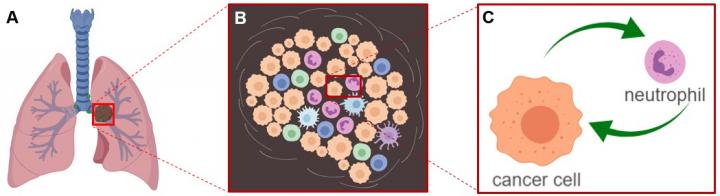
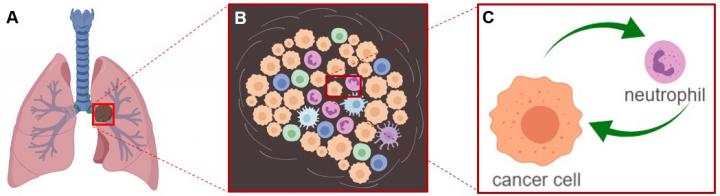
Using a mouse model developed by her lab, along with sophisticated single-cell sequencing technology, Oliver's work uncovered clues to the role neutrophils, a type of immune cell, play in different types of lung cancer. In humans and other organisms, neutrophils are the body's 'first responders' to an injury. Neutrophils are present at sites of trauma such as a cut, and they are part of the body's innate response to fighting a tumor. It had been previously shown that poor prognosis in lung cancer and poor response to immunotherapy treatment for lung cancer were associated with high levels of neutrophils.
"The association of high presence of neutrophils with a bad response to immunotherapy means neutrophils might be a target for scientists to develop new treatments to help people who aren't responding well to currently available drugs," Oliver suggested. Oliver found that the tumors changed the behavior of the neutrophils, causing inhibition of their normal roles and influencing them to behave in ways that supported tumor growth.
Gurkan Mollaoglu, a PhD student in the Oliver lab, conducted the laboratory work. "It is both challenging and exciting to study how cancer cells shape their environment to become more favorable for the cancer," says Mollaoglu. "The mouse models that we developed here are powerful tools that mirror many features of human tumors. Using these models, we showed how cancer cells modify their microenvironment and how the altered microenvironment, in return, favors cancer cells." Earlier this year, based on his accomplishments with this work, Mollaoglu was chosen to attend the 68th Lindau Nobel Laureate Meeting, an annual meeting where select young scientists meet several dozen Nobel laureates.
The Oliver lab and Eric Snyder, MD, PhD, HCI cancer researcher and assistant professor of pathology at the U of U, made critical contributions to the study.
In the next steps of the work, Oliver and her team plan to characterize what the neutrophils do to help the tumors, and whether altering neutrophils can improve response to lung cancer therapies.
###
The study was funded by the Huntsman Cancer Foundation, National Institutes of Health/National Cancer Institute (P30 CA042014, R01 CA187457, F99 CA223015), Damon Runyon Cancer Research Foundation, the V Foundation for Cancer Research, American Cancer Society, and the University of Utah Immunology, Inflammation, and Infectious Diseases initiative.
Media Contact
Amie Parker
[email protected]
801-213-5755
http://www.huntsmancancer.org
Original Source
https://huntsmancancer.org/newsroom/2018/10/interplay-between-tumor-cells-and-immune-cells.php http://dx.doi.org/10.1016/j.immuni.2018.09.020