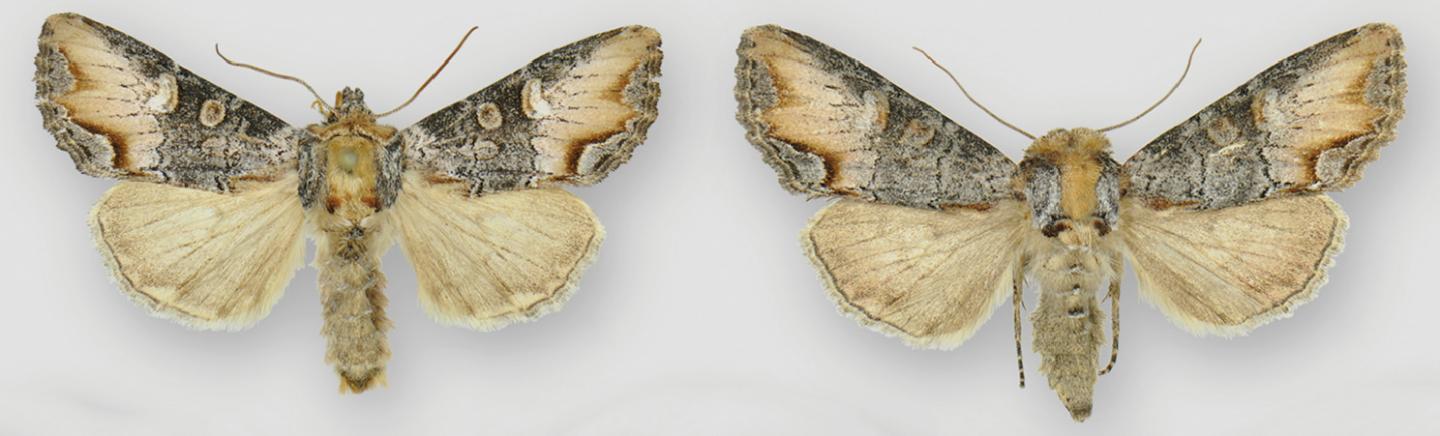
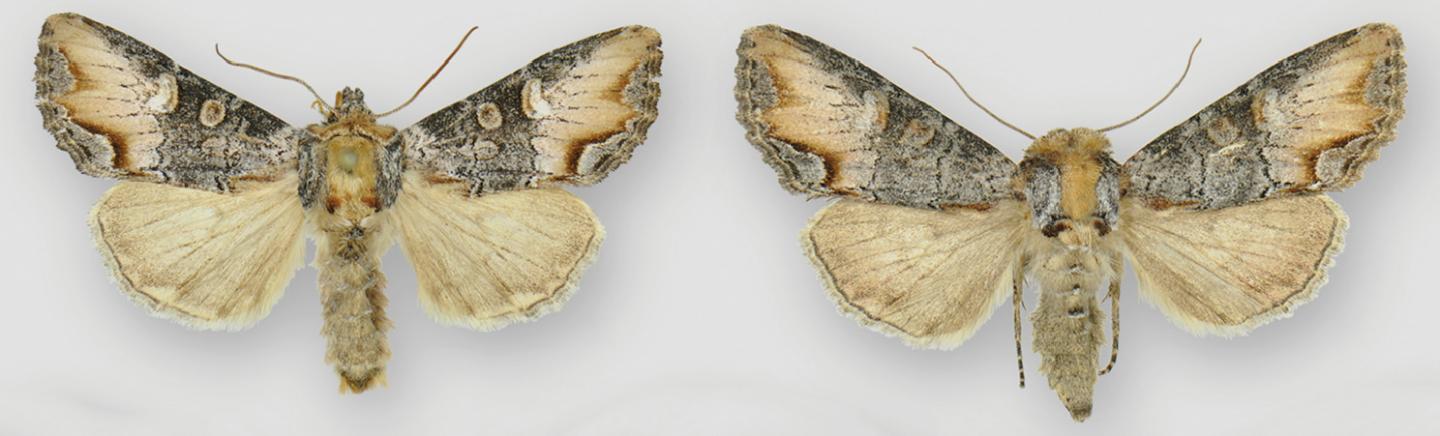
Credit: Lars G. Crabo
A newly-recognized species of owlet moth recently discovered to inhabit high-elevation mountains in western North America was named after the Greek mythological character Icarus. From now on, scientists will be referring to the new insect as Admetovis icarus.
In their paper, Dr Lars Crabo, Washington State University, USA, and Dr Christian Schmidt, Agriculture and Agri-Food Canada, explain that the combination of the distinct flame-shaped mark on the moth's forewing and its high-elevation habitat were quick to remind them of Icarus, who is said to have died after flying so close to the sun that his wings made of wax and feathers caught fire.
The study is part of the seventh volume of the "Contributions to the systematics of New World macro-moths" series, where all previous volumes have also been published as special issues in ZooKeys.
Found in the town of Nederland, Colorado, the moth was collected at an elevation of 2,896 m above sea level. The species has also been recorded all the way from central Utah and central Colorado to the Selkirk Mountains of southeastern British Columbia, including a record from northeastern Oregon. It can be spotted between June and August at night.
In fact, it turns out that the moth has been collected during surveys in the past on multiple occasions, but has been misidentified with another closely related species: Admetovis oxymorus.
While the flame mark is a characteristic feature in all three species known in the genus (Admetovis), in the newly described species it is darker. When compared, the wings of the Icarus moth are also more mottled.
Despite the biology of the larvae being currently unknown, the scientists believe they are climbing cutworms and feed on woody shrubs, similarly to the species Admetovis oxymorus.
"Finding undiscovered moths is not that unusual, even though scientists have been naming insects since the eighteenth century," says lead author Dr Lars Crabo.
"The Contributions series, edited by Don Lafontaine and Chris Schmidt, in which this discovery is published, really encourages professional and citizen scientists alike to go through the steps necessary to properly name the species that they have discovered. This series of seven volumes also includes a new check list for the United States and Canada, which has led to a re-kindling of interest in moths during the last decade."
###
Original source:
Crabo LG, Schmidt BC (2018) A revision of Admetovis Grote, with the description of a new species from western North America (Noctuidae, Noctuinae, Hadenini). In: Schmidt BC, Lafontaine JD (Eds) Contributions to the systematics of New World macro-moths VII. ZooKeys 788: 167-181. https://doi.org/10.3897/zookeys.788.26480
Additional information:
Similarly to all previous volumes of the series, "Contributions to the systematics of New World macro-moths VII" is also published in the open access scholarly journal ZooKeys.
The studies add numerous taxonomic and nomenclatural changes, and also describe a total of 24 new taxa from the Nearctic and the Neotropics, including a new genus, 22 new species and one subspecies.
A dedicated Editorial, authored by Christian Schmidt and Donald, both affiliated with the Canadian National Collection of Insects, Arachnids, and Nematodes (CNC), Ottawa Research and Development Centre, Agriculture and Agri-Food Canada is also available.
Media Contact
Lars G. Crabo
[email protected]
@Pensoft
http://www.pensoft.net
Related Journal Article
http://dx.doi.org/10.3897/zookeys.788.26480