• HOME
  • NEWS
  • EXPLORE
    • CAREER
      • Companies
      • Jobs
    • EVENTS
    • iGEM
      • News
      • Team
    • PHOTOS
    • VIDEO
    • WIKI
  • BLOG
  • COMMUNITY
    • FACEBOOK
    • INSTAGRAM
    • TWITTER
Saturday, February 7, 2026
BIOENGINEER.ORG
No Result
View All Result
  • Login
  • HOME
  • NEWS
  • EXPLORE
    • CAREER
      • Companies
      • Jobs
        • Lecturer
        • PhD Studentship
        • Postdoc
        • Research Assistant
    • EVENTS
    • iGEM
      • News
      • Team
    • PHOTOS
    • VIDEO
    • WIKI
  • BLOG
  • COMMUNITY
    • FACEBOOK
    • INSTAGRAM
    • TWITTER
  • HOME
  • NEWS
  • EXPLORE
    • CAREER
      • Companies
      • Jobs
        • Lecturer
        • PhD Studentship
        • Postdoc
        • Research Assistant
    • EVENTS
    • iGEM
      • News
      • Team
    • PHOTOS
    • VIDEO
    • WIKI
  • BLOG
  • COMMUNITY
    • FACEBOOK
    • INSTAGRAM
    • TWITTER
No Result
View All Result
Bioengineer.org
No Result
View All Result
Home NEWS Science News Biology

UM researchers publish discoveries on antibiotic resistance

Bioengineer by Bioengineer
October 1, 2018
in Biology
Reading Time: 2 mins read
0
Share on FacebookShare on TwitterShare on LinkedinShare on RedditShare on Telegram
IMAGE

Credit: Courtesy of Patrick Secor

MISSOULA – University of Montana researchers recently published their new insights into how pathogenic bacteria resist antibiotic treatment in Proceedings of the Natural Academy of Sciences.

"Antibiotic resistance is a major problem," said Patrick Secor, assistant professor in UM's Division of Biological Sciences and lead researcher on the paper. "However, it is often the case that if you take bacteria that survive antibiotic treatment from someone's infected lungs and treat those same bacteria with antibiotics in the lab, the bacteria die. We wanted to understand why."

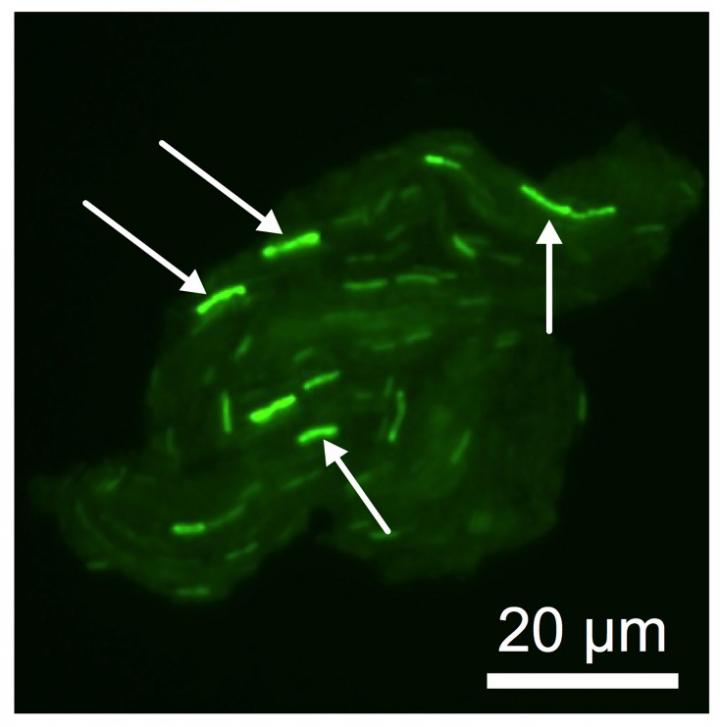
Secor and researchers at UM and the University of Washington discovered that polymers present in airway mucus physically push on bacterial cells.

"We found that bacteria living in high concentrations of polymers get a little stressed out," said Lia Michaels, a researcher at UM and co-author of the paper. "Basically, the polymer-rich environment activates stress responses in the bacteria, causing them to tolerate higher levels of antibiotics."

"I like to compare it to the stress our bodies undergo when we exercise," Secor said. "Exercising today allows you to run a little further or lift a little more weight later on. This is analogous to the stress responses turned on in bacteria living in airway mucus – exposure to stress today allows the bacteria to survive the stress of antibiotic exposure later on."

The researchers discovered that stress responses induced by mucus polymers pressing on the bacteria were a result of mild DNA damage in the bacterial cells.

"One thing that this DNA damage did was slow bacterial growth," said Laura Jennings, UM research assistant professor and co-author of the paper. "Because most antibiotics work best on rapidly dividing cells, these slow-growing bacteria were more difficult to kill with antibiotics."

The researchers speculate that the mechanisms by which polymers turn on bacterial stress responses could be targeted therapeutically to treat long-term bacterial infections.

"Our hope is that we could come up with new ways to treat bacterial infections or increase the efficacy of antibiotic treatment," Secor said.

###

The paper, "Entropically-driven aggregation of bacteria by host polymers promotes antibiotic tolerance in Pseudomonas aeruginosa," is online at http://www.pnas.org/content/early/2018/09/27/1806005115.

Media Contact

Patrick Secor
[email protected]
406-243-2614

http://www.umt.edu

Original Source

http://news.umt.edu/2018/10/100118anti.php

Share12Tweet8Share2ShareShareShare2

Related Posts

Florida Cane Toad: Complex Spread and Selective Evolution

Florida Cane Toad: Complex Spread and Selective Evolution

February 7, 2026
New Study Uncovers Mechanism Behind Burn Pit Particulate Matter–Induced Lung Inflammation

New Study Uncovers Mechanism Behind Burn Pit Particulate Matter–Induced Lung Inflammation

February 6, 2026

DeepBlastoid: Advancing Automated and Efficient Evaluation of Human Blastoids with Deep Learning

February 6, 2026

Navigating the Gut: The Role of Formic Acid in the Microbiome

February 6, 2026
Please login to join discussion

POPULAR NEWS

  • Robotic Ureteral Reconstruction: A Novel Approach

    Robotic Ureteral Reconstruction: A Novel Approach

    82 shares
    Share 33 Tweet 21
  • Digital Privacy: Health Data Control in Incarceration

    63 shares
    Share 25 Tweet 16
  • Study Reveals Lipid Accumulation in ME/CFS Cells

    57 shares
    Share 23 Tweet 14
  • Breakthrough in RNA Research Accelerates Medical Innovations Timeline

    53 shares
    Share 21 Tweet 13

About

We bring you the latest biotechnology news from best research centers and universities around the world. Check our website.

Follow us

Recent News

Phage-Antibiotic Combo Beats Resistant Peritoneal Infection

Boosting Remote Healthcare: Stepped-Wedge Trial Insights

Barriers and Boosters of Seniors’ Physical Activity in Karachi

Subscribe to Blog via Email

Enter your email address to subscribe to this blog and receive notifications of new posts by email.

Join 73 other subscribers
  • Contact Us

Bioengineer.org © Copyright 2023 All Rights Reserved.

Welcome Back!

Login to your account below

Forgotten Password?

Retrieve your password

Please enter your username or email address to reset your password.

Log In
No Result
View All Result
  • Homepages
    • Home Page 1
    • Home Page 2
  • News
  • National
  • Business
  • Health
  • Lifestyle
  • Science

Bioengineer.org © Copyright 2023 All Rights Reserved.