• HOME
  • NEWS
  • EXPLORE
    • CAREER
      • Companies
      • Jobs
    • EVENTS
    • iGEM
      • News
      • Team
    • PHOTOS
    • VIDEO
    • WIKI
  • BLOG
  • COMMUNITY
    • FACEBOOK
    • INSTAGRAM
    • TWITTER
Saturday, February 7, 2026
BIOENGINEER.ORG
No Result
View All Result
  • Login
  • HOME
  • NEWS
  • EXPLORE
    • CAREER
      • Companies
      • Jobs
        • Lecturer
        • PhD Studentship
        • Postdoc
        • Research Assistant
    • EVENTS
    • iGEM
      • News
      • Team
    • PHOTOS
    • VIDEO
    • WIKI
  • BLOG
  • COMMUNITY
    • FACEBOOK
    • INSTAGRAM
    • TWITTER
  • HOME
  • NEWS
  • EXPLORE
    • CAREER
      • Companies
      • Jobs
        • Lecturer
        • PhD Studentship
        • Postdoc
        • Research Assistant
    • EVENTS
    • iGEM
      • News
      • Team
    • PHOTOS
    • VIDEO
    • WIKI
  • BLOG
  • COMMUNITY
    • FACEBOOK
    • INSTAGRAM
    • TWITTER
No Result
View All Result
Bioengineer.org
No Result
View All Result
Home NEWS Science News Biology

Novel method produces highest-ever signals for human embryonic stem cell detection

Bioengineer by Bioengineer
September 26, 2018
in Biology
Reading Time: 2 mins read
0
Share on FacebookShare on TwitterShare on LinkedinShare on RedditShare on Telegram
IMAGE

Credit: SUTD

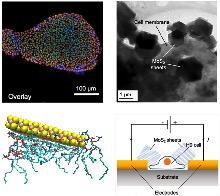
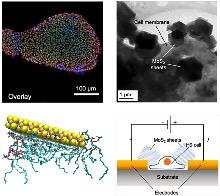
A new method developed by researchers at Singapore University of Technology and Design (SUTD) can potentially ensure patient safety for future stem cell-based therapies, by enhancing native stem cell bioelectric signals.

Reliable methods to monitor and validate stem cell pluripotency are required to advance stem cell therapies and ensure patient safety. Electrical-based detection (EBD) methods are non-invasive and can be used to detect stem cell pluripotency in real-time, and avoid the cost and cell-damaging issues caused by traditional detection methods. However, past EBD methods have produced low current signals, preventing commercialisation.

SUTD researchers PhD candidate Sophia Chan and Dr Desmond Loke, together with colleagues from Nanyang Technological University (NTU) and the Agency for Science, Technology and Research (A*STAR) have developed a method to achieve ultra-high bioelectric signals from human embryonic stem cells (hESCs).

Recently published in ACS Applied Bio Materials, the research team achieved a 1.828 mA cell signal using direct current-voltage measurements and two-dimensional molybdenum disulphide sheets. This is two-orders of magnitude higher than previous EBD methods.

"Stem cells are promising starting materials for currently untreated and life-threatening diseases. However, they are limited by readily available methods to ensure therapeutic safety. Our method is able to enhance native stem cell signals feasible for commercialisation to ensure therapeutic safety." says Chan.

The researchers also demonstrate that the 2D-MoS¬2 sheets enhanced bioelectric signals without affecting the native characteristics of the stem cells. From molecular dynamics (MD) simulations, the group deduced that the increased current flow was a result of the spontaneous interactions formed between the sheets and the cells.

###

Media Contact

Melissa Koh
[email protected]
65-649-98742

http://www.sutd.edu.sg

Related Journal Article

http://dx.doi.org/10.1021/acsabm.8b00085

Share12Tweet7Share2ShareShareShare1

Related Posts

Florida Cane Toad: Complex Spread and Selective Evolution

Florida Cane Toad: Complex Spread and Selective Evolution

February 7, 2026
New Study Uncovers Mechanism Behind Burn Pit Particulate Matter–Induced Lung Inflammation

New Study Uncovers Mechanism Behind Burn Pit Particulate Matter–Induced Lung Inflammation

February 6, 2026

DeepBlastoid: Advancing Automated and Efficient Evaluation of Human Blastoids with Deep Learning

February 6, 2026

Navigating the Gut: The Role of Formic Acid in the Microbiome

February 6, 2026
Please login to join discussion

POPULAR NEWS

  • Robotic Ureteral Reconstruction: A Novel Approach

    Robotic Ureteral Reconstruction: A Novel Approach

    82 shares
    Share 33 Tweet 21
  • Digital Privacy: Health Data Control in Incarceration

    63 shares
    Share 25 Tweet 16
  • Study Reveals Lipid Accumulation in ME/CFS Cells

    57 shares
    Share 23 Tweet 14
  • Breakthrough in RNA Research Accelerates Medical Innovations Timeline

    53 shares
    Share 21 Tweet 13

About

We bring you the latest biotechnology news from best research centers and universities around the world. Check our website.

Follow us

Recent News

Evaluating Pediatric Emergency Care Quality in Ethiopia

TPMT Expression Predictions Linked to Azathioprine Side Effects

Improving Dementia Care with Enhanced Activity Kits

Subscribe to Blog via Email

Success! An email was just sent to confirm your subscription. Please find the email now and click 'Confirm' to start subscribing.

Join 73 other subscribers
  • Contact Us

Bioengineer.org Ā© Copyright 2023 All Rights Reserved.

Welcome Back!

Login to your account below

Forgotten Password?

Retrieve your password

Please enter your username or email address to reset your password.

Log In
No Result
View All Result
  • Homepages
    • Home Page 1
    • Home Page 2
  • News
  • National
  • Business
  • Health
  • Lifestyle
  • Science

Bioengineer.org Ā© Copyright 2023 All Rights Reserved.