Credit: NUS BIGHEART
A multidisciplinary team of researchers at the National University of Singapore (NUS) has developed a portable, easy-to-use device for quick and accurate screening of diseases. This versatile technology platform called enVision (enzyme-assisted nanocomplexes for visual identification of nucleic acids) can be designed to detect a wide range of diseases – from emerging infectious diseases (e.g. Zika and Ebola) and high-prevalence infections (e.g. hepatitis, dengue, and malaria) to various types of cancers and genetic diseases.
enVision takes between 30 minutes to one hour to detect the presence of diseases, which is two to four times faster than existing infection diagnostics methods. In addition, each test kit costs under S$1 – 100 times lower than the current cost of conducting similar tests.
"The enVision platform is extremely sensitive, accurate, fast, and low-cost. It works at room temperature and does not require heaters or special pumps, making it very portable. With this invention, tests can be done at the point-of-care, for instance in community clinics or hospital wards, so that disease monitoring or treatment can be administered in a timely manner to achieve better health outcomes," said team leader Assistant Professor Shao Huilin from the Biomedical Institute for Global Health Research and Technology (BIGHEART) and Department of Biomedical Engineering at NUS. Asst Prof Shao is also an investigator with the Institute of Molecular and Cell Biology (IMCB) under the Agency for Science, Technology and Research (A*STAR).
Superior sensitivity and specificity compared to clinical gold standard
The research team used the human papillomavirus (HPV), the key cause of cervical cancer, as a clinical model to validate the performance of enVision. In comparison to clinical gold standard, this novel technology has demonstrated superior sensitivity and specificity.
"enVision is not only able to accurately detect different subtypes of the same disease, it is also able to spot differences within a specific subtype of a given disease to identify previously undetectable infections," Asst Prof Shao added.
Bringing the lab to the patient
In addition, test results are easily visible – the assay turns from colourless to brown if a disease is present – and could also be further analysed using a smartphone for quantitative assessment of the amount of pathogen present. This makes enVision an ideal solution for personal healthcare and telemedicine.
"Conventional technologies – such as tests that rely on polymerase chain reaction to amplify and detect specific DNA molecules – require bulky and expensive equipment, as well as trained personnel to operate these machines. With enVision, we are essentially bringing the clinical laboratory to the patient. Minimal training is needed to administer the ,test and interpret the results, so more patients can have access to effective, lab-quality diagnostics that will substantially improve the quality of care and treatment," said Dr Nicholas Ho, a researcher from NUS BIGHEART and A*STAR's IMCB, and co-first author of the study.
Versatile point-of-care diagnostic device
In this study, Asst Prof Shao and her team developed patented DNA molecular machines that can recognise genetic material of different diseases and perform different functions. These molecular machines form the backbone of the enVision platform.
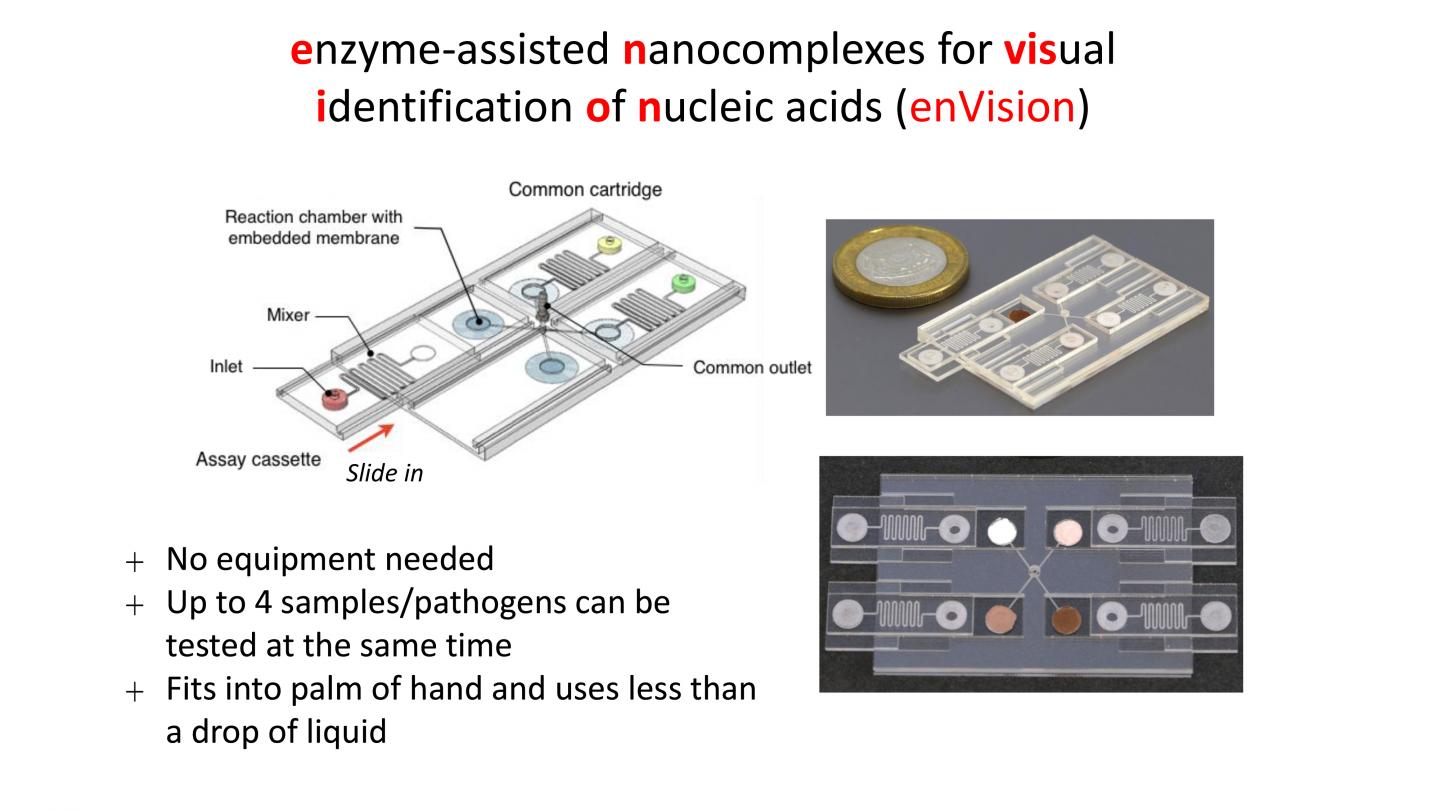
The novel platform adopts a 'plug-and-play' modular design and uses microfluidic technology to reduce the amount of samples and biochemical reagents required as well as to optimise the technology's sensitivity for visual readouts.
"The enVision platform has three key steps – target recognition, target-independent signal enhancement, and visual detection. It employs a unique set of molecular switches, composed of enzyme-DNA nanostructures, to accurately detect, as well as convert and amplify molecular information into visible signals for disease diagnosis," explained Dr Lim Geok Soon, a researcher from NUS BIGHEART and A*STAR's IMCB, and co-first author of the study.
Each test is housed in a tiny plastic chip that is preloaded with a DNA molecular machine that is designed to recognise disease-specific molecules. The chip is then placed in a common signal cartridge that contains another DNA molecular machine responsible for producing visual signals when disease-specific molecules are detected.
Multiple units of the same test chip – to test different patient samples for the same disease – or a collection of test chips to detect different diseases could be mounted onto the common cartridge.
"Having a target-independent signal enhancement step frees up the design possibilities for the recognition element. This allows enVision to be programmed as a biochemical computer with varying signals for different combinations of target pathogens. This can be very useful to monitor populations for multiple diseases like dengue and malaria simultaneously, or testing for highly mutable pathogens like the flu with high sensitivity and specificity," said Dr Ho.
Future work
Asst Prof Shao and her team took about a year and a half to develop the enVision platform. Building on the current work, the research team is developing a sample preparation module – for extraction and treatment of DNA material – to be integrated with the enVision platform to enhance point-of-care application. In addition, the research team foresees that the smartphone app could include more advanced image correction and analysis algorithms to further improve its performance for real-world application.
This research work was published in prestigious scientific journal Nature Communications in August 2018, and featured as an Editors' Highlight by the journal.
###
Media Contact
Fun Yip
[email protected]
65-651-61374
@NUSingapore
http://www.nus.edu.sg/
Original Source
http://news.nus.edu.sg/press-releases/envision-device-for-disease-screening http://dx.doi.org/10.1038/s41467-018-05733-0