Credit: International Osteoporosis Foundation
Hematopoietic stem cell transplantation (HSCT) is the treatment of choice for many patients with malignant and non-malignant hematological diseases, such as leukemia and multiple myeloma. The success of recent advances in such transplantation techniques and supportive care measures, has led to greater numbers of long-term HSCT survivors.
Consequently, an increasing patient population is impacted by the late effects of HSCT – most notably, bone loss and osteoporosis. The result is an increased risk of fragility fractures causing severe pain, long-term disability and loss of quality of life.
To address this serious problem, the International Osteoporosis Foundation (IOF) expert Working Group on Cancer and Bone Disease has published a new review which looks at the major factors affecting bone health in HSCT patients, and provides expert guidance for the monitoring, evaluation and treatment of bone loss in these patients.
Lead author of the study, Professor David Kendler, of the Department of Medicine, University of British Colombia, Vancouver, Canada, commented:
"Impaired bone health is among the most significant factors affecting long-term quality of life following HSCT. The HSCT and other forms of cancer treatment, as well as various factors related to the cancer itself, may all contribute to more rapid bone loss and increased fracture risk – these include hypogonadism, HSCT preparative regimens, nutritional factors, and glucocorticoid use. We therefore urge clinicians to ensure that HSCT recipients are monitored, evaluated and, if indicated, treated for bone loss to prevent potentially serious and life-threatening fractures."
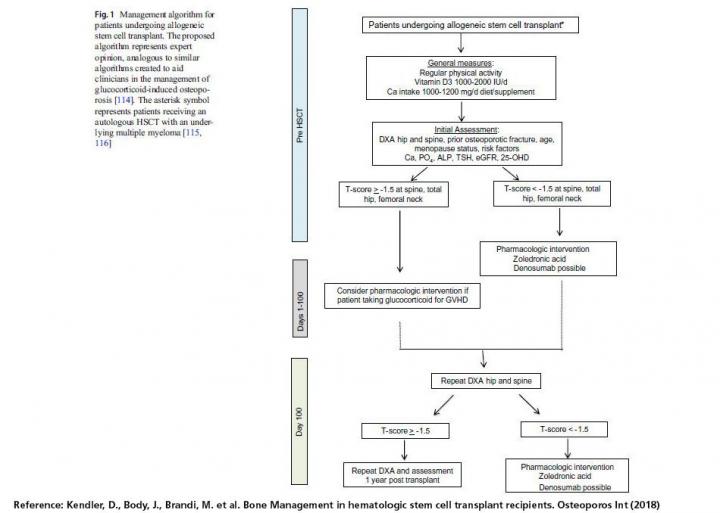
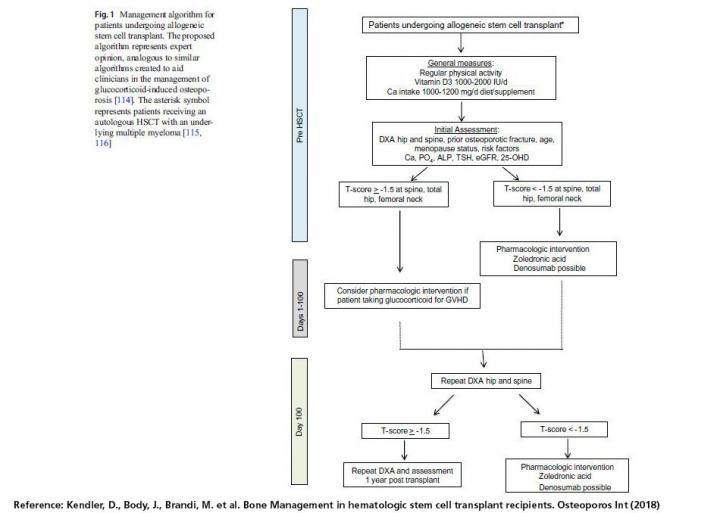
The review 'Bone management in hematologic stem cell transplant recipients' outlines clinical management strategies based on the latest evidence and best practice.
Professor René Rizzoli, chair of the IOF Working Group and Emeritus Professor of Medicine at the University Hospitals of Geneva, Switzerland, added:
"HSCT recipients who have survived hematologic cancers should not lose their hard-won quality of life because of poor bone health. Therefore, it is important that skeletal health is monitored and managed in these patients. The basic 'check list' includes bone mineral density examination, evaluation of clinical risk factors, and general dietary and physical activity measures for all, with appropriate application of osteoporosis pharmacotherapies in those who are found to be at increased risk of bone loss and fracture."
###
Reference:
Kendler DL, Body JJ, Brandi ML, Broady R, Cannata-Andia J, Cannata-Ortiz MJ, El Maghraoui A, Guglielmi G, Hadji P, Pierroz DD, de Villiers TJ, Rizzoli R, Ebeling PR. International Osteoporosis Foundation Committee of Scientific Advisors Working Group on Cancer and Bone Disease. Bone management in hematologic stem cell transplant recipients. Osteoporos Int. 2018 Sep 3. doi: 10.1007/s00198-018-4669-4. [Epub ahead of print]. https://link.springer.com/article/10.1007/s00198-018-4669-4
About IOF
The International Osteoporosis Foundation (IOF) is the world's largest nongovernmental organization dedicated to the prevention, diagnosis and treatment of osteoporosis and related musculoskeletal diseases. IOF members, including committees of scientific researchers as well as 240 patient, medical and research societies in 99 locations, work together to make fracture prevention and healthy mobility a worldwide heath care priority. http://www.iofbonehealth.org http://www.facebook.com/ @iofbonehealth
About Osteoporosis International
An international multi-disciplinary journal which is a joint initiative between the International Osteoporosis Foundation (IOF) and the National Osteoporosis Foundation (NOF) of the USA, 'Osteoporosis International' provides an interdisciplinary platform for the communication of high quality original, experimental or clinical papers on all aspects of osteoporosis and other metabolic bone diseases. It publishes studies pertaining to the diagnosis, prevention, treatment and management of osteoporosis, and the spectrum of disorders that deficiencies in bone density can produce. Editors in Chief: John A. Kanis, Felicia Cosman
2017 Impact Factor: 3.856, 5-year Impact Factor: 4.011
Ranked 40th of 143 journals in the category Endocrinology and Metabolism
https://link.springer.com/journal/198
Media Contact
L. Misteli
[email protected]
41-229-940-100
@iofbonehealth
http://www.iofbonehealth.org
Original Source
https://www.iofbonehealth.org/news/strategies-protect-bone-health-hematologic-stem-cell-transplant-recipients http://dx.doi.org/10.1007/s00198-018-4669-4