

• HOME
  • NEWS
  • EXPLORE
    • CAREER
      • Companies
      • Jobs
    • EVENTS
    • iGEM
      • News
      • Team
    • PHOTOS
    • VIDEO
    • WIKI
  • BLOG
  • COMMUNITY
    • FACEBOOK
    • INSTAGRAM
    • TWITTER
Saturday, February 7, 2026
BIOENGINEER.ORG
No Result
View All Result
  • Login
  • HOME
  • NEWS
  • EXPLORE
    • CAREER
      • Companies
      • Jobs
        • Lecturer
        • PhD Studentship
        • Postdoc
        • Research Assistant
    • EVENTS
    • iGEM
      • News
      • Team
    • PHOTOS
    • VIDEO
    • WIKI
  • BLOG
  • COMMUNITY
    • FACEBOOK
    • INSTAGRAM
    • TWITTER
  • HOME
  • NEWS
  • EXPLORE
    • CAREER
      • Companies
      • Jobs
        • Lecturer
        • PhD Studentship
        • Postdoc
        • Research Assistant
    • EVENTS
    • iGEM
      • News
      • Team
    • PHOTOS
    • VIDEO
    • WIKI
  • BLOG
  • COMMUNITY
    • FACEBOOK
    • INSTAGRAM
    • TWITTER
No Result
View All Result
Bioengineer.org
No Result
View All Result
Home NEWS Science News Biology

Evaluating the contribution of black carbon to climate change

Bioengineer by Bioengineer
September 11, 2018
in Biology
Reading Time: 2 mins read
0
Share on FacebookShare on TwitterShare on LinkedinShare on RedditShare on Telegram
IMAGE

Credit: Hitoshi Matsui

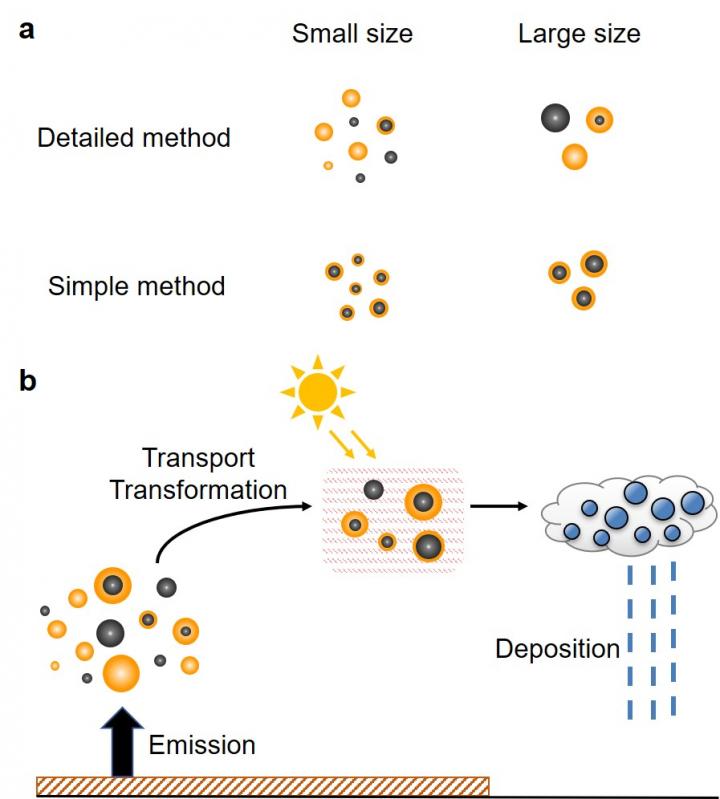
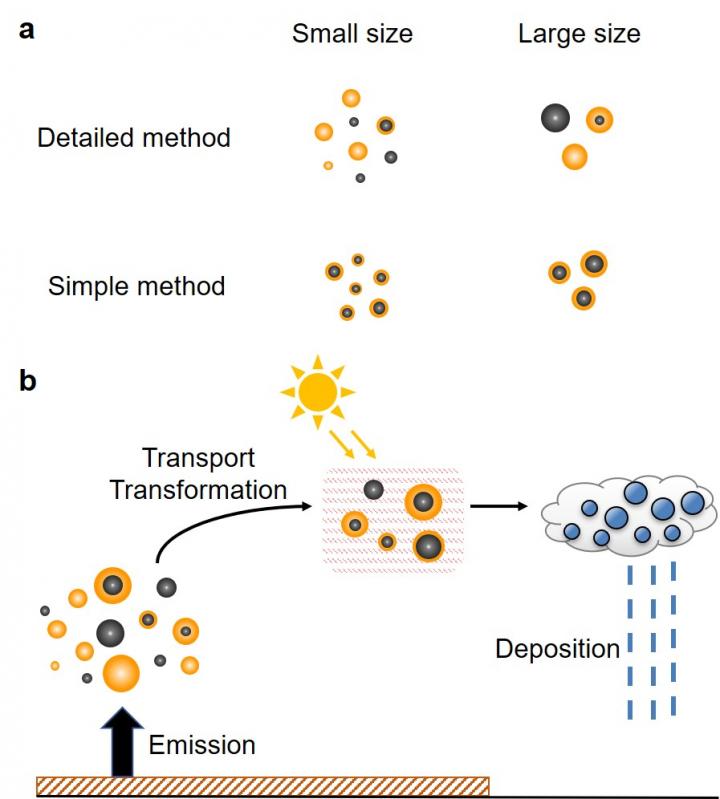
Nagoya, Japan – Black carbon refers to tiny carbon particles that form during incomplete combustion of carbon-based fuels. Black carbon particles absorb sunlight, so they are considered to contribute to global warming. However, the contribution of black carbon to the heating of the Earth's atmosphere is currently uncertain. Models that can accurately assess the warming effect of black carbon on our atmosphere are needed so that we can understand the contribution of these tiny carbon particles to climate change. The mixing state of black carbon particles and their particle size strongly influence their ability to absorb sunlight, but current models have large uncertainties associated with both particle size and mixing state.

Researchers from Nagoya and Cornell Universities have combined their expertise to develop a model that can predict the direct radiative effect of black carbon with high accuracy. The team achieved such a model by considering various particle sizes and mixing states of black carbon particles in air.

"Most aerosol models are using one or two black carbon mixing states, which are not sufficient to accurately describe the mixing state diversity of black carbon in air," says Hitoshi Matsui. "Our model considers that black carbon particles have multiple mixing states in air. As a result, we can model the ability of black carbon particles to heat air more accurately than in previous estimates."

The researchers found that the direct radiative effect of black carbon predicted by their model was highly sensitive to the particle size distribution only when the complex mixing states of black carbon were suitably described.

High sensitivity was obtained by the developed model because it calculated factors like the lifetime of black carbon in the atmosphere, the ability of black carbon to absorb sunlight, and the effect of materials coating the black carbon particles on their ability to absorb sunlight realistically. All of these factors are influenced by the particle size and mixing state of black carbon.

The results show that properly describing the particle size and mixing state of black carbon is very important to understand the contribution of black carbon to climate change.

The team's results suggest that the interactions of black carbon with atmospheric and rain patterns are likely to be more complex than previously considered. The developed model improves our ability to estimate the effectiveness of removing black carbon from the atmosphere to suppress future changes in temperature, which should help to direct research on strategies to mitigate climate change.

###

The article "Black carbon radiative effects highly sensitive to emitted particle size when resolving mixing-state diversity" is freely available from Nature Communications at DOI: 10.1038/s41467-018-05635-1

Media Contact

Sebastian Eifrid
[email protected]
@NU__Research

http://www.nagoya-u.ac.jp/en/

Original Source

http://en.nagoya-u.ac.jp/research/activities/news/2018/09/09112018-env.html http://dx.doi.org/10.1038/s41467-018-05635-1


Share15Tweet7Share2ShareShareShare1

Related Posts

Florida Cane Toad: Complex Spread and Selective Evolution

Florida Cane Toad: Complex Spread and Selective Evolution

February 7, 2026
New Study Uncovers Mechanism Behind Burn Pit Particulate Matter–Induced Lung Inflammation

New Study Uncovers Mechanism Behind Burn Pit Particulate Matter–Induced Lung Inflammation

February 6, 2026

DeepBlastoid: Advancing Automated and Efficient Evaluation of Human Blastoids with Deep Learning

February 6, 2026

Navigating the Gut: The Role of Formic Acid in the Microbiome

February 6, 2026
Please login to join discussion

POPULAR NEWS

  • Robotic Ureteral Reconstruction: A Novel Approach

    Robotic Ureteral Reconstruction: A Novel Approach

    82 shares
    Share 33 Tweet 21
  • Digital Privacy: Health Data Control in Incarceration

    63 shares
    Share 25 Tweet 16
  • Study Reveals Lipid Accumulation in ME/CFS Cells

    57 shares
    Share 23 Tweet 14
  • Breakthrough in RNA Research Accelerates Medical Innovations Timeline

    53 shares
    Share 21 Tweet 13

About

We bring you the latest biotechnology news from best research centers and universities around the world. Check our website.

Follow us

Recent News

Digital Health Perspectives from Baltic Sea Experts

Florida Cane Toad: Complex Spread and Selective Evolution

Exploring Decision-Making in Dementia Caregivers’ Mobility

Subscribe to Blog via Email

Enter your email address to subscribe to this blog and receive notifications of new posts by email.

Join 73 other subscribers
  • Contact Us

Bioengineer.org © Copyright 2023 All Rights Reserved.

Welcome Back!

Login to your account below

Forgotten Password?

Retrieve your password

Please enter your username or email address to reset your password.

Log In
No Result
View All Result
  • Homepages
    • Home Page 1
    • Home Page 2
  • News
  • National
  • Business
  • Health
  • Lifestyle
  • Science

Bioengineer.org © Copyright 2023 All Rights Reserved.
