Toronto (August 17, 2016) – Mr. Peter Goodhand, President of The Ontario Institute for Cancer Research (OICR), today announced a new collaborative research study in partnership with Thermo Fisher Scientific and Queen’s University to help bring more targeted diagnosis and treatment to breast cancer patients in the future.
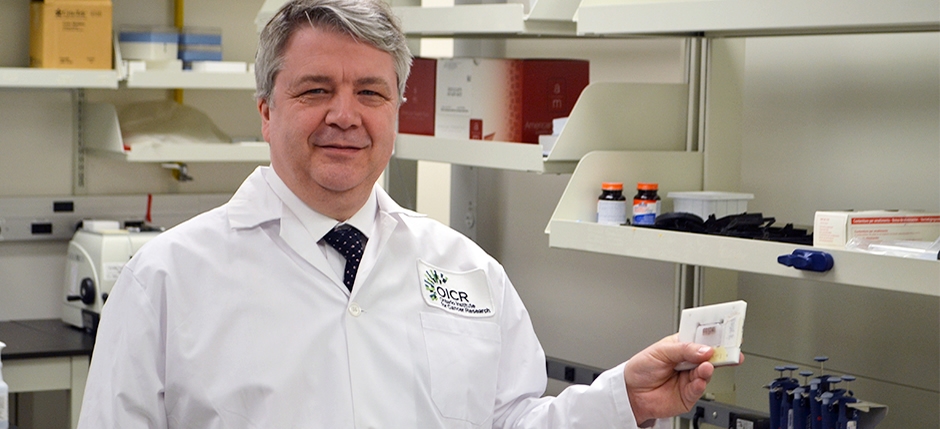
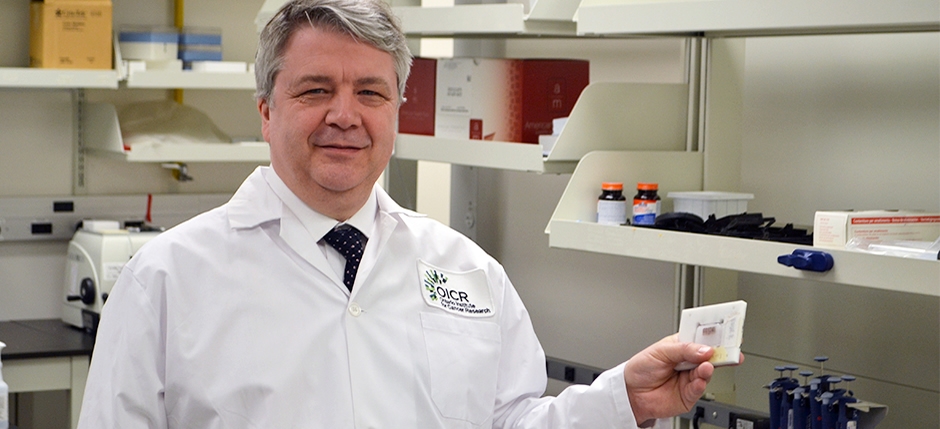
The study, led by Dr. John Bartlett, Director of OICR’s Transformative Pathology Program, and Dr. Harriet Feilotter, Department of Pathology and Molecular Medicine, Queen’s University, aims to identify mutations and copy number changes found in breast cancer samples and establish whether these abnormalities correlate with on-market drugs, available clinical trials, or published studies.
OICR-affiliated researchers and collaborators at Queen’s University and Sunnybrook Health Sciences Centre will process the same breast cancer samples to establish whether the results are reproducible at different sites. This study will also characterize more than 400 additional retrospective breast cancer samples supporting ongoing clinical research efforts of Dr. Bartlett’s team at OICR, which strives to improve the clinical management of the disease.
Collaborators Drs. Martin Yaffe and Arun Seth at Sunnybrook Health Sciences Centre will provide laboratory space and additional technical support for the study. Dr. Yaffe is also Co-leader of OICR’s Smarter Imaging and Imaging Translation Programs.
The study will use Thermo Fisher’s Oncomine Comprehensive Assay, a targeted, next-generation sequencing (NGS) research tool that analyzes 143 genes relevant to cancer and which is the NGS assay used for the NCI-MATCH study in the United States. The data generated can be further studied with the Oncomine Knowledgebase Reporter, which is a curated set of published evidence that matches driver genetic variants with relevant information, such as on-market drugs, available clinical trials, or published studies. The findings of the OICR study will be used to assess the technology and could inform subsequent clinical trials.
“Our ultimate goal is to one day be able to better stratify breast cancer patients, meaning we will be able to improve our understanding of the unique characteristics driving their cancer and better link patients with drugs or with clinical trials that can help them,” said Bartlett. “If successful this study could lead to more molecular diagnostics and more information for breast cancer patients when they receive their diagnosis.”
“For these types of studies, clinical researchers anticipate receiving numerous samples that may be partially degraded with little viable nucleic acid material,” said Andy Felton, PhD, Vice President of Product Management for Clinical Next Generation Sequencing at Thermo Fisher. “The Oncomine Comprehensive assay and Ion Torrent NGS systems yield robust results with challenging samples, essential performance requirements for platforms that will contribute to the advancement of precision medicine.”
“This collaboration demonstrates Ontario’s leadership and innovation in solving difficult challenges in cancer research,” said Reza Moridi, Minister of Research, Innovation and Science. “Research such as this will undoubtedly help drive discoveries that lead to better diagnosis and treatments for all patients battling breast cancer in Ontario.”
Drs. Feilotter and Bartlett have also engaged six laboratories in Ontario, including at Hamilton Health Sciences, London Health Sciences Centre, Ottawa General Hospital, Sunnybrook Health Sciences Centre, Sudbury Health Science North and University Health Network to look at the robustness and reproducibility of the assay across different cancer samples. This collaboration could extend the findings of this study beyond breast cancer to other common cancers.
###
About the Ontario Institute for Cancer Research (OICR)
OICR is an innovative cancer research and development institute dedicated to prevention, early detection, diagnosis and treatment of cancer. The Institute is an independent, not-for-profit corporation, supported by the Government of Ontario. OICR’s research supports more than 1,700 investigators, clinician scientists, research staff and trainees located at its headquarters and in research institutes and academia across the Province of Ontario. OICR has key research efforts underway in small molecules, biologics, stem cells, imaging, genomics, informatics and bio-computing. For more information, please visit the website at http://www.oicr.on.ca.
Ontario Institute for Cancer Research
Christopher Needles
416-673-8505
[email protected]
@OICR_news
Media Contact
Christopher Needles
[email protected]
416-673-8505
The post New retrospective study to find mutations to better diagnose breast cancer in the future appeared first on Scienmag.