• HOME
  • NEWS
  • EXPLORE
    • CAREER
      • Companies
      • Jobs
    • EVENTS
    • iGEM
      • News
      • Team
    • PHOTOS
    • VIDEO
    • WIKI
  • BLOG
  • COMMUNITY
    • FACEBOOK
    • INSTAGRAM
    • TWITTER
Friday, June 19, 2026
BIOENGINEER.ORG
No Result
View All Result
  • Login
  • HOME
  • NEWS
  • EXPLORE
    • CAREER
      • Companies
      • Jobs
        • Lecturer
        • PhD Studentship
        • Postdoc
        • Research Assistant
    • EVENTS
    • iGEM
      • News
      • Team
    • PHOTOS
    • VIDEO
    • WIKI
  • BLOG
  • COMMUNITY
    • FACEBOOK
    • INSTAGRAM
    • TWITTER
  • HOME
  • NEWS
  • EXPLORE
    • CAREER
      • Companies
      • Jobs
        • Lecturer
        • PhD Studentship
        • Postdoc
        • Research Assistant
    • EVENTS
    • iGEM
      • News
      • Team
    • PHOTOS
    • VIDEO
    • WIKI
  • BLOG
  • COMMUNITY
    • FACEBOOK
    • INSTAGRAM
    • TWITTER
No Result
View All Result
Bioengineer.org
No Result
View All Result
Home NEWS Science News Biology

Shape-shifting material can morph, reverse itself using heat, light

Bioengineer by Bioengineer
August 26, 2018
in Biology
Reading Time: 2 mins read
0
Credit: Bowman Lab / University of Colorado Boulder

Credit: Bowman Lab / University of Colorado Boulder

Share on FacebookShare on TwitterShare on LinkedinShare on RedditShare on Telegram
Credit: Bowman Lab / University of Colorado Boulder

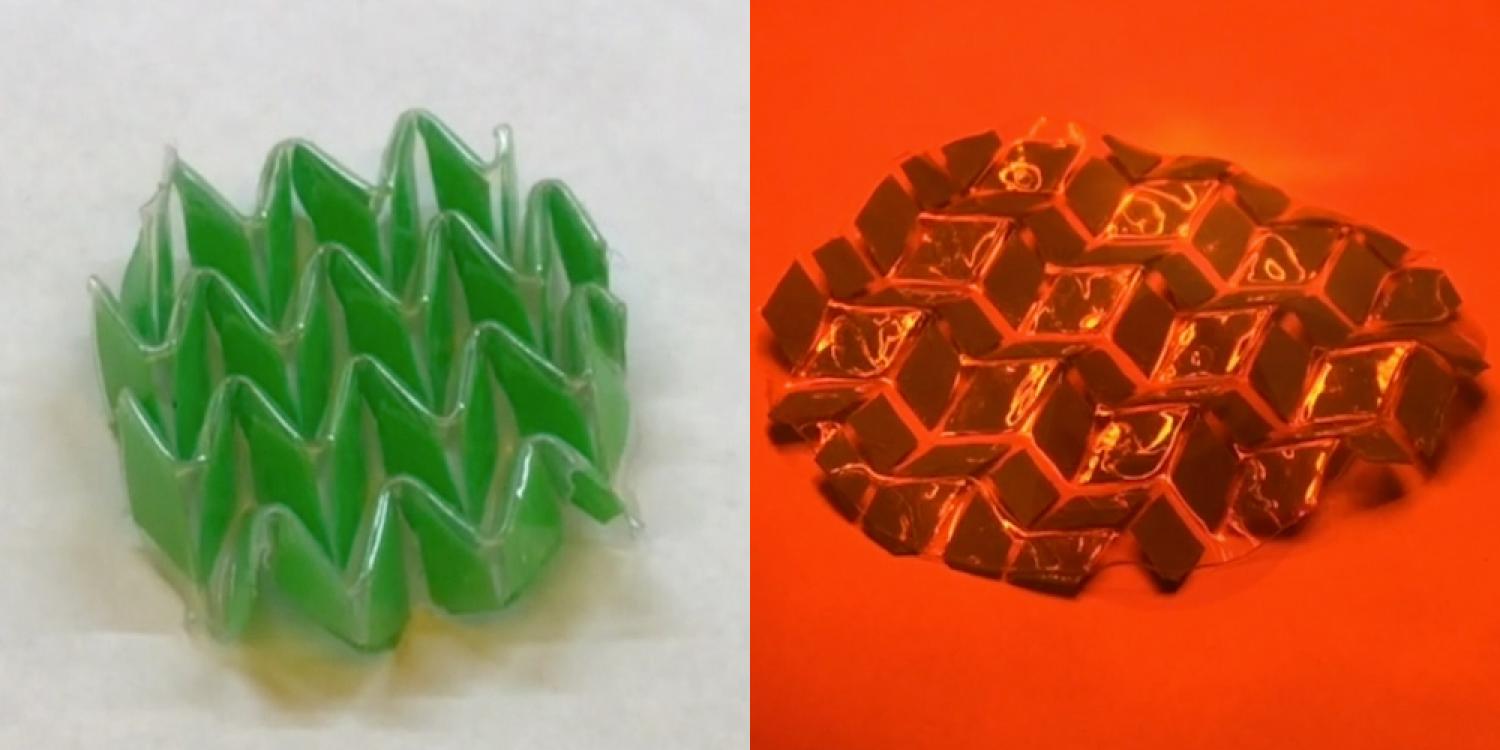
A new material developed by University of Colorado Boulder engineers can transform into complex, pre-programmed shapes via light and temperature stimuli, allowing a literal square peg to morph and fit into a round hole before fully reverting to its original form.

The controllable shape-shifting material, described today in the journal Science Advances, could have broad applications for manufacturing, robotics, biomedical devices and artificial muscles.

“The ability to form materials that can repeatedly oscillate back and forth between two independent shapes by exposing them to light will open up a wide range of new applications and approaches to areas such as additive manufacturing, robotics and biomaterials”, said Christopher Bowman, senior author of the new study and a Distinguished Professor in CU Boulder’s Department of Chemical and Biological Engineering (CHBE).

Previous efforts have used a variety of physical mechanisms to alter an object’s size, shape or texture with programmable stimuli. However, such materials have historically been limited in size or extent and the object state changes have proven difficult to fully reverse.

The new CU Boulder material achieves readily programmable two-way transformations on a macroscopic level by using liquid crystal elastomers (LCEs), the same technology underlying modern television displays. The unique molecular arrangement of LCEs make them susceptible to dynamic change via heat and light.

To solve this, the researchers installed a light-activated trigger to LCE networks that can set a desired molecular alignment in advance by exposing the object to particular wavelengths of light. The trigger then remains inactive until exposed to the corresponding heat stimuli. For example, a hand-folded origami swan programmed in this fashion will remain folded at room temperature. When heated to 200 degrees Fahrenheit, however, the swan relaxes into a flat sheet. Later, as it cools back to room temperature, it will gradually regain its pre-programmed swan shape.

The ability to change and then change back gives this new material a wide range of possible applications, especially for future biomedical devices that could become more flexible and adaptable than ever before.

“We view this as an elegant foundational system for transforming an object’s properties,” said Matthew McBride, lead author of the new study and a post-doctoral researcher in CHBE. “We plan to continue optimizing and exploring the possibilities of this technology.”

###

Additional co-authors of the study include Alina Martinez, Marvin Alim, Kimberly Childress, Michael Beiswinger, Maciej Podgorski and Brady Worrell of CU Boulder and Lewis Cox and Jason Killgore of the National Institute of Standards and Technology (NIST). The National Science Foundation provided funding for the research.

Media Contact

Trent Knoss
[email protected]
303-735-0528
@cubouldernews

http://www.colorado.edu/news

Original Source

https://www.colorado.edu/today/node/29796 http://dx.doi.org/10.1126/sciadv.aat4634

Share15Tweet8Share2ShareShareShare2

Related Posts

New Study Seeks to Prolong Immune System Longevity — Biology

New Study Seeks to Prolong Immune System Longevity

June 18, 2026
Great Apes Display Individual Thinking Styles Similar to Humans, Study Finds — Biology

Great Apes Display Individual Thinking Styles Similar to Humans, Study Finds

June 17, 2026

Scientists Awarded $4 Million to Enhance Endangered Species Management on Military Lands

June 17, 2026

New Study Reveals Ebola Virus Persistence in the Central Nervous System, Led by Mount Sinai Microbiologists

June 17, 2026
Please login to join discussion

POPULAR NEWS

  • ESMO 2025: mRNA COVID Vaccines Enhance Efficacy of Cancer Immunotherapy

    326 shares
    Share 130 Tweet 82
  • Saying Goodbye to PGY-6: Pediatric Fellowship Realities

    102 shares
    Share 41 Tweet 26
  • Multi-Hospital Study Reveals Long Covid Burden Is Twice as High as Current Estimates

    92 shares
    Share 36 Tweet 23
  • Detection of EDCs in Breast Milk and Infant Urine Up to Six Months Highlights Early Exposure Risks

    76 shares
    Share 30 Tweet 19

About

We bring you the latest biotechnology news from best research centers and universities around the world. Check our website.

Follow us

Recent News

Confined Migration Causes DNA Damage in Neurons

Multimodal Multitask AI Transforms Lung Cancer Grading

New Study Seeks to Prolong Immune System Longevity

Subscribe to Blog via Email

Success! An email was just sent to confirm your subscription. Please find the email now and click 'Confirm' to start subscribing.

Join 82 other subscribers
  • Contact Us

Bioengineer.org © Copyright 2023 All Rights Reserved.

Welcome Back!

Login to your account below

Forgotten Password?

Retrieve your password

Please enter your username or email address to reset your password.

Log In
No Result
View All Result
  • Homepages
    • Home Page 1
    • Home Page 2
  • News
  • National
  • Business
  • Health
  • Lifestyle
  • Science

Bioengineer.org © Copyright 2023 All Rights Reserved.