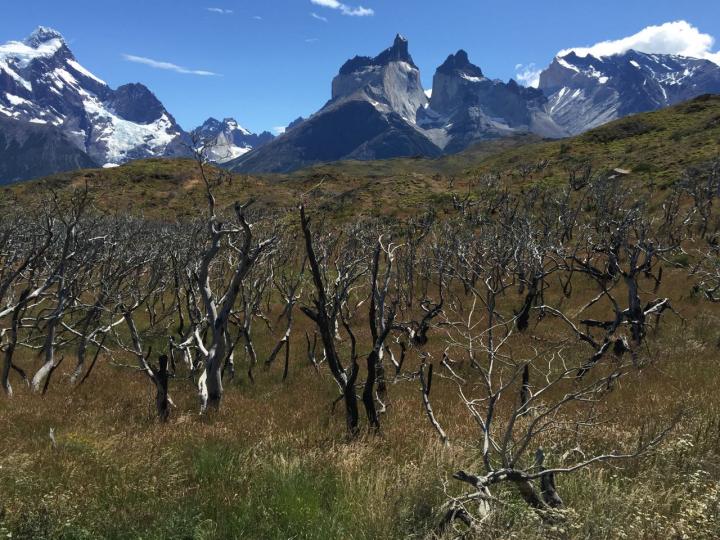
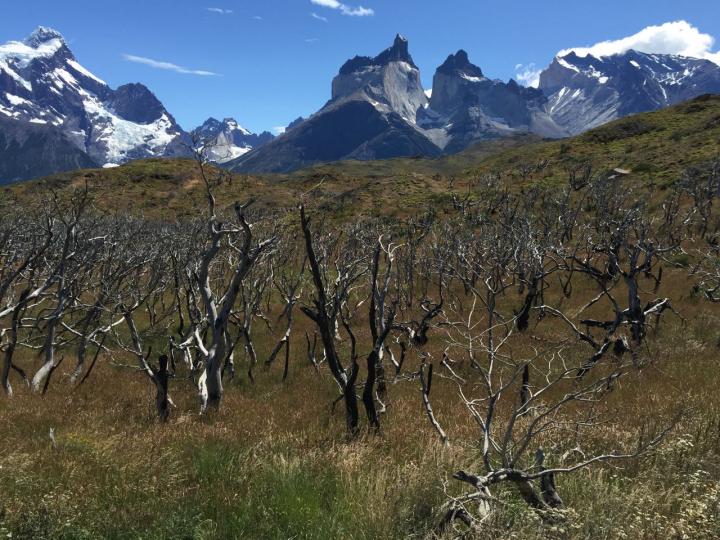
Credit: Photo by D. McWethy
BOZEMAN – A Montana State University-led team has discovered several reasons why massive fires continue to burn through south-central Chile.
Besides low humidity, high winds and extreme temperatures — some of the same factors contributing to fires raging across the United States — central Chile is experiencing a mega drought and large portions of its diverse native forests have been converted to more flammable tree plantations, the researchers said.
Their results were published Aug. 22, in PLOS ONE, an online scientific journal published by the Public Library of Science.
Lead author Dave McWethy, an assistant professor in MSU's Department of Earth Sciences in the College of Letters and Science, said Chile has replaced many of its native forests with plantation forests to supply pulp and timber mills that produce paper and wood products. As a result, he said, highly flammable non-native pine and eucalypt forests now cover the region. Eucalypt trees, which are native to Australia, and pine trees native to the United States contain oils and resins in their leaves that, when dry, can easily ignite.
"Chile replaced more heterogenous, less flammable native forests with structurally homogenous, flammable exotic forest plantations at a time when the climate is becoming warmer and drier," said McWethy. "This situation will likely facilitate future fires to spread more easily and promote more large fires into the future."
Co-author Anibal Pauchard, professor at the University of Concepcion and researcher at the Institute of Ecology and Biodiversity in Chile, said wildfires have been a part of the Chilean landscape for centuries, but they have grown larger and more intense in recent decades, despite costly government efforts to control them.
"Unfortunately, fires in central Chile are promoted by increasing human ignitions, drier and hotter climate, and the availability of abundant flammable fuels associated with pine plantations and degraded shrublands dominated by invasive species," Pauchard said.
In 2016-2017 alone, fires burned nearly 1.5 million acres — almost twice the area of the U.S. state of Rhode Island. It was the largest area burned during a single fire season since detailed recordkeeping began in the early 1960s. In 2014, major fires near the cities of Valparaiso and Santiago destroyed thousands of homes and forced more than 10,000 people to evacuate.
The devastation prompted the Chilean government to ask what land-use policies and environmental factors were behind these fires, McWethy said. That led to a national debate about preventing and reducing the consequences of future fires and to the involvement of McWethy and his collaborators.
McWethy received a Fulbright grant that sent him to Chile from 2015-2016 to research the wildfires and teach at the University of Concepcion. The work also had roots in a $4 million WildFIRE PIRE grant that MSU received in 2010 from the National Science Foundation. That eight-year project was led by Cathy Whitlock, MSU Earth sciences professor, and involved McWethy, Pauchard, Andres Holz from Portland State University in Oregon, and Thomas Veblen from the University of Colorado Boulder. It studied the similarities and contrasts in fire, climate and land-use in Chile, Argentina, Australia, New Zealand and the U.S.
McWethy conducted the latest study with renowned Chilean researchers from South America and the U.S. Besides Pauchard, Holz and Veblen, they included Rafael Garcia at the University of Concepcion and the Institute of Ecology and Biodiversity and Mauro Gonzalez from the Universidad Austral de Chile in Valdivia and the Center for Climate and Resilience Research in Santiago. MSU collaborators were Julian Stahl, a former graduate student in MSU's Earth science department, and Bryce Currey, a current doctoral student in MSU's Department of Land Resources and Environmental Sciences.
"This study is an excellent example of how scientists from Chile and the United States can work on issues that are relevant to both countries and where different expertise can be combined to better understand a complex problem," Pauchard said.
McWethy said wildfires in south-central Chile and the western U.S. are affected by many of the same conditions, but the main difference is that native forests in the western U.S. are well-adapted to fire. In Chile, most native forests in the central and southern regions are not.
To better understand the Chilean fires, the researchers compared satellite information with records from the Chilean Forest Service for 2001 through 2017. They studied eight types of vegetation as well as climate conditions, elevation, slope and population density across a wide range of latitudes in Chile.
"Now we have compelling evidence that after climate, landscape composition is crucial in determining fire regimes. In particular, exotic forest plantations need to be managed to purposely reduce fire hazard," Pauchard said. "Which forestry species we plant and how we manage them matters in terms of fire frequency and intensity."
Among other things, the researchers recommended in the paper that Chile try to move away from exotic plantations toward more heterogeneous, less flammable native forests.
"Protecting and restoring native forests would likely buffer the negative impacts of fires that are projected to continue to increase into the future," McWethy said.
He admitted, however, that the recommendation would be hard to implement.
"So much of the landscape has changed in south-central Chile, that it's going to be difficult to restore," McWethy said.
###
Media Contact
David McWethy
[email protected]
406-994-6903
@montanastate?lang=en
http://www.montana.edu
Original Source
http://journals.plos.org/plosone/article?id=10.1371/journal.pone.0201195