Credit: Courtesy of Chris Doe
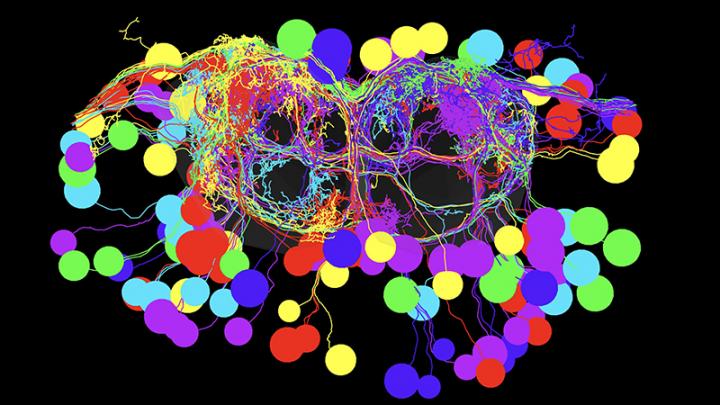
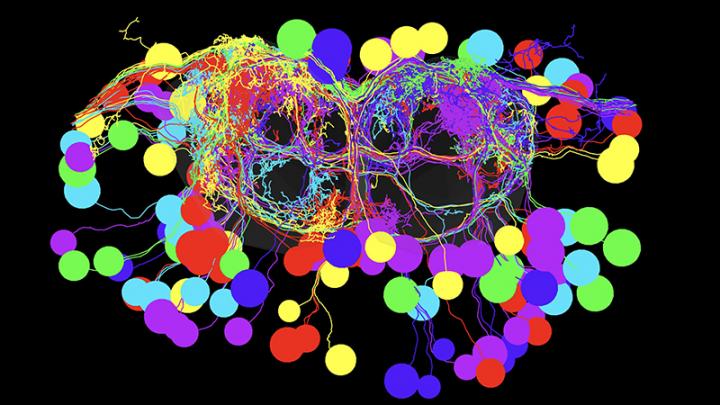
EUGENE, Ore. — Aug. 22, 2018 — In the fruit fly, a single pair of brain neurons command backward locomotion in both larvae and adults, researchers report.
The mapping of descending circuitry that can smoothly and rapidly switch movement from forward to backward is unprecedented, said Chris Doe, a biology professor and co-director of the University of Oregon's Institute of Neuroscience. He was principal investigator on the project, detailed in a paper published Aug. 2 in the journal eLife.
"The big step we've made is that we have a single neuron that both triggers a new behavior and suppresses an antagonistic behavior," said Doe, who also is a Howard Hughes Medical Institute investigator and member of the UO's Institute of Molecular Biology.
"It is even more striking, because these neurons drive the same behavioral switch in larvae and adults, which have completely different motor neurons and modes of locomotion," he said. "Our finding that the same pair of neurons control crawling of a limbless maggot and walking of an adult fly was quite surprising."
Changing directions from forward to reverse is vital to survival for fruit flies. Drosophila larvae die after wasps lay eggs that consume larvae from the inside out. Spiders, ants and beetles eat adult fruit flies. Just how neural circuits trigger smooth switching between antagonistic behaviors is a mystery in most animals, Doe said, but it has been seen in nematodes as well.
The methodology behind the discovery provides a way for scientists to link other direct connections between individual brain neurons and nervous system neurons. Doe's lab already is looking at neurons tied to navigation behavior in fruit flies.
The seven-member research used genetic screening, electron microscopy, optogenetics and manual manipulations in the project. They initially looked generally for as many as 10 behavioral responses, but then focused on forward-backward motion. Fluorescent proteins inserted into larvae and adult flies helped track telltale chemical flows in the circuitry when behavior changed.
The team methodically moved through several steps to identify the two backward-inducing brain neurons, starting with more than 300 neurons and gradually winnowing down the population until the final two neurons were found.
The biggest surprise, Doe said, was realizing that the same pair of neurons in a larva retracted its connection to the suite of muscles during metamorphosis and then re-engaged with the motor neurons for the six legs that control muscles in the adults. In limbless larvae, crawling is done by peristalsis, or contractions.
"Limbed locomotion involves a pattern of motion, legs, that is completely different," Doe said. "All the motor neurons are different in the two stages. Those in larvae are lost in metamorphosis. The brain neuron apparently recognizes this in both systems."
The neuron, Doe said, drove halted forward motion and induced backward motion intensely and continuously. For escape purposes, one behavior must be rapidly inactivated by way of neural communication. Flies and mosquitoes, for instance, can sense a human's swat and change directions to avoid contact. Larvae can recognize and avoid noxious environments like high salt or bright light using backwards locomotion.
"Until now, no one has shown that there is an upstream neuron that can coordinately suppress some behaviors and induce others," he said. "Our study gives other researchers a good example of what they may expect to find. A fly has many behaviors. The idea is to map the neurons and circuits controlling all."
The discovery emerged from basic, or fundamental level, research. Doe has explored the early development of neural stem cells as an HHMI investigator since 1994. About five years ago, his lab began studying neural circuits generating motor behaviors, such as crawling or flying.
Such research, as specific neural networks become better understood, Doe said, potentially could help to improve the precision of human prosthetics. It could also feed into robotics, assuring accurate antagonistic responses for controlling bomb-searching robots or help guide rovers exploring the surfaces on other planets, he said.
###
In addition to Doe, team members were Arnaldo Carreira-Rosario, Aref Arzan Zarin, Matthew Q. Clark and Laurina Manning, all of the UO, and Richard Fetter and Albert Cardona, both of the HHMI's Janelia Research Campus.
HHMI and National Institutes of Health grants primarily funded the research. A Porter Physiology Development Fellowship awarded to Clark in 2015-15 from the American Physiological Society also supported the work.
Source: Chris Doe, professor of biology, co-director UO Institute of Neuroscience, HHMI investigator, 541-346-4877, [email protected]
Note: The UO is equipped with an on-campus television studio with a point-of-origin Vyvx connection, which provides broadcast-quality video to networks worldwide via fiber optic network. There also is video access to satellite uplink and audio access to an ISDN codec for broadcast-quality radio interviews.
Links:
About Chris Doe: http://ion.uoregon.edu/content/chris-doe-0
Doe HHMI lab: https://www.hhmi.org/scientists/chris-q-doe
Media Contact
Jim Barlow
[email protected]
541-346-3481
@uoregon
http://around.uoregon.edu
Related Journal Article
http://dx.doi.org/10.7554/eLife.38554