• HOME
  • NEWS
  • EXPLORE
    • CAREER
      • Companies
      • Jobs
    • EVENTS
    • iGEM
      • News
      • Team
    • PHOTOS
    • VIDEO
    • WIKI
  • BLOG
  • COMMUNITY
    • FACEBOOK
    • INSTAGRAM
    • TWITTER
Saturday, February 7, 2026
BIOENGINEER.ORG
No Result
View All Result
  • Login
  • HOME
  • NEWS
  • EXPLORE
    • CAREER
      • Companies
      • Jobs
        • Lecturer
        • PhD Studentship
        • Postdoc
        • Research Assistant
    • EVENTS
    • iGEM
      • News
      • Team
    • PHOTOS
    • VIDEO
    • WIKI
  • BLOG
  • COMMUNITY
    • FACEBOOK
    • INSTAGRAM
    • TWITTER
  • HOME
  • NEWS
  • EXPLORE
    • CAREER
      • Companies
      • Jobs
        • Lecturer
        • PhD Studentship
        • Postdoc
        • Research Assistant
    • EVENTS
    • iGEM
      • News
      • Team
    • PHOTOS
    • VIDEO
    • WIKI
  • BLOG
  • COMMUNITY
    • FACEBOOK
    • INSTAGRAM
    • TWITTER
No Result
View All Result
Bioengineer.org
No Result
View All Result
Home NEWS Science News Biology

Predatory sea corals team up to feed on stinging jellyfish

Bioengineer by Bioengineer
July 31, 2018
in Biology
Reading Time: 2 mins read
0
Share on FacebookShare on TwitterShare on LinkedinShare on RedditShare on Telegram
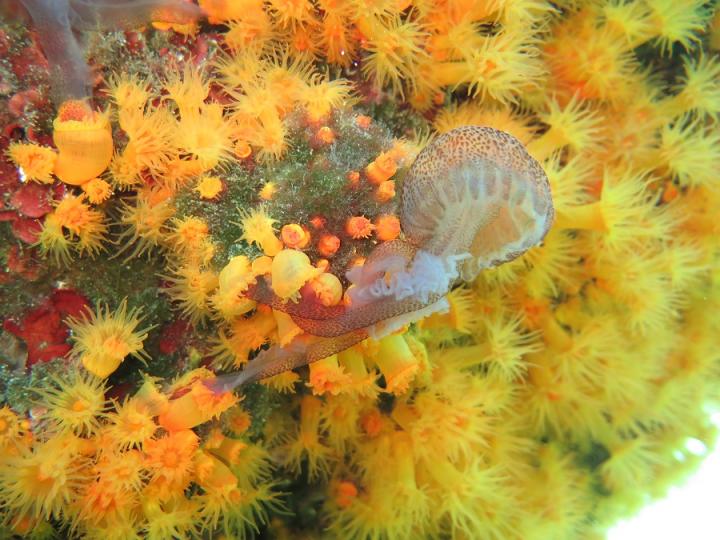
IMAGE

Credit: Fabio Badalementi

Cave-dwelling corals in the Mediterranean can work alongside one another to catch and eat stinging jellyfish, a study reveals.

Scientists have shown for the first time that corals can cooperate to capture and devour jellyfish which are swept against the walls by ocean currents.

A team including researchers from the University of Edinburgh made the discovery when they spotted jellyfish stuck to undersea cliffs and caves near islands off the coast of Sicily.

Observations carried out by the team have revealed how the corals – which feed mostly on tiny marine creatures called plankton – are able to catch such large prey.

As jellyfish try to swim away they brush against more of the individual corals which each latch onto them.

This coordinated effort to catch prey benefits the coral – a bright orange species called Astroides calycularis – by giving each access to a large meal, the teams says.

The jellyfish seen being eaten – called Pelagia noctiluca, or the mauve stinger – is responsible for most of the painful stings people suffer while swimming in the Mediterranean.

The study, published in the journal Ecology, was a collaboration with researchers in Italy.

Fabio Badalementi, Research Director at the Italian National Research Council and Honorary Professor at the University of Edinburgh, said: "Although both species have been known for years, we had no idea that the coral could catch and eat these jellyfish."

Professor Murray Roberts, of the University of Edinburgh's School of GeoSciences, said: "This is a really fascinating observation. The conventional wisdom is that corals don't eat jellyfish, but these results show that we need to keep both our eyes and minds open to new discoveries."

###

Media Contact

Corin Campbell
[email protected]
44-131-650-6382
@edinunimedia

http://www.ed.ac.uk

Related Journal Article

http://dx.doi.org/10.1002/ecy.2413
Share12Tweet8Share2ShareShareShare2

Related Posts

Florida Cane Toad: Complex Spread and Selective Evolution

Florida Cane Toad: Complex Spread and Selective Evolution

February 7, 2026
New Study Uncovers Mechanism Behind Burn Pit Particulate Matter–Induced Lung Inflammation

New Study Uncovers Mechanism Behind Burn Pit Particulate Matter–Induced Lung Inflammation

February 6, 2026

DeepBlastoid: Advancing Automated and Efficient Evaluation of Human Blastoids with Deep Learning

February 6, 2026

Navigating the Gut: The Role of Formic Acid in the Microbiome

February 6, 2026
Please login to join discussion

POPULAR NEWS

  • Robotic Ureteral Reconstruction: A Novel Approach

    Robotic Ureteral Reconstruction: A Novel Approach

    82 shares
    Share 33 Tweet 21
  • Digital Privacy: Health Data Control in Incarceration

    63 shares
    Share 25 Tweet 16
  • Study Reveals Lipid Accumulation in ME/CFS Cells

    57 shares
    Share 23 Tweet 14
  • Breakthrough in RNA Research Accelerates Medical Innovations Timeline

    53 shares
    Share 21 Tweet 13

About

We bring you the latest biotechnology news from best research centers and universities around the world. Check our website.

Follow us

Recent News

Evaluating Pediatric Emergency Care Quality in Ethiopia

TPMT Expression Predictions Linked to Azathioprine Side Effects

Improving Dementia Care with Enhanced Activity Kits

Subscribe to Blog via Email

Success! An email was just sent to confirm your subscription. Please find the email now and click 'Confirm' to start subscribing.

Join 73 other subscribers
  • Contact Us

Bioengineer.org © Copyright 2023 All Rights Reserved.

Welcome Back!

Login to your account below

Forgotten Password?

Retrieve your password

Please enter your username or email address to reset your password.

Log In
No Result
View All Result
  • Homepages
    • Home Page 1
    • Home Page 2
  • News
  • National
  • Business
  • Health
  • Lifestyle
  • Science

Bioengineer.org © Copyright 2023 All Rights Reserved.