Credit: Weizmann Institute of Science
In 1924, Russian biochemist Alexander Oparin claimed that life on Earth developed through gradual chemical changes of organic molecules, in the "primordial soup" which likely existed on Earth four billion years ago. In his view, the complex combination of lifeless molecules, joining forces within small oily droplets, could assume life faculties – self-replication, selection and evolution. These ideas were received with considerable doubt, still pertaining today.
Thirty years later, when DNA structure was deciphered, it was realized that this molecule is capable of self-replication, seemingly solving the enigma of life's origin without resort to Oparin's droplets. But critics argued that life requires not only replicators, but also enzyme catalysts to control metabolism. Another 30 years passed before the discovery that RNA, key component in information transfer from DNA to proteins, can also be an enzyme. This is how the concept of "RNA World" was born, whereby life began when the primordial soup gave birth to a ribozyme, which can both replicate and control metabolism.
Despite this doubts lingered, because a replicating ribosome is a highly complex molecule, with negligible probability of spontaneous appearance in the soup. This led to an alternative concept – mutually catalytic networks, affording the copying of entire molecular ensembles. This idea echoes Oparin's evolving complex combination of simple molecules, each with high likelihood of appearance in the soup. What remained was to generate a detailed chemical model that will help support such a narrative.
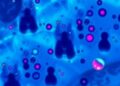
Prof. Doron Lancet and colleagues at the Weizmann Institute of Science, Dept. of Molecular Genetics came up with such a model. First, it was necessary to identify the appropriate type of molecules, that can accrete together and effectively form networks of mutual interactions, in line with Oparin's droplets. Lancet proposed lipids, oily compounds that spontaneously form the aggregated membranes enclosing all living cells. Lipid bubbles (vesicles) can grow and split much like living cells. This is how Lancet generated the concept "Lipid World" two decades ago.
To analyze the invoked molecular networks, they have used tools of systems biology and computational chemistry, that allow instilling rigor into the somewhat ephemeral concept of mutually catalytic networks.
They first address in detail the nagging question of how lipid assemblies can store and transmit information from one growth-split generation to another. They come up with a hitherto rarely explored notion that what gets propagated is compositional information, and show by detailed computer simulations how this happens. Furthermore, they indicate a profound similarity of such composition copying to the way by which growing and proliferating living cells preserve their epigenetic information, that which is independent of DNA replication.
In an article just appeared in the Journal of the Royal Society Interface Lancet and colleagues report an extensive literature survey, showing that lipids can exert enzyme-like catalysis, similar to ribozymes. This s a property crucial for forming the mutual interaction networks. Subsequently, the authors show, using the tools of systems biology and computational chemistry, that the oily droplets can accumulate and store compositional information, and when undergoing fission, transmit the information to progeny.
Based on the computer model they developed, the scientists demonstrated that specific lipid compositions, called "composomes", can undergo compositional mutations, be subject to natural selection in response to environmental changes, and even undergo Darwinian selection. Prof. Lancet comments that such an information system, which is based on compositions and not on the sequence of chemical "letters" as in DNA, is reminiscent of the realm of epigenetics, where traits are inherited independent of the DNA sequence. This lends credence to the scientists' assumption that life could emerge before the advent of DNA and RNA. In their article they in fact delineate a chemical path that lead to the appearance of genetic material in the framework of the oily droplets.
Lancet's "Lipid World" concept is contingent upon the question of whether there were sufficient oil-like "water hating" molecules in the primordial soup. Here too, the scientists describe a comprehensive literature search, according to which there is a high probability for such molecules to be present on early Earth. This conclusion was reinforced by a very recent study showing that Enceladus, one of Saturn's moons, has a sub-glacial ocean (primordial ocean) replete with "water hating" compounds, some of which could form Lipid World-type droplets. Prof. Lancet contends that these findings, along with innovative model-based computations, show that the probability of life's emergence is relatively high, including the exciting possibility that Enceladus presently harbors some early lipid-based life forms.
###
Prof. Doron Lancet is the incumbent of the Ralph D. and Lois R. Silver Professorial Chair of Human Genomics.
The Weizmann Institute of Science in Rehovot, Israel, is one of the world's top-ranking multidisciplinary research institutions. Noted for its wide-ranging exploration of the natural and exact sciences, the Institute is home to scientists, students, technicians and supporting staff. Institute research efforts include the search for new ways of fighting disease and hunger, examining leading questions in mathematics and computer science, probing the physics of matter and the universe, creating novel materials and developing new strategies for protecting the environment.
Media Contact
Yael Edelman
[email protected]
972-893-43852
@WeizmannScience
http://www.weizmann.ac.il
Original Source
https://wis-wander.weizmann.ac.il/life-sciences/century-old-model-life%E2%80%99s-origin-gets-significant-substantiation