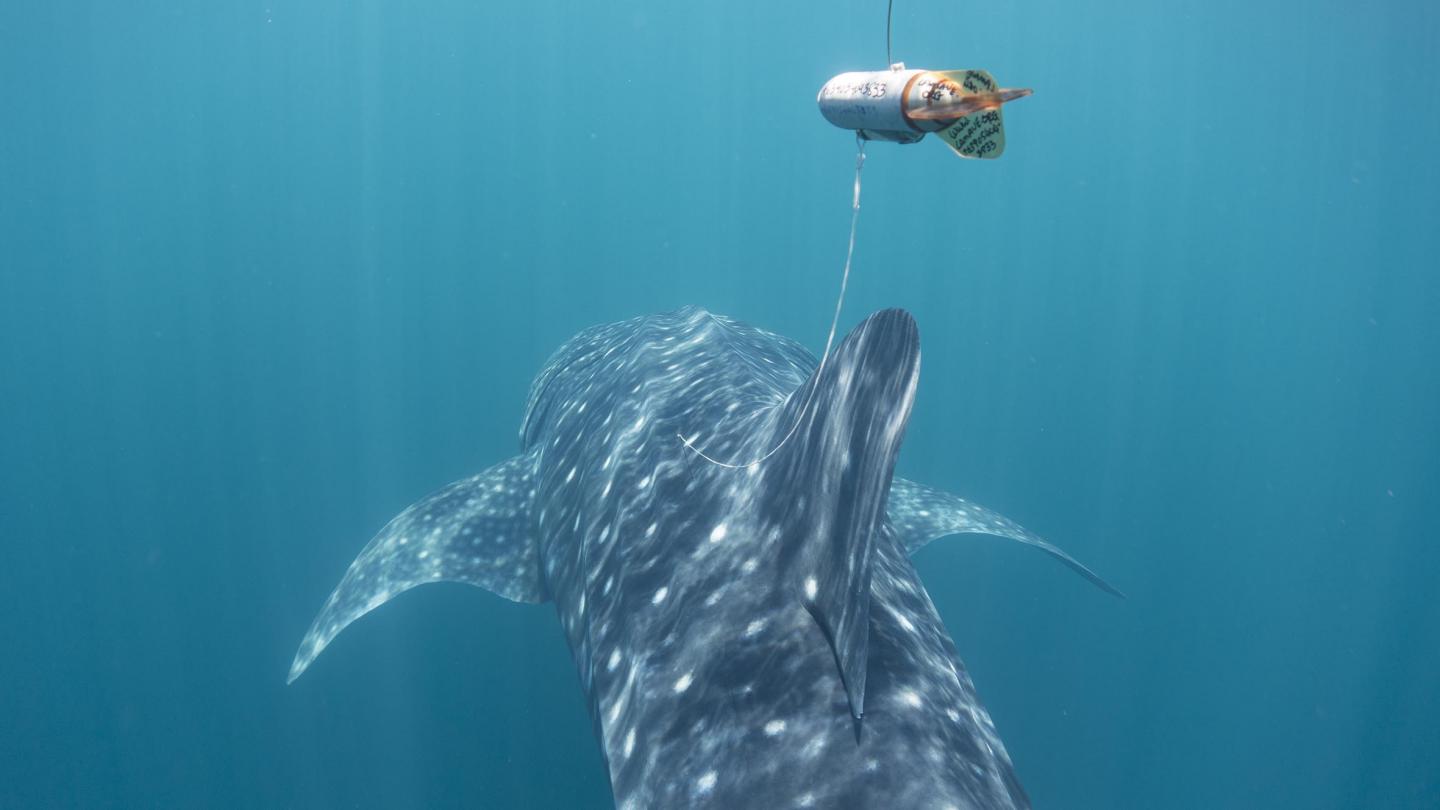
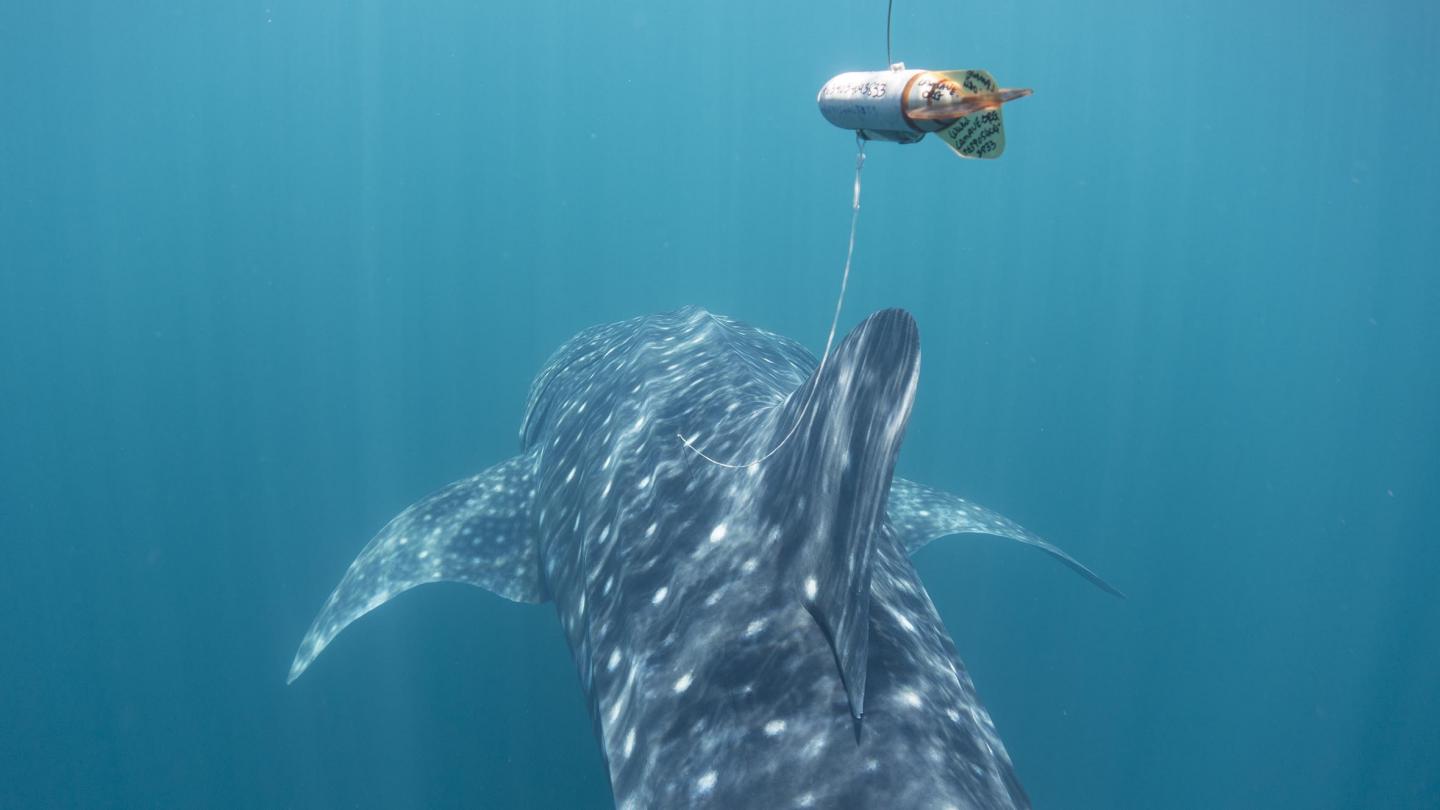
Credit: Gonzalo Araujo
A new scientific study published in PeerJ – the Journal of Life and Environmental Sciences has tracked juvenile whale sharks across the Philippines emphasising the importance of the archipelago for the species. The study is the most complete tracking study of whale sharks in the country, with satellite tags deployed on different individuals in multiple sites.
The Philippines is an important hotspot for whale sharks and globally hosts the third largest known population of whale sharks (whaleshark.org). While the species has been protected in the Philippines since 1998, globally the species was uplisted in 2016 to 'endangered to extinction' in the IUCN Red List of Threatened Species due to a population decline of more than 50%, largely caused by continued exploitation in the Indo-Pacific. Particularly in South East Asia, concerns remain due to continued fishing in regional waters; understanding the movements of whale sharks in the Philippines is vital if we are to identify conservation priorities for the species.
By attaching Wildlife Computers SPOT5 satellite tags to whale sharks, researchers from Large Marine Vertebrates Research Institute Philippines (LAMAVE), Marine Megafauna Foundation (MMF) and Tubbataha Management Office (TMO) were able to follow the movements of juvenile whale sharks in near real-time to gain an insight into their behaviour. The tags work by communicating with passing ARGOS satellites, transmitting a location when the wet/dry sensor is triggered when a tagged whale shark breaks the surface. To aid transmission tags were tethered to a whale shark by a 1.8-meter line to ensure the tags broke the surface more frequently.
17 individual whale sharks were tagged in three different locations in the Philippines: Panaon Island (Southern Leyte), northern Mindanao (Misamis Oriental and Surigao del Norte) and Tubbataha Reefs Natural Park (Palawan). Tagging took place between April 2015 and April 2016. All tagged whale sharks were juveniles, ranging in size between 4.5 – 7 meters and 73% of them were male.
In their paper, peer-reviewed and published in PeerJ – the Journal of Life & Environmental Sciences, the researchers discovered that the tracks from the tags showed that all whale sharks stayed within the Philippines over the tracking period, emphasising the importance of the archipelago for the species. The longest track observed was from a whale shark originally tagged in Tubbataha Reefs Natural Park, which appeared to swim through the Sulu and Bohol Seas and into the Pacific, a journey accumulating over 2,500 km in length. While whale sharks are not known for their speed, results revealed that one individual whale shark was averaging 47km a day, further emphasising the species' mobile tendencies.
Lead author of the study, Gonzalo Araujo stresses that "this research highlights the high mobility of whale sharks, even juveniles, and the need for broader scale management and conservation plans for this endangered species."
Dedicated research by LAMAVE and citizen science has identified over 600 individuals in the Sulu and Bohol Seas, yet the proximity of this population to fisheries in the broader region (South China Sea) means it is vital to monitor this population as a whole to understand if this population is in recovery or continuing to decline. Identifying threats and mitigation strategies is a conservation priority for the species. LAMAVE continues to study whale sharks in five key areas in the Philippines, working with local and national governments as well as collaborating organisations to develop conservation strategies for this iconic species.
###
Contact:
Sally Snow – [email protected]
Media pack (including embargoed article, video and images): https://drive.google.com/drive/folders/1sFyHTLvwOK1y_iejy3G4IkNGxMES0Zm0
Video 1: Behind the Science: Tagging Whale Sharks in the Phillipines (link)
Images:
Image credit: A tagged juvenile whale shark swims through the waters of Panaon Island, Southern Leyte (Gonzalo Araujo)
Image credit: The team tag a whale shark, surrounded by barracuda in Tubbataha Reefs Natural Park (Steve De Neef)
Image credit: Tracks of whale sharks tagged in Tubbataha Reefs Natural Park, with park boundaries in orange. Araujo G, Rohner CA, Labaja J, Conales SJ, Snow SJ, Murray R, Pierce SJ, Ponzo A. (2018) Satellite tracking of juvenile whale sharks in the Sulu and Bohol Seas, Philippines. PeerJ 6:e5231 https://doi.org/10.7717/peerj.5231 (CC BY)
Link to the Published Version of the article (quote this link in your story – the link will ONLY work after the embargo lifts): https://peerj.com/articles/5231 your readers will be able to freely access this article at this URL.
Citation to the article: Araujo et al. (2018), Satellite tracking of juvenile whale sharks in the Sulu and Bohol Seas, Philippines. PeerJ 6:e5231; DOI 10.7717/peerj.5231
About:
PeerJ is an Open Access publisher of two peer-reviewed journals and a preprint server. PeerJ's mission is to help the world efficiently publish its knowledge. All works published by PeerJ are Open Access and published using a Creative Commons license (CC-BY 4.0). PeerJ is based in San Diego, CA and the UK and can be accessed at peerj.com
PeerJ is the peer-reviewed journal for Biology, Medicine and Environmental Sciences. PeerJ has recently added 15 areas in environmental science subject areas, including Natural Resource Management, Climate Change Biology, and Environmental Impacts. peerj.com/environmental-sciences
PeerJ has an Editorial Board of over 1,900 respected academics, including 5 Nobel Laureates. PeerJ was the recipient of the 2013 ALPSP Award for Publishing Innovation. PeerJ Media Resources (including logos) can be found at: peerj.com/about/press
Large Marine Vertebrates Research Institute Philippines (LAMAVE) is the largest independent non-profit non-governmental organization solely dedicated to the conservation of marine megafauna and their habitats in the Philippines. LAMAVE strives for conservation through scientific research, policy and education. http://www.lamave.org
Tubbataha Reefs Natural Park is the largest marine protected area in the Philippines. It was declared a UNESCO World Heritage Site in 1993. The park is managed and protected by the Tubbataha Protected Area Management Board, the Tubbataha Management Office and the Marine Park Rangers. http://www.tubbatahareefs.org
The Marine Megafauna Foundation was created in 2009 to research, protect and conserve the populations of threatened marine megafauna around the world. 'Megafauna' are large marine species such as sharks, rays, marine mammals and sea turtles. http://www.marinemegafauna.org
Media Contacts
For the authors:
Sally Snow – [email protected]
For PeerJ: email: [email protected] , https://peerj.com/about/press/
Note: If you would like to join the PeerJ Press Release list, please register at: http://bit.ly/PressList
Media Contact
Sally Snow
[email protected]
@ThePeerJ
http://https://peerj.com
Related Journal Article
http://dx.doi.org/10.7717/peerj.5231