Credit: ISGlobal
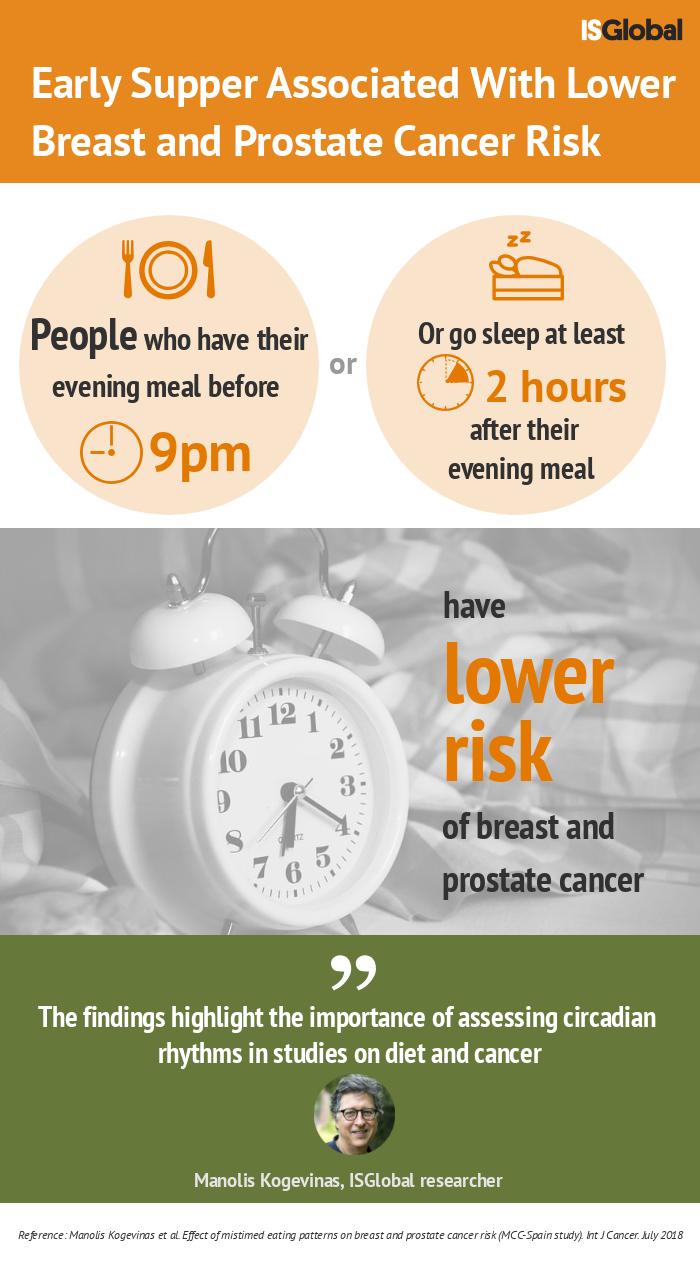
Having an early supper or leaving an interval of at least two hours before going to bed are both associated with a lower risk of breast and prostate cancer. Specifically, people who take their evening meal before 9 pm or wait at least two hours before going to sleep have an approximate 20% lower risk of those types of cancer compared to people who have supper after 10pm or those who eat and go to bed very close afterwards, respectively. These were the main conclusions of a new study by the Barcelona Institute for Global Health (ISGlobal), a centre supported by the "la Caixa" Banking Foundation. The study is the first to analyse the association between cancer risk and the timing of meals and sleep.
Previous studies of the link between food and cancer have focused on dietary patterns–for example, the effects of eating red meat, fruit and vegetables and the associations between food intake and obesity. However, little attention has been paid to other factors surrounding the everyday act of eating: the timing of food intake and the activities people do before and after meals. Recent experimental studies have shown the importance of meal timing and demonstrated the health effects of eating late at night.
The aim of the new study, published in the International Journal of Cancer, was to assess whether meal timing could be associated with risk of breast and prostate cancer, two of the most common cancers worldwide. Breast and prostate cancers are also among those most strongly associated with night-shift work, circadian disruption and alteration of biological rhythms. The study assessed each participant's lifestyle and chronotype (an individual attribute correlating with preference for morning or evening activity).
The study, which formed part of the MCC-Spain project, co-financed by the CIBER of Epidemiology and Public Health (CIBERESP), included data from 621 cases of prostate cancer and 1,205 cases of breast cancer, as well as 872 male and 1,321 female controls selected randomly from primary health centres. The participants, who represented various parts of Spain, were interviewed about their meal timing, sleep habits and chronotype and completed a questionnaire on their eating habits and adherence to cancer prevention recommendations.
"Our study concludes that adherence to diurnal eating patterns is associated with a lower risk of cancer," explained ISGlobal researcher Manolis Kogevinas, lead author of the study. The findings "highlight the importance of assessing circadian rhythms in studies on diet and cancer", he added.
If the findings are confirmed, Kogevinas noted, "they will have implications for cancer prevention recommendations, which currently do not take meal timing into account". He added: "The impact could be especially important in cultures such as those of southern Europe, where people have supper late."
ISGlobal researcher Dora Romaguera, the last author of the study, commented: "Further research in humans is needed in order to understand the reasons behind these findings, but everything seems to indicate that the timing of sleep affects our capacity to metabolise food."
Animal experimental evidence has shown that the timing of food intake has "profound implications for food metabolism and health", commented Romaguera.
###
Reference
Manolis Kogevinas, Ana Espinosa, Adela Castelló, Inés Gómez-Acebo, Marcela Guevara, Vicente Martin, Pilar Amiano, Juan Alguacil, Rosana Peiro, Victor Moreno, Laura Costas, Guillermo Fernández-Tardón, Jose Juan Jimenez, Rafael Marcos-Gragera, Beatriz Perez-Gomez, Javier Llorca, Conchi Moreno-Iribas, Tania Fernández-Villa, Madalen Oribe, Nuria Aragones, Kyriaki Papantoniou, Marina Pollán, Gemma Castano-Vinyals, Dora Romaguera. Effect of mistimed eating patterns on breast and prostate cancer risk (MCC-Spain study). Int J Cancer. June 2018
Media Contact
Marta Solano
[email protected]
34-661-451-600
http://www.isglobal.org/en/