• HOME
  • NEWS
  • EXPLORE
    • CAREER
      • Companies
      • Jobs
    • EVENTS
    • iGEM
      • News
      • Team
    • PHOTOS
    • VIDEO
    • WIKI
  • BLOG
  • COMMUNITY
    • FACEBOOK
    • INSTAGRAM
    • TWITTER
Saturday, February 7, 2026
BIOENGINEER.ORG
No Result
View All Result
  • Login
  • HOME
  • NEWS
  • EXPLORE
    • CAREER
      • Companies
      • Jobs
        • Lecturer
        • PhD Studentship
        • Postdoc
        • Research Assistant
    • EVENTS
    • iGEM
      • News
      • Team
    • PHOTOS
    • VIDEO
    • WIKI
  • BLOG
  • COMMUNITY
    • FACEBOOK
    • INSTAGRAM
    • TWITTER
  • HOME
  • NEWS
  • EXPLORE
    • CAREER
      • Companies
      • Jobs
        • Lecturer
        • PhD Studentship
        • Postdoc
        • Research Assistant
    • EVENTS
    • iGEM
      • News
      • Team
    • PHOTOS
    • VIDEO
    • WIKI
  • BLOG
  • COMMUNITY
    • FACEBOOK
    • INSTAGRAM
    • TWITTER
No Result
View All Result
Bioengineer.org
No Result
View All Result
Home NEWS Science News Health

Can nanoparticles be used to lower antibiotic resistance?

Bioengineer by Bioengineer
July 10, 2018
in Health
Reading Time: 2 mins read
0
Share on FacebookShare on TwitterShare on LinkedinShare on RedditShare on Telegram
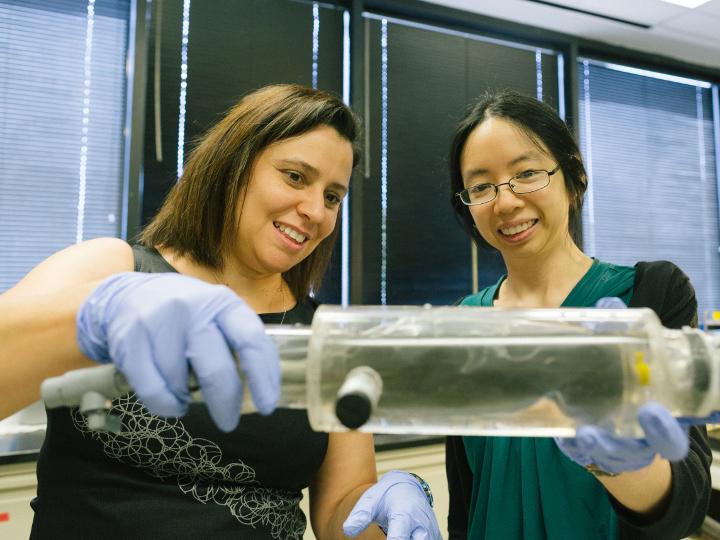
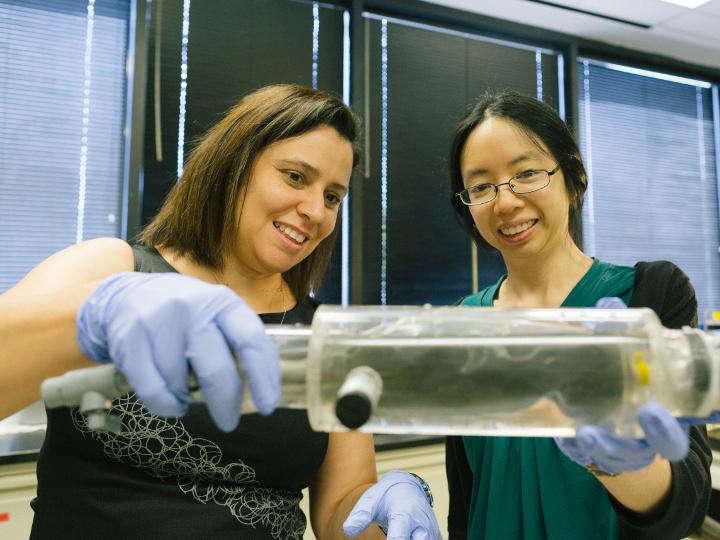
IMAGE

Credit: University of Houston

Antibiotic resistance is one of the world's most serious threats to public health, forcing the use of medications that are more toxic, more expensive and not always effective. There are several causes, including over-prescription of antibiotics in both humans and in livestock.

Two engineers with the University of Houston have embarked on a project to determine whether the use of tiny amounts of antibiotics embedded in corn-based nanoparticles could allow the use of lower dosages and avoid wiping out the microbiome – the collection of both healthy and disease-causing bacteria found in the intestines – and the resulting genetic mutations that lead to antibiotic resistance.

Debora Rodrigues, associate professor of civil and environmental engineering, and Stacey Louie, assistant professor of civil and environmental engineering, have developed a reactor to simulate pig intestines in order to study how antibiotics react in the pig microbiome.

"Pigs have a lot of similarities to humans," said Rodrigues, principal investigator on a $437,535 grant from the USDA National Institute of Food and Agriculture. "We are working with livestock, but ultimately it could be helpful for humans."

Collaborators Cristina Sabliov and Carlos Astete at Louisiana State University will create corn-based nanoparticles loaded with antibiotics for the project.

Early data supports the researchers' hypothesis that the plant-based nanoparticles will be less toxic than many other forms of nanoparticle. They are designed to dissolve in the simulated pig intestine.

The reactor mimics a pig's lower intestine, with a dialysis bag positioned to capture nutrients as pig slurry is funneled through. Louie said the bag functions much like the gut, allowing water, sugars and other nutrients to pass through.

Antibiotics – both at regular dosages and the minute amounts in the nanoparticles – will be added to the slurry, allowing the researchers to test how the drugs affect the microbiome at different dosages.

The goal is to determine if administering antibiotics in a different way will avoid the widespread damage to the microbiome associated with current practices.

"We'll study how the microbial community is changing and what genes related to antibiotic resistance are emerging," Rodrigues said.

###

This work is supported by the USDA National Institute of Food and Agriculture, AFRI project 2017-07878.

Media Contact

Jeannie Kever
[email protected]
713-743-0778
@UH_News

http://www.uh.edu/news-events

Original Source

http://www.uh.edu/news-events/stories/2018/june2018/07102018rodrigues-antibiotic-resistance.php

Share15Tweet8Share2ShareShareShare2

Related Posts

Boosting Remote Healthcare: Stepped-Wedge Trial Insights

February 7, 2026

Barriers and Boosters of Seniors’ Physical Activity in Karachi

February 7, 2026

Evaluating Pediatric Emergency Care Quality in Ethiopia

February 7, 2026

TPMT Expression Predictions Linked to Azathioprine Side Effects

February 7, 2026
Please login to join discussion

POPULAR NEWS

  • Robotic Ureteral Reconstruction: A Novel Approach

    Robotic Ureteral Reconstruction: A Novel Approach

    82 shares
    Share 33 Tweet 21
  • Digital Privacy: Health Data Control in Incarceration

    63 shares
    Share 25 Tweet 16
  • Study Reveals Lipid Accumulation in ME/CFS Cells

    57 shares
    Share 23 Tweet 14
  • Breakthrough in RNA Research Accelerates Medical Innovations Timeline

    53 shares
    Share 21 Tweet 13

About

We bring you the latest biotechnology news from best research centers and universities around the world. Check our website.

Follow us

Recent News

Boosting Remote Healthcare: Stepped-Wedge Trial Insights

Barriers and Boosters of Seniors’ Physical Activity in Karachi

Evaluating Pediatric Emergency Care Quality in Ethiopia

Subscribe to Blog via Email

Enter your email address to subscribe to this blog and receive notifications of new posts by email.

Join 73 other subscribers
  • Contact Us

Bioengineer.org © Copyright 2023 All Rights Reserved.

Welcome Back!

Login to your account below

Forgotten Password?

Retrieve your password

Please enter your username or email address to reset your password.

Log In
No Result
View All Result
  • Homepages
    • Home Page 1
    • Home Page 2
  • News
  • National
  • Business
  • Health
  • Lifestyle
  • Science

Bioengineer.org © Copyright 2023 All Rights Reserved.