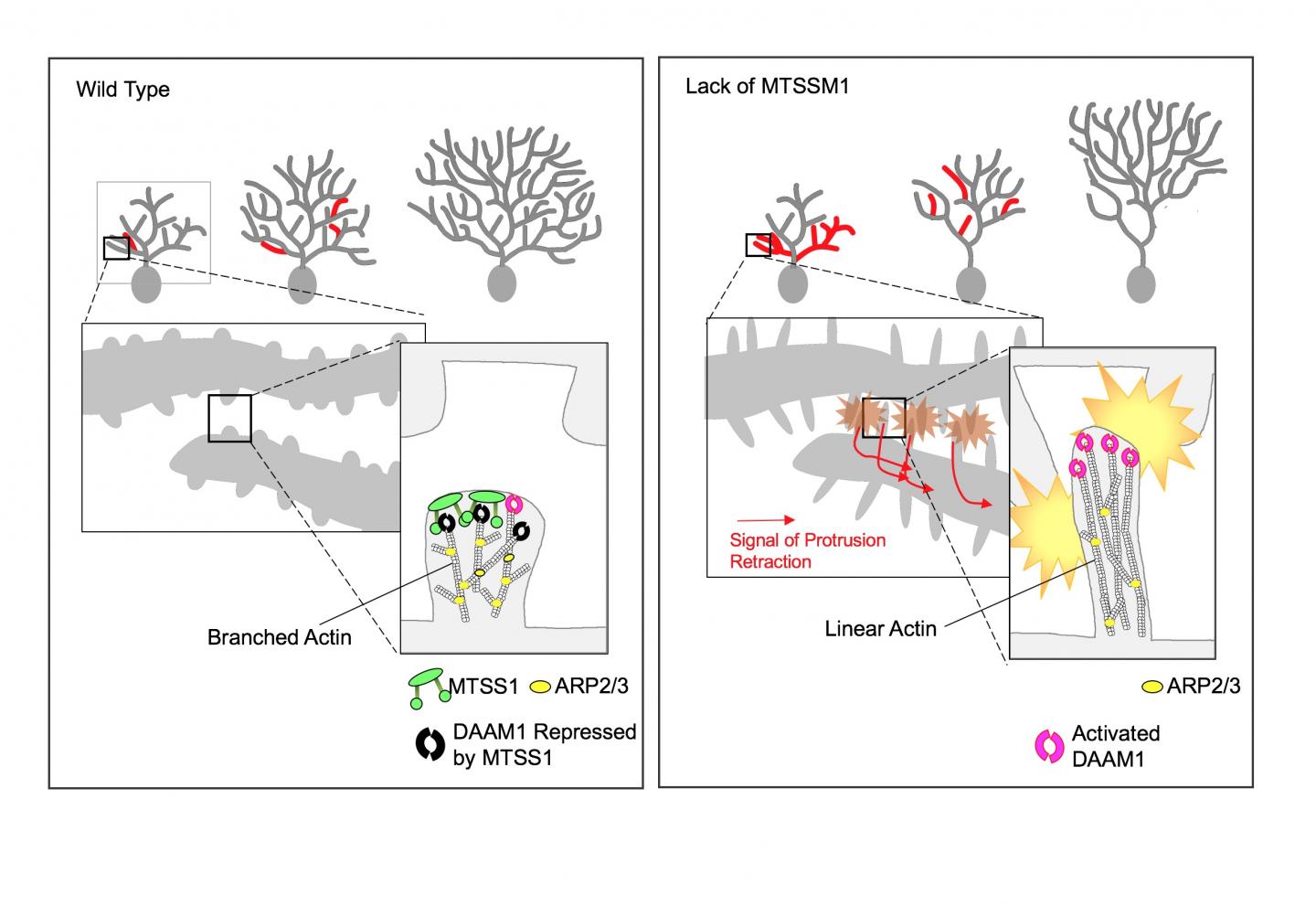
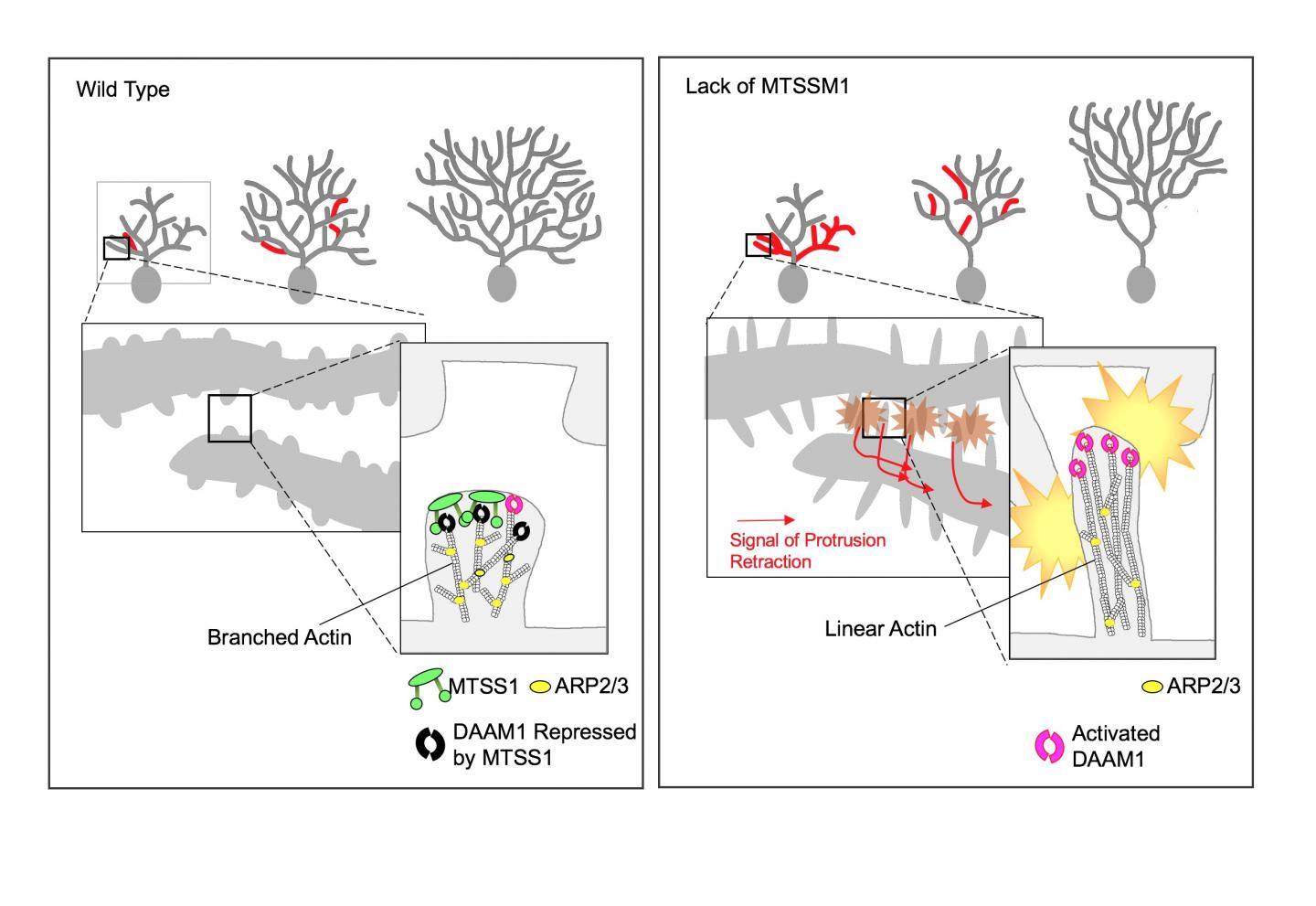
Credit: Kyoto University iCeMS
A protein called "MetastasisMetastasis-suppressor 1" (MTSS1) activates one pathway and inhibits another competing pathway, thus playing a dual role that determines how neuron branches in the brain form, according to research published in the journal Cell Reports.
Researchers at the Institute for Integrated Cell-Material Sciences (iCeMS) and colleagues in Japan wanted to investigate the role of MTSS1 in neuron branch development in Purkinje cells.
These neurons are among the largest in the human brain, occupying the outer layer of the cerebellum, which is located at the brain's base. Purkinje cells are comprised of a large cell body and an intricate tree-shaped portion of branches. These branches grow to completely fill available space in order to uniformly receive information from the surrounding environment. But they also retract if they come into contact with other branches. This process allows the neurons to control branch growth to be able to cover the maximum area possible while minimizing inefficient redundancies.
Previous studies have shown that MTSS1 may be involved in Purkinje branch development, but the details of how it is involved were lacking.
Professor Mineko Kengaku is a developmental neurobiologist whose work aims to understand the dynamic movements of developing neurons in the brain. By reconstructing the cell architecture of the brain in petri dishes, Kengaku believes she and her team can help in the development of therapies for damaged brains.
Kengaku and her team found that inhibiting MTSS1 expression in Purkinje cells in baby mice led to incomplete growth of Purkinje branches, indicating MTSS1 is an important regulator of branch development. Computer simulations showed similar results.
Upon further investigation, they found that MTSS1 regulates actin, the protein that forms a skeletal basis of neuron branches, by two competing pathways. They showed that in Purkinje cells, MTSS1 activates a pathway called ARP2/3, which initiates growth of new actin filaments at a 70° angle from the 'mother filament'. MTSS1 also binds to and inhibits a protein, called DAAM1, which forms straight unbranched actin filaments, and thought to compete with ARP2/3. Inhibiting MTSS1 was found to stimulate the growth of dendrites until they contact neighbouring ones, causing them to retract. This is the first time MTSS1 has been identified as a DAAM1 inhibitor in vertebrate neurons.
###
For more information about this research, contact
Mineko Kengaku
[email protected]
About Kyoto University's Institute for Integrated Cell-Material Sciences (iCeMS)
At iCeMS, our mission is to explore the secrets of life by creating compounds to control cells, and further down the road to create life-inspired super materials that confront the myriad problems that afflict modern society. In only a decade, collaborative research at iCeMS has resulted in significant cutting-edge scientific discoveries, and the creation of over 1500 unique materials. We will keep turning our inspirations into purposeful, transformative innovations for the practical benefit of society.
For more information about iCeMS, contact
Mari Toyama
[email protected]
Media Contact
Mari Toyama
[email protected]
@KyotoU_News
http://www.kyoto-u.ac.jp/en