
Credit: UT Southwestern
DALLAS – July 2, 2018 – Using data from large clinical trials, UT Southwestern researchers developed a way to predict which patients will benefit most from aggressive high blood pressure treatment.
The machine learning algorithm they devised combines three variables routinely collected during clinic visits and demonstrates how the emerging field of bioinformatics could transform patient care. Their work, available online now and publishing July 15 in the American Journal of Cardiology, describes a risk prediction model in which patient age, urinary albumin/creatinine ratio (UACR), and cardiovascular disease history successfully identified hypertensive patients for whom the benefits of intensive therapy outweigh the risks.
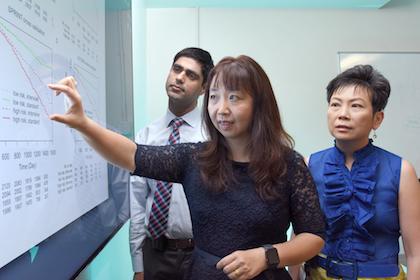
"Large randomized trials have provided inconsistent evidence regarding the benefit of intensive blood pressure lowering in hypertensive patients," said corresponding author Dr. Yang Xie, Director of the Quantitative Biomedical Research Center at UT Southwestern and of the University's Bioinformatics Core Facility. "To the best of our knowledge, this is the first study to identify a subgroup of patients who derive a higher net benefit from intensive blood pressure treatment."
Researchers used patient data from two National Institutes of Health-funded randomized controlled trials that tested intensive vs. standard blood pressure-lowering treatments – the Systolic Blood Pressure Intervention Trial (SPRINT) and the Action to Control Cardiovascular Risk in Diabetes (ACCORD) trial. The SPRINT trial included 9,361 nondiabetic hypertensive adults at an elevated risk of cardiovascular event, while ACCORD enrolled 10,251 patients with Type 2 diabetes.
"I think our algorithm can help us identify high-risk patients who will most likely benefit from intensive blood pressure reduction. Long-term intensive HBP drug therapy can reduce risk of heart failure and death, but it carries an increased risk of side effects," said co-author Dr. Wanpen Vongpatanasin, Professor of Internal Medicine and holder of the Norman and Audrey Kaplan Chair in Hypertension and the Fredric L. Coe Professorship in Nephrolithiasis Research in Mineral Metabolism.
The researchers' machine learning method determined three simple criteria to identify adults with high blood pressure who are at the highest risk for early major adverse cardiovascular events – such as cardiovascular death, heart attack, or stroke. Those criteria are: an age of 74 or older, a UACR of 34 or higher, and a history of clinical cardiovascular disease, such as heart disease, stroke, or heart failure. Patients who met one or more of the three criteria were predicted to be among a high-risk group who had a greater benefit from intensive blood pressure-lowering treatment. In contrast, the team found that patients younger than age 74 who had a UACR less than 34 and no history of cardiovascular disease may do equally as well with less intensive treatment.
"We feel that our findings have major clinical implications, since in addition to its predictive effects, the model generated here is simple and easy to implement in clinical practice without additional lab tests or computational tools," said Dr. Xie, who is also an Associate Professor of Clinical Sciences and Bioinformatics. "We hope that clinicians can someday use this algorithm to identify which patients should receive standard versus intensive treatment, and we hope to design a prospective clinical trial to further validate this algorithm."
###
Other UT Southwestern researchers involved in the study included Dr. Sandeep R. Das, Associate Professor of Internal Medicine; Dr. Rebecca Vigen, Assistant Professor of Internal Medicine; Dr. Tao Wang, Assistant Professor of Clinical Sciences and in the Center for the Genetics of Host Defense; Dr. Xin Luo, a data scientist; Dr. Rong Lu, a biostatistical consultant; Dr. Xiaowei Zhan, Assistant Professor of Clinical Sciences and in the Center for the Genetics of Host Defense; and Dr. Guanghua Xiao, Associate Professor of Clinical Sciences and Bioinformatics. Lead authors are Shidan Wang, a graduate student researcher, and Dr. Rohan Khera, a cardiology research fellow.
The study received support from the National Institutes of Health.
Media Contact
Deborah Wormser
[email protected]
@UTSWNews
http://www.swmed.edu
Original Source
https://www.utsouthwestern.edu/newsroom/articles/year-2018/hypertension-algorithm.html