Credit: Julien Heon
With many recreational triathletes and runners ramping up their training in hopes of getting a personal best this summer, a new measure of stress in the body demonstrates that more isn't better when it comes to endurance sport training.
A University of Guelph study is the first to show that overload training may alter firing in the body's sympathetic nerve fibers, which could hinder performance.
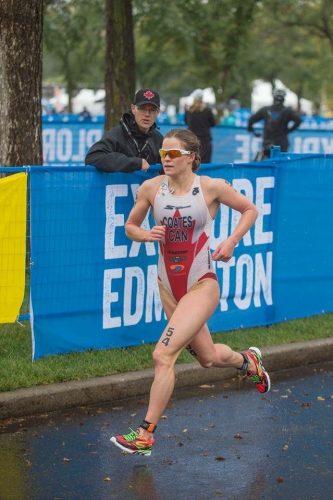
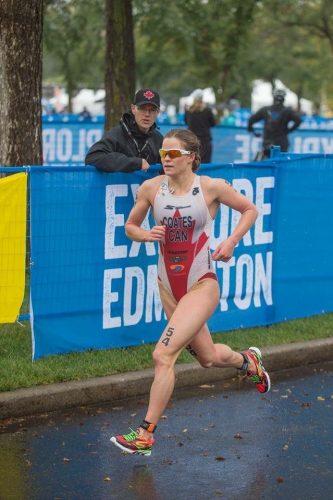
"The theory behind overload training is that you train to the point of complete exhaustion, so that when you rest and recover, you will be able to perform at a higher level than before," said Alexandra Coates, a PhD student in human health and nutritional science and lead author of the study.
"But that may not be entirely correct."
The study revealed that muscle sympathetic nerve activity, which constricts the muscle's blood vessels and indicates stress in the body, increased in over-trained athletes.
"Athletes who followed a consistent training regime and didn't have the same overload stress demonstrated improvements in their overall fitness and other markers of cardiovascular health," said Coates.
Published in the journal Medicine and Science in Sports and Exercise, this is the first study to investigate the impact of overload training on muscle sympathetic nerve activity.
Previous studies have measured indirect physiological factors, such as heart rate variability, but examining muscle nerve fibre activity provides a direct measure of the nervous system's response, said Coates.
The study involved recreational triathletes and cyclists. Over three weeks, one group did overload training (150 per cent of their regular training volume), and the other group continued with their regular training regimen.
Coates measured the athletes' sympathetic nerve activity, as well as heart rate variability and reflexive blood pressure regulation, before and after the three weeks.
"Measuring sympathetic nerve activity requires specialized equipment and trained technicians, so it is difficult to capture," said Coates, who conducted the tests with Prof. Philip Millar, Department of Human Health and Nutritional Sciences.
Millar runs one of the few labs in North America that can measure muscle sympathetic nerve activity.
To measure that activity, a researcher inserts a micro-electrode needle into a nerve in the lower leg while the athlete lies still. This needle records how often the sympathetic nerve fires.
In general, a high level of resting sympathetic activity will reflect an unhealthy state; very healthy athletes typically have low levels of sympathetic activity at rest.
Coates and her team discovered sympathetic nerve activity increased in the overtrained athletes after the three-week period of overload training.
"This was very interesting to us, because generally sympathetic nerve activity stays pretty consistent day to day, therefore we believe the athlete's nervous systems were temporarily altered by the overtraining," she said. "In this instance, it seems like the athletes overdid it."
The recreational athletes who followed their regular training showed no jump in nerve activity. Instead, they demonstrated improved cardiac reflex sensitivity and heart rate variability – signs of improved physical health, added Coates.
"The athletes who did the overload training did not experience this same level of improved health," she said. "They didn't get worse, but they didn't get any better either, and their sympathetic nerve activity went up. It appears the overtraining negated some of the beneficial effects of the regular training."
###
Media Contact
Alexandra Coates
[email protected]
250-661-6563
@uofg
http://www.uoguelph.ca
Original Source
https://news.uoguelph.ca/2018/06/u-of-g-study-finds-new-measure-for-stress-in-over-trained-athletes/ http://dx.doi.org/10.1249/MSS.0000000000001514