• HOME
  • NEWS
  • EXPLORE
    • CAREER
      • Companies
      • Jobs
    • EVENTS
    • iGEM
      • News
      • Team
    • PHOTOS
    • VIDEO
    • WIKI
  • BLOG
  • COMMUNITY
    • FACEBOOK
    • INSTAGRAM
    • TWITTER
Sunday, May 17, 2026
BIOENGINEER.ORG
No Result
View All Result
  • Login
  • HOME
  • NEWS
  • EXPLORE
    • CAREER
      • Companies
      • Jobs
        • Lecturer
        • PhD Studentship
        • Postdoc
        • Research Assistant
    • EVENTS
    • iGEM
      • News
      • Team
    • PHOTOS
    • VIDEO
    • WIKI
  • BLOG
  • COMMUNITY
    • FACEBOOK
    • INSTAGRAM
    • TWITTER
  • HOME
  • NEWS
  • EXPLORE
    • CAREER
      • Companies
      • Jobs
        • Lecturer
        • PhD Studentship
        • Postdoc
        • Research Assistant
    • EVENTS
    • iGEM
      • News
      • Team
    • PHOTOS
    • VIDEO
    • WIKI
  • BLOG
  • COMMUNITY
    • FACEBOOK
    • INSTAGRAM
    • TWITTER
No Result
View All Result
Bioengineer.org
No Result
View All Result
Home NEWS Science News Biology

Australian shrub contains new class of organic compound

Bioengineer by Bioengineer
June 27, 2018
in Biology
Reading Time: 2 mins read
0
Share on FacebookShare on TwitterShare on LinkedinShare on RedditShare on Telegram
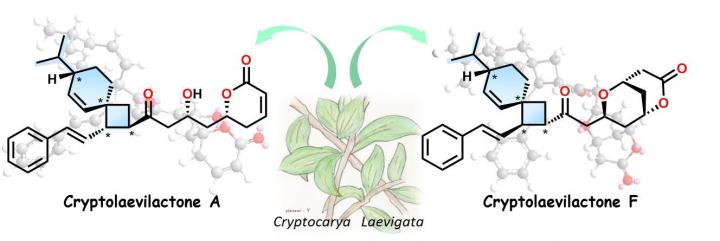
IMAGE

Credit: Kanazawa University

Kanazawa – The botanical world can be an exciting place for chemists. Plant species produce a beautiful array of organic molecules with complex structures, often of great practical use. Indeed, this is a realm where new discoveries are still being made. Recently, a Japanese-led research team discovered an entirely new structural class in compounds from a jungle-dwelling shrub.

The glossy or red-fruited laurel (binomial name: Cryptocarya laevigata) inhabits the rainforests of eastern Australia. Little was known about the chemical makeup of this tall shrub until the team, led by Kanazawa University, analyzed an extract of its twigs and leaves. The plant's essential oil was found to contain a family of six new compounds, the structural analysis of which revealed some surprises.

As reported in Organic Letters, NMR experiments showed that at the center of the compounds lay a peculiar, nine-membered carbon cycle known as a spiro-nonene. This structure consists of two rings of carbon atoms–one containing six atoms, the other four–linked by a single "pinch point" atom that is a part of both rings. This motif had never been seen before in any natural product.

Four-carbon rings–cyclobutanes–are rare because of their unstable structure. Carbon generally prefers to build larger rings, which are less strained. A few cyclobutanes do exist in nature; however, the Kanazawa team thinks that C. laevigata cyclizes these particular compounds in a unique way, reacting a monoterpene with a polyketide, instead of two identical alkenes as is usual.

The intricacy doesn't stop there. The C. laevigata products also contain lactone groups–cyclic esters–prompting the name of these compounds, "cryptolaevilactones." Esters are often associated with fruity aromas and perfumery. Three of the compounds in fact contain bicyclic lactones, where the ester is cyclized into two interlocking rings. However, as study co-author Fumika Tsurumi admits, "These might be artifacts of the purification process. Further experiments will help to clarify this."

"Nature is often the most inventive organic chemist," adds lead author Kyoko Nakagawa-Goto. "In our lab we're still working on synthesizing these cryptolaevilactones from scratch. In fact, we have yet to fully establish the chirality. The absolute configuration between the cyclobutane and lactone is unclear. Once we have produced larger amounts, which are not available from the plant extracts, we can test them for useful biological activity."

###

Media Contact

Tomoya Sato
[email protected]
81-762-645-076

http://www.kanazawa-u.ac.jp/e/index.html

Original Source

https://pubs.acs.org/doi/10.1021/acs.orglett.8b00624 http://dx.doi.org/10.1021/acs.orglett.8b00624.
Share13Tweet8Share2ShareShareShare2

Related Posts

Uncovering C. elegans Immunity via Genetic Screens — Biology

Uncovering C. elegans Immunity via Genetic Screens

May 16, 2026
Single mother must adapt swiftly — the survival of her colony depends on it — Biology

Single mother must adapt swiftly — the survival of her colony depends on it

May 15, 2026

Why Are Nearly Everyone Right-Handed? It Might Be Linked to How We Learned to Walk

May 15, 2026

Excessive Neuronal Activity Initiates Severe Autoimmune Brain Disorder

May 15, 2026
Please login to join discussion

POPULAR NEWS

  • Research Indicates Potential Connection Between Prenatal Medication Exposure and Elevated Autism Risk

    844 shares
    Share 338 Tweet 211
  • New Study Reveals Plants Can Detect the Sound of Rain

    730 shares
    Share 291 Tweet 182
  • Salmonella Haem Blocks Macrophages, Boosts Infection

    62 shares
    Share 25 Tweet 16
  • Breastmilk Balances E. coli and Beneficial Bacteria in Infant Gut Microbiomes

    58 shares
    Share 23 Tweet 15

About

We bring you the latest biotechnology news from best research centers and universities around the world. Check our website.

Follow us

Recent News

Targeted Radiotherapy Extends Control of Early-Stage Breast Cancer Spread

Just Two Radiotherapy Sessions Over Eight Days Effectively Treat Prostate Cancer Without Additional Side Effects

Advancements and Insights into Life Expectancy for Chronic Obstructive Pulmonary Disease Patients

Subscribe to Blog via Email

Enter your email address to subscribe to this blog and receive notifications of new posts by email.

Join 82 other subscribers
  • Contact Us

Bioengineer.org © Copyright 2023 All Rights Reserved.

Welcome Back!

Login to your account below

Forgotten Password?

Retrieve your password

Please enter your username or email address to reset your password.

Log In
No Result
View All Result
  • Homepages
    • Home Page 1
    • Home Page 2
  • News
  • National
  • Business
  • Health
  • Lifestyle
  • Science

Bioengineer.org © Copyright 2023 All Rights Reserved.