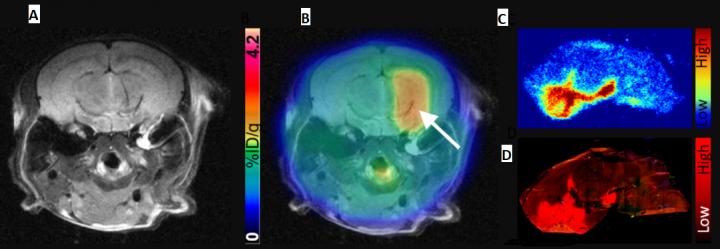
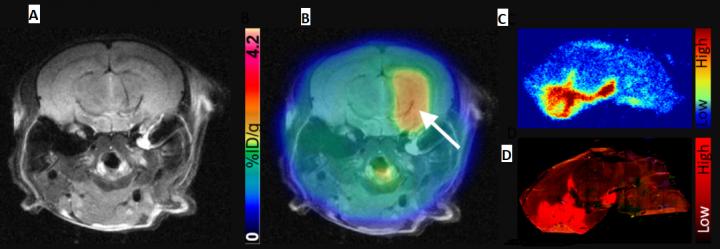
Credit: T Haywood et al., Stanford University School of Medicine, Stanford, Calif.
PHILADELPHIA – A new molecular imaging method can monitor the success of gene therapy in all areas of the brain, potentially allowing physicians to more effectively tackle brain conditions such as Parkinson's disease, Alzheimer's disease and multiple sclerosis. The research was presented today at the SNMMI 2018 Annual Meeting, June 23-26 in Philadelphia.
Gene therapy for diseases of the central nervous system (CNS) is a growing field; however, progress is limited by the absence of imaging techniques that can successfully monitor delivery of the therapy. Although reporter gene systems have been a key tool in molecular imaging for a number of years, they have not allowed monitoring of all areas of the brain. A new positron emission tomography (PET) reporter gene/probe system makes it possible, for the first time, to noninvasively monitor the level and location of gene expression in all areas of the brain, giving the medical team an early indication of the likelihood of treatment success.
"It is challenging to find a reporter gene and imaging agent that can be used in all areas of the brain with a high signal-to-background ratio," said Thomas Haywood, PhD, from the department of radiology at Stanford University, Stanford, California. "18F-DASA-23 is a novel radiotracer, or reporter probe, developed in the Gambhir lab at Stanford that is capable of crossing the blood-brain barrier and targeting the pyruvate kinase M2 protein in the central nervous system with minimal endogenous expression in the brain," he explained. "This allows us to monitor reporter gene expression and ultimately therapeutic gene expression for gene therapy in all regions of the brain." The radiotracer has recently undergone first-in-human trials at Stanford for the early detection of therapeutic response in glioblastoma.
In the study, after validating the utility of pyruvate kinase M2 (PKM2) as a PET reporter gene, mice were infected with a virus containing the gene, then imaged with the 18F-DASA-23 radiotracer over a period of two months to observe the increase in PKM2 expression over time. Results, confirmed by 18F-DASA-23 uptake studies and mRNA analysis, showed a good correlation between PKM2 and the radiotracer (see figure below). Further analysis showed an increase in PKM2 expression in infected mice when compared to controls. These encouraging data suggest PKM2 has the potential to be further developed into a PET reporter gene system for the imaging of gene therapy in the central nervous system.
"Having a reporter gene/reporter probe system that allows monitoring of all areas of the brain opens the door to more accurate and less invasive imaging of the brain and of gene therapies used to tackle diseases of the brain," Haywood said.
###
Scientific Paper 78: Thomas Haywood, Corinne Beinat, Gayatri Gowrishankar, Chirag B. Patel, Department of Radiology, Stanford University; Israt S. Alam, Stanford University; and Sanjiv S. Gambhir, Department of Radiology, Stanford University School of Medicine, Stanford, CA. "A Novel Positron Emission Tomography Reporter Gene/Reporter Probe for the Central Nervous System," SNMMI 2018 Annual Meeting, June 23-26, 2018, Philadelphia.
Please visit the SNMMI Media Center for more information about molecular imaging and personalized medicine. To schedule an interview with the researchers, please contact Laurie Callahan at 703-652-6773 or [email protected]. 2018 SNMMI Annual Meeting abstracts can be found online at http://jnm.snmjournals.org/content/59/supplement_1. Current and past issues of The Journal of Nuclear Medicine are online at http://jnm.snmjournals.org.
Link to Abstract
ABOUT THE SOCIETY OF NUCLEAR MEDICINE AND MOLECULAR IMAGING
The Society of Nuclear Medicine and Molecular Imaging (SNMMI) is an international scientific and medical organization dedicated to advancing nuclear medicine and molecular imaging, a vital element of today's medical practice that adds an additional dimension to diagnosis, changing the way common and devastating diseases are understood and treated and helping provide patients with the best health care possible.
SNMMI's more than 16,000 members set the standard for molecular imaging and nuclear medicine practice by creating guidelines, sharing information through journals and meetings, and leading advocacy on key issues that affect molecular imaging and therapy research and practice. For more information, visit http://www.snmmi.org.
Media Contact
Laurie F Callahan
[email protected]
@SNM_MI
http://www.snm.org
Original Source
http://www.snmmi.org/NewsPublications/NewsDetail.aspx?ItemNumber=29464