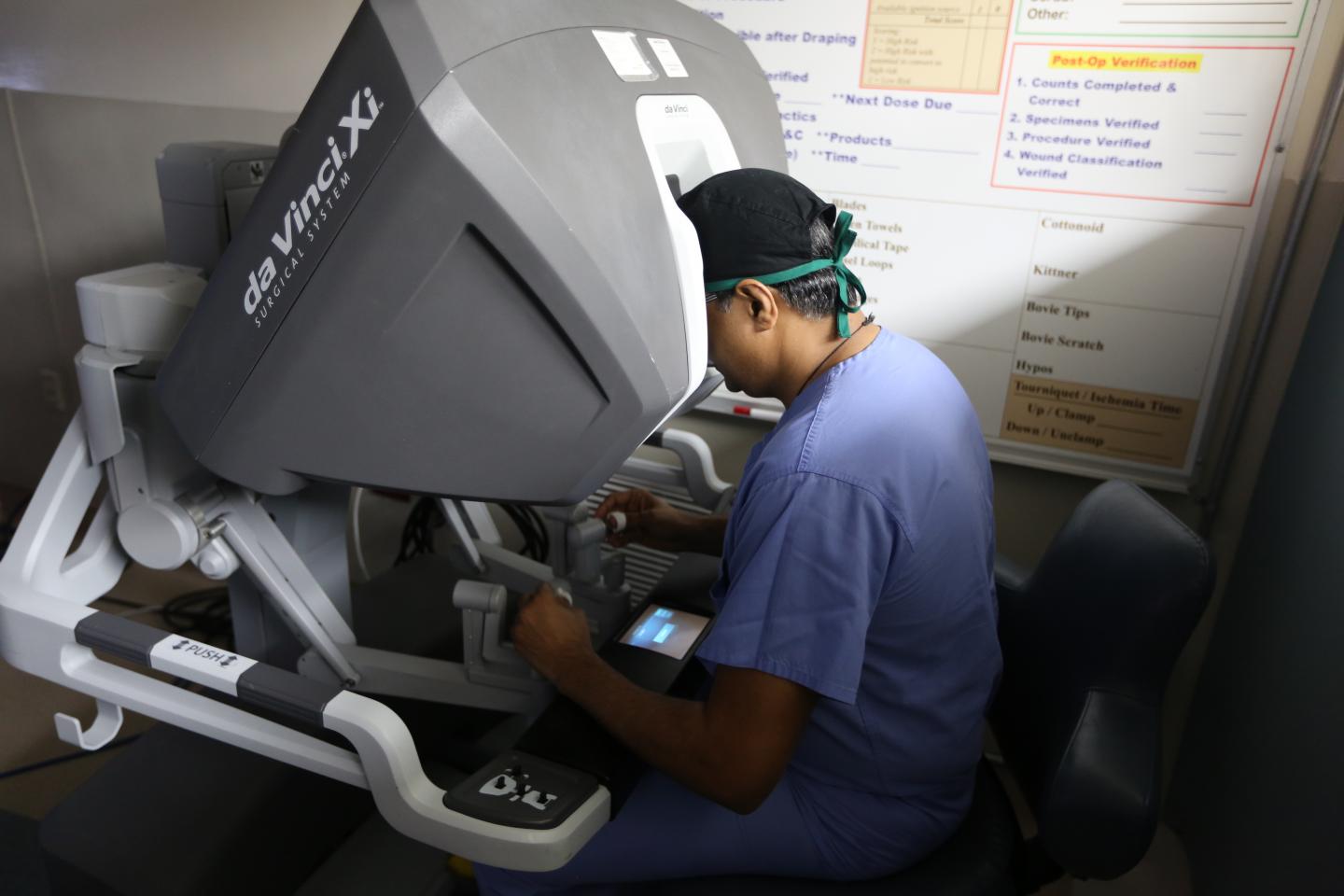
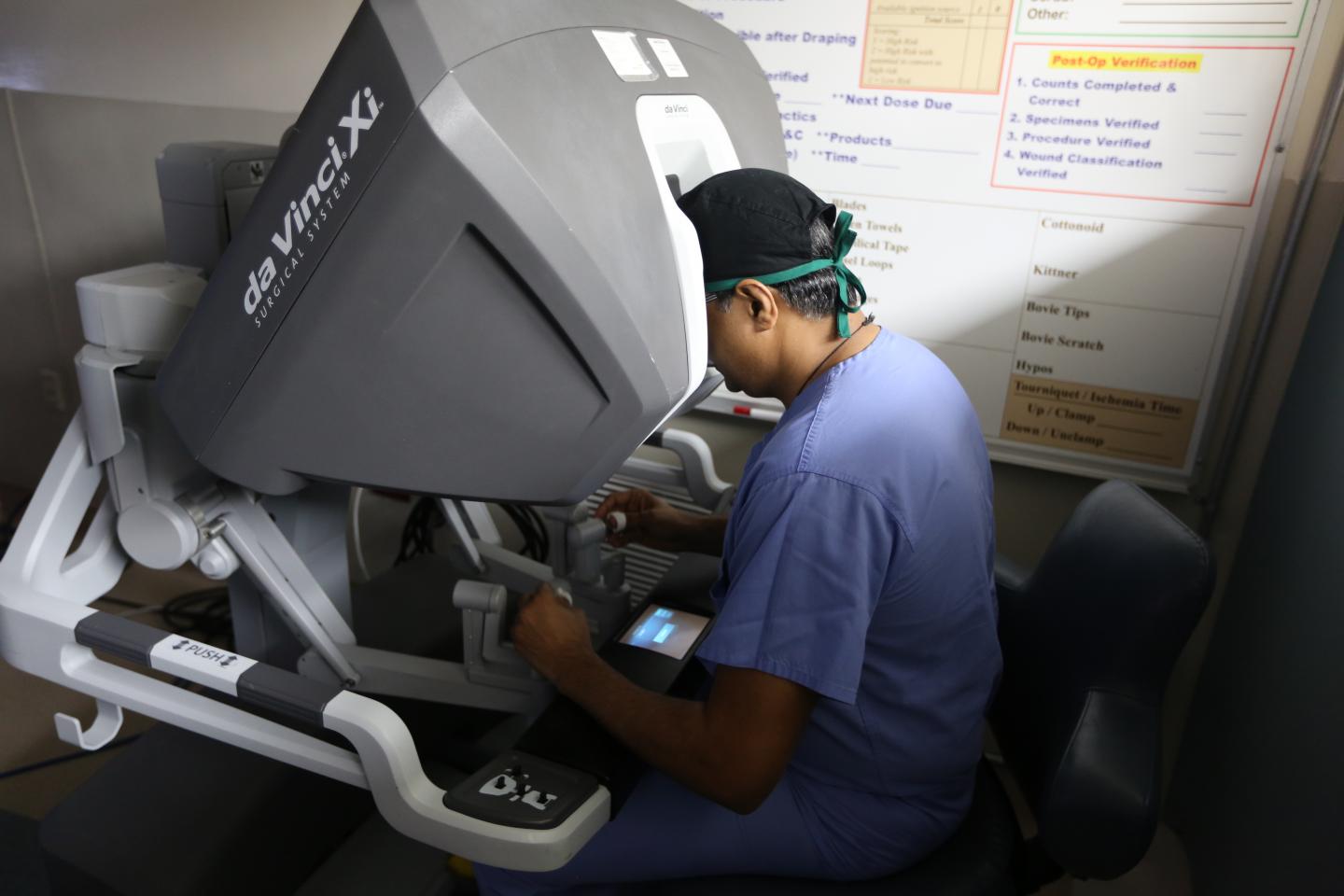
Credit: Courtesy Sylvester Comprehensive Cancer Center.
The first comprehensive study comparing the outcomes of robotic surgery to those of traditional open surgery in any organ has found that the surgeries are equally effective in treating bladder cancer. The seven-year study, conducted at 15 institutions, including Sylvester Comprehensive Cancer Center, and directed by Dipen J. Parekh, M.D., chair of urology and director of robotic surgery at the University of Miami Miller School of Medicine, is published in the June 23 issue of The Lancet.
The Randomized Open Versus Robotic Cystectomy (RAZOR) trial showed lower blood loss and blood transfusion rates and shorter hospital stays for patients who received minimally invasive surgery, but there were no differences in complication rates and the two-year progression-free survival was nearly the same.
"We have done more than 4 million surgeries with the robotic approach since the device came into existence, and on average we do close to a million robotic surgeries a year globally," said Parekh, who is chief clinical officer of the University of Miami Health System. "There are close to 5,000 robotic systems installed all over the world – each one costs about $2 million – and yet until we did this study there was not a single Phase 3 multicenter randomized trial comparing this expensive new technology to the traditional open approach of doing surgeries."
A total of 350 patients were involved in the bladder cancer study. Half received the open surgical approach and half received robotic surgery, and they were followed for two to three years so that outcomes could be compared.
"No one had followed these patients over a period of time to find out if you are impacting their cancer outcomes with this robotic approach," Parekh said. "We were able to prove unequivocally that we are not compromising patient outcomes by using robotic surgery."
The most important lesson from the study, Parekh said, is that more trials should be done, on other organs. "It is possible to do well-designed Phase 3 multicenter surgical trials comparing new technology and surgical innovations to traditional ones before proclaiming superiority or success of one over the other," he said. "There's a steep cost to robotic technology, and there is a learning curve, so we need to build on this in terms of making rational, data-based decisions."
Patients will also have more solid information as a result of this study and future research, Parekh said. "The patients will ask better questions, and the physicians for the first time will be able to answer these questions, based on data rather than based on intuition. This is the highest level of data one can get."
There has been an assumption that patients who receive robotic surgery will perceive a better quality of life than patients who have open surgery. Patients participating in the RAZOR study were asked about their quality of life at three and six months after surgery, and while both groups reported a significant return to their previous quality of life, there was no advantage of one group over the other.
Some critics of robotic surgery have expressed concern about the lack of tactile feedback – an important guide in open surgery. "When you do robotic surgery you don't feel anything," Parekh said. "It's more by visual cues. If you're doing open surgery you have the organs in your hands, you can feel them, and you assess and do these surgeries accordingly."
Parekh has extensive experience performing robotic surgeries with the da Vinci Xi Surgical System at UHealth Tower. It provides a magnified, three-dimensional view of the organs, and a wide range of motion and flexibility. Robotic surgery has become particularly popular with prostate cancer patients – 90 percent of them choose it – which would make it difficult if not impossible to do a randomized study of surgical results in prostate cancer. But Parekh says that because robotic surgery is being used in many other organs, including kidney, colorectal, OB/GYN and lung cancer, more studies are needed.
And while there are improvements in perioperative recovery with robotic technology, operating room time is significantly longer for robotic surgery.
"The findings of this study provide high-level evidence to inform a discussion between patients and their physicians regarding the benefits and risks of various approaches for a complex and often morbid surgery, like radical cystectomy," the trial description says. "It also underscores the need for further high-quality trials to critically evaluate surgical innovation prior to adoption into practice."
###
Media Contact
Diana Gonzalez
[email protected]
305-243-8219
@univmiami
http://www.miami.edu