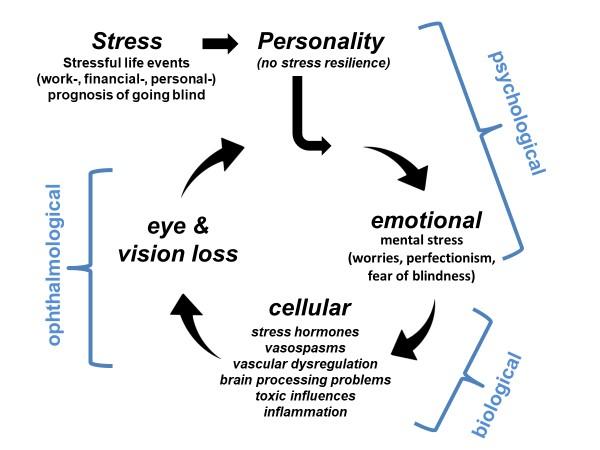
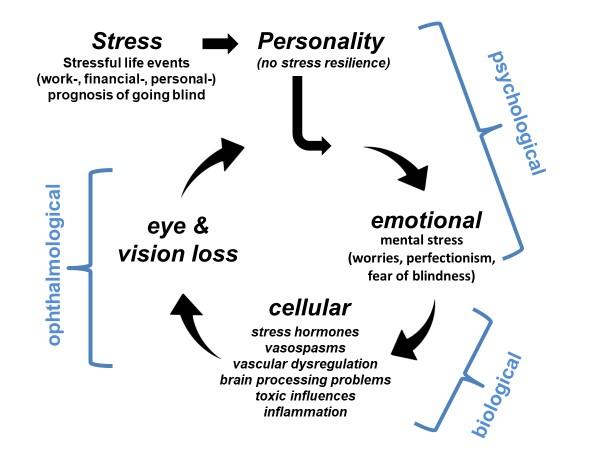
Credit: Bernhard Sabel
Magdeburg, Germany, June 19, 2018 – Persistent psychological stress, which is widely recognized as a consequence of vision loss, is also a major contributor to its development and progression, according to a study now published in the EPMA Journal, the official journal of the European Association for Predictive, Preventive, and Personalized Medicine. Clinical practice implications of this finding include a recommendation to improve the clinician-patient relationship and provide stress-reduction treatments and psychological counseling to interrupt the vicious cycle of stress and progressive vision loss.
"There is clear evidence of a psychosomatic component to vision loss, as stress is an important cause ? not just a consequence ? of progressive vision loss resulting from diseases such as glaucoma, optic neuropathy, diabetic retinopathy, and age-related macular degeneration," says Prof. Bernhard Sabel, PhD, Director of the Institute of Medical Psychology at Magdeburg University, Germany, lead investigator of the study. Prof. Sabel has pioneered a holistic treatment approach that combines stress management, patient education, and vision recovery and restoration techniques at the SAVIR-Center for Vision Restoration in Germany.
The study, which will be presented in November 2018 at the 5th International Conference of "Low Vision and Brain" in Berlin, is based on a comprehensive analysis of hundreds of published research and clinical reports on the relationship of stress and ophthalmologic diseases. Some case reports are presented showing how stress induces vision loss and how reduction of stress contributes to vision restoration.
"Continuous stress and elevated cortisol levels negatively impact the eye and brain due to autonomic nervous system (sympathetic) imbalance and vascular deregulation," Prof. Sabel explains, emphasizing that both the eye and the brain are involved in vision loss, a fact that is often overlooked by treating physicians and is not systematically documented in the medical literature. He notes that of the relatively few scientific reports in the field of psychosomatic ophthalmology available, even fewer explore the relationship of stress, vision loss, and vision restoration. This is rather surprising given that many patients suspect that mental stress had contributed to their vision loss, representing a large disconnect between scientific activity and what the public needs.
"The behavior and words of the treating physician can have far-reaching consequences for the prognosis of vision loss. Many patients are told that the prognosis is poor and that they should be prepared to become blind one day. Even when this is far from certainty and full blindness almost never occurs, the ensuing fear and anxiety are a neurological and psychological double-burden with physiological consequences that often worsen the disease condition," adds Dr. Muneeb Faiq, PhD, All India Institute of Medical Sciences, New Delhi, India, and Department of Ophthalmology, NYU Langone Health, New York University School of Medicine, USA, and a co-investigator on the study. Increased intraocular pressure, endothelial dysfunction (Flammer syndrome), and inflammation are some of the consequences of stress causing further damage.
Adjunct therapies like brain stimulation, relaxation response, vision restoration, anxiety management, and social support counteract stress and induce a relaxation response by rebalancing the autonomic system of reducing sympathetic and activating parasympathetic activity. They have been used successfully in tandem with therapies to increase blood flow to the eye, thereby opening the window of opportunity for vision restoration.
The investigators believe this holistic approach can be used more widely in the clinical management of eye diseases. They advise that stress reduction and relaxation techniques (e.g., meditation, autogenic training, stress management training, and psychotherapy to learn to cope) should be recommended, not only as complementary to traditional treatments of vision loss, but possibly as preventive measures to reduce progression of vision loss. Secondly, doctors should try their best to inculcate positivity and optimism while giving their patients the information to which they are entitled, especially regarding the important value of stress reduction. In this way, the vicious cycle could be interrupted. Stress management is also pertinent to the caregivers/family members whose support and encouragement are important to maintain a stress-free state of mind, which in turn may keep the stress markers at bay.
Prof. Sabel and his colleagues note that, "future clinical studies are underway to confirm the causal role of stress in different low vision diseases to evaluate the efficacy of different anti-stress therapies for preventing progression and improving vision restoration in randomized trials as a foundation of psychosomatic ophthalmology."
###
Media Contact
Bernhard Sabel
[email protected]
49-391-672-1800
http://www.imp.ovgu.de
Related Journal Article
http://dx.doi.org/10.1007/s13167-018-0136-8