• HOME
  • NEWS
  • EXPLORE
    • CAREER
      • Companies
      • Jobs
    • EVENTS
    • iGEM
      • News
      • Team
    • PHOTOS
    • VIDEO
    • WIKI
  • BLOG
  • COMMUNITY
    • FACEBOOK
    • INSTAGRAM
    • TWITTER
Saturday, February 7, 2026
BIOENGINEER.ORG
No Result
View All Result
  • Login
  • HOME
  • NEWS
  • EXPLORE
    • CAREER
      • Companies
      • Jobs
        • Lecturer
        • PhD Studentship
        • Postdoc
        • Research Assistant
    • EVENTS
    • iGEM
      • News
      • Team
    • PHOTOS
    • VIDEO
    • WIKI
  • BLOG
  • COMMUNITY
    • FACEBOOK
    • INSTAGRAM
    • TWITTER
  • HOME
  • NEWS
  • EXPLORE
    • CAREER
      • Companies
      • Jobs
        • Lecturer
        • PhD Studentship
        • Postdoc
        • Research Assistant
    • EVENTS
    • iGEM
      • News
      • Team
    • PHOTOS
    • VIDEO
    • WIKI
  • BLOG
  • COMMUNITY
    • FACEBOOK
    • INSTAGRAM
    • TWITTER
No Result
View All Result
Bioengineer.org
No Result
View All Result
Home NEWS Science News Biology

In the gaping mouth of ancient crocodiles

Bioengineer by Bioengineer
June 18, 2018
in Biology
Reading Time: 2 mins read
0
Share on FacebookShare on TwitterShare on LinkedinShare on RedditShare on Telegram
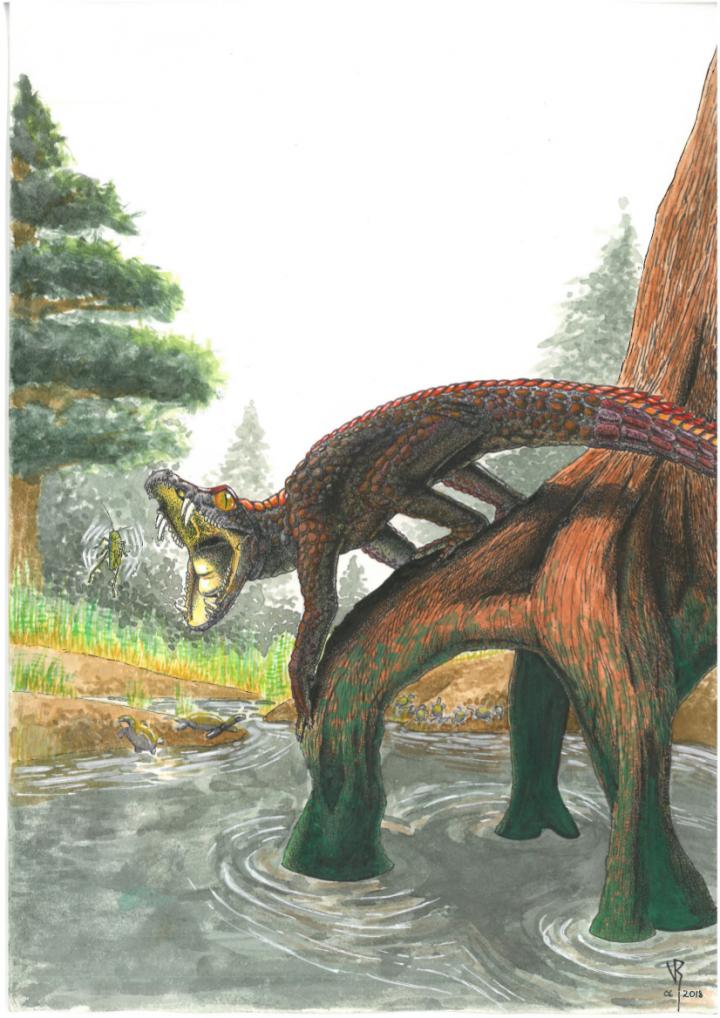
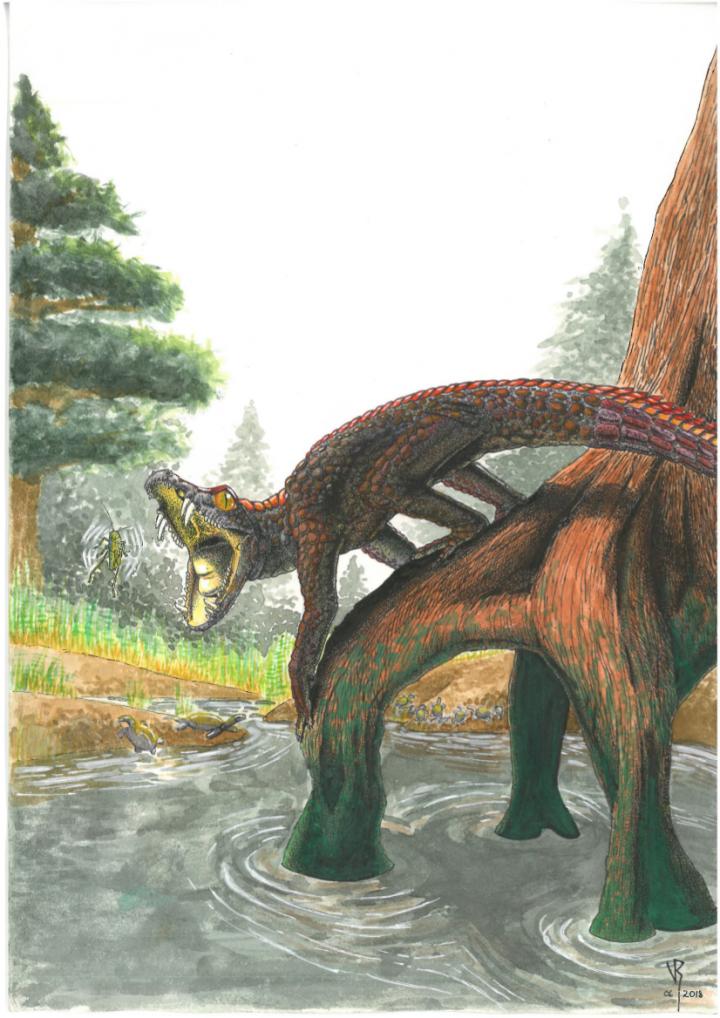
IMAGE

Credit: Artist: Viktor Rademacher

The mouth of today's crocodilians inspires fear and awe, with their wide gape and the greatest known bite force in the vertebrate animal kingdom. However, this apex predator of today and its modus of attack (its mouth) had humble beginnings.

The very earliest crocodilians were very different to the beasts we know well today, they were much smaller bodied, slender and had longer legs. It is speculated that they led a much different lifestyle to the crocodiles we all know and fear today.

A new study by a team of international experts, led by University of Witwatersrand PhD candidate Kathleen Dollman and Professor Jonah Choiniere published today in the American Museum Novitates, endeavoured to further explore the mouth of one of the earliest occurring and least understand groups of crocodilians, the shartegosuchids.

In 2010, Choiniere was a part of a field team working in the Late Jurassic (±160 mya) exposures in the western Gobi in Mongolia, when he found the fossil of a small snout of a shartegosuchid. This work was co-authored by researchers based at the American Museum of Natural History, the George Washington University and the Institute for Vertebrate Palaeontology and Palaeoanthropology.

The snout was later CT scanned at the American Museum of Natural History, exposing an unusual, closed secondary palate. Crocodilians are one of only a few groups of animals that evolve a completely closed, bony secondary palate (along with turtles and mammals). A closed secondary palate has many biological implications for crocodilians, including breathing whilst under water and reinforcing the skull to allow for their incredible bite force.

This study showed that these early crocodilians, the shartegosuchids, are important because they evolved a completely closed secondary palate much earlier than previously thought. This is an interesting example of convergent evolution, whereby a similar feature evolves independently in two completely unrelated groups. The advent of a convergent evolutionary event allows scientists to test questions about why that feature evolved and even the function of that feature which in this case is the first step in understanding the purpose of a closed secondary palate in crocodilians.

"I was surprised to find that there were many features in the palate and snout that were completely different between shartegosuchids and extant crocodilians," says Dollman. Shartegosuchids have a thickened and sculptured palate together with a tall and short rostrum, whereas extant crocodilians have a smooth palate with a long and broad rostrum.

"We would expect to see the same palatal structures and snout shapes in both shartegosuchids and extant crocodiles if they were using it for similar functions and had evolved a closed palate for similar reasons," says Dollman. "The observed differences tell us that shartegosuchids likely had predation practices to which there is no modern analogue in crocodilians".

"It's been nearly 10 years since we collected this fossil after driving 5 days across the Gobi Desert," said Choiniere, "and I am delighted that it's formed a part of Kathleen's PhD."

###

Media Contact

Kimberleigh Tommy
[email protected]
27-011-717-6048
@Wits_News

http://www.wits.ac.za

Share13Tweet7Share2ShareShareShare1

Related Posts

Florida Cane Toad: Complex Spread and Selective Evolution

Florida Cane Toad: Complex Spread and Selective Evolution

February 7, 2026
New Study Uncovers Mechanism Behind Burn Pit Particulate Matter–Induced Lung Inflammation

New Study Uncovers Mechanism Behind Burn Pit Particulate Matter–Induced Lung Inflammation

February 6, 2026

DeepBlastoid: Advancing Automated and Efficient Evaluation of Human Blastoids with Deep Learning

February 6, 2026

Navigating the Gut: The Role of Formic Acid in the Microbiome

February 6, 2026
Please login to join discussion

POPULAR NEWS

  • Robotic Ureteral Reconstruction: A Novel Approach

    Robotic Ureteral Reconstruction: A Novel Approach

    82 shares
    Share 33 Tweet 21
  • Digital Privacy: Health Data Control in Incarceration

    63 shares
    Share 25 Tweet 16
  • Study Reveals Lipid Accumulation in ME/CFS Cells

    57 shares
    Share 23 Tweet 14
  • Breakthrough in RNA Research Accelerates Medical Innovations Timeline

    53 shares
    Share 21 Tweet 13

About

We bring you the latest biotechnology news from best research centers and universities around the world. Check our website.

Follow us

Recent News

Evaluating Pediatric Emergency Care Quality in Ethiopia

TPMT Expression Predictions Linked to Azathioprine Side Effects

Improving Dementia Care with Enhanced Activity Kits

Subscribe to Blog via Email

Success! An email was just sent to confirm your subscription. Please find the email now and click 'Confirm' to start subscribing.

Join 73 other subscribers
  • Contact Us

Bioengineer.org © Copyright 2023 All Rights Reserved.

Welcome Back!

Login to your account below

Forgotten Password?

Retrieve your password

Please enter your username or email address to reset your password.

Log In
No Result
View All Result
  • Homepages
    • Home Page 1
    • Home Page 2
  • News
  • National
  • Business
  • Health
  • Lifestyle
  • Science

Bioengineer.org © Copyright 2023 All Rights Reserved.