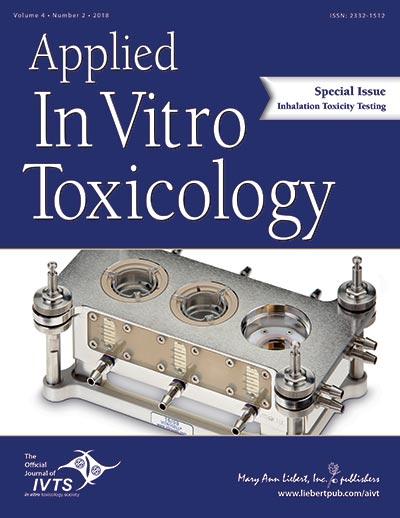
Credit: Mary Ann Liebert, Inc., publishers
New Rochelle, NY, June 13, 2018–Integrated approaches that avoid the use of animals to assess the toxicity of inhaled materials may include a computational model to screen for chemical reactivity, a human tissue-based assay to predict the absorption of a chemical into the respiratory tract, and other types of advanced systems based on in vitro and in vivo respiratory biology. A comprehensive review of the progress and ongoing efforts in this fascinating field is the focus of a new special issue on Inhalation Toxicity Testing published in Applied In Vitro Toxicology, a peer-reviewed journal from Mary Ann Liebert, Inc., publishers. The issue is available free on the Applied In Vitro Toxicology website.
The special issue on Inhalation Toxicity Testing is led by Guest Editor Amy Clippinger, PhD, Director of the PETA International Science Consortium Ltd.
"The articles in this special issue describe research to develop and apply human-relevant in silico and in vitro approaches that incorporate cutting-edge science and don't use animals," says Dr. Clippinger.
In the article "Profiling Acute Oral and Inhalation Toxicity Data Using a Computational Workflow to Screen for Facile Chemical Reactivity," Dan Wilson, PhD, and coauthors from The Dow Chemical Company (Midland, MI) describe the computational approaches they are developing to screen for inhalation toxicity based on classes of chemically reactive compounds.
Wiebke Hoffmann, The European Union Reference Laboratory for Alternatives to Animal Testing (Ispra, Italy) and colleagues from University of Vienna (Austria), University of Lausanne (Geneva, Switzerland), Douglas Connect (Basel, Switzerland), and Epithelix Sarl (Geneva) describe their ability to study pulmonary absorption in vitro in the article entitled "Establishment of a Human 3D Tissue-Based Assay for Upper Respiratory Tract Absorption ."
In "Prevalidation of an Acute Inhalation Toxicity Test Using the EpiAirway In Vitro Human Airway Model," George Jackson et al., MatTek Corp. (Ashland, MA) present the results of prevalidation studies using EpiAirway tissues, which are exposed to test chemicals for 3 hours before being assessed for tissue viability.
Also included in the special issue is the Roundtable Discussion "Nonanimal Approaches to Assessing the Toxicity of Inhaled Substances: Current Progress and Future Promise." Dr. Clippinger leads the expert participants from industry, academia, government agencies, and non-profit organizations in a lively discussion on topics including the breadth of nonanimal approaches, their advantages and limitations versus animal inhalation tests, and how to move forward.
"I am pleased with this special issue of Applied In Vitro Toxicology as it focuses on an area of great importance for risk assessment, which has been a challenge to address using in vitro methods. This issue does a wonderful job demonstrating how in vitro methods can be successfully used to understand inhalation toxicology," says Jim McKim, PhD, Editor-in-Chief of Applied In Vitro Toxicology and Founder and CEO, IonTox, LLC.
###
About the Journal
Applied In Vitro Toxicology provides the latest peer-reviewed research on the application of alternative in vitro testing methods for predicting adverse effects in the pharmaceutical, chemical, and personal care industries. Led by Editor-in-Chief James M. McKim, PhD, DABT, Founder and CEO, IonTox, LLC, the Journal addresses important issues facing these diverse industries, including regulatory requirements; the reduction, refinement, and replacement of animal testing; new screening methods; evaluation of new cell and tissue models; and the most appropriate methods for assessing safety and satisfying regulatory demands. The Journal is published quarterly online with Open Access options and in print. Complete tables of content and a sample issue may be viewed on the Applied In Vitro Toxicology website.
About the Publisher
Mary Ann Liebert, Inc., publishers is a privately held, fully integrated media company known for establishing authoritative peer-reviewed journals in promising areas of science and biomedical research, including Assay and Drug Development Technologies, Human Gene Therapy, and OMICS: A Journal of Integrative Biology. Its biotechnology trade magazine, GEN (Genetic Engineering & Biotechnology News), was the first in its field and is today the industry's most widely read publication worldwide. A complete list of the firm's 80 journals, books, and newsmagazines is available on the Mary Ann Liebert, Inc., publishers website.
Media Contact
Kathryn Ryan
[email protected]
914-740-2250
@LiebertPub
http://www.liebertpub.com
Original Source
https://home.liebertpub.com/news/novel-computational-and-human-cell-based-in-vitro-approaches-for-toxicity-testing-of-inhaled-substances/2393 http://dx.doi.org/10.1089/aivt.2017.0041