

• HOME
  • NEWS
  • EXPLORE
    • CAREER
      • Companies
      • Jobs
    • EVENTS
    • iGEM
      • News
      • Team
    • PHOTOS
    • VIDEO
    • WIKI
  • BLOG
  • COMMUNITY
    • FACEBOOK
    • INSTAGRAM
    • TWITTER
Saturday, February 7, 2026
BIOENGINEER.ORG
No Result
View All Result
  • Login
  • HOME
  • NEWS
  • EXPLORE
    • CAREER
      • Companies
      • Jobs
        • Lecturer
        • PhD Studentship
        • Postdoc
        • Research Assistant
    • EVENTS
    • iGEM
      • News
      • Team
    • PHOTOS
    • VIDEO
    • WIKI
  • BLOG
  • COMMUNITY
    • FACEBOOK
    • INSTAGRAM
    • TWITTER
  • HOME
  • NEWS
  • EXPLORE
    • CAREER
      • Companies
      • Jobs
        • Lecturer
        • PhD Studentship
        • Postdoc
        • Research Assistant
    • EVENTS
    • iGEM
      • News
      • Team
    • PHOTOS
    • VIDEO
    • WIKI
  • BLOG
  • COMMUNITY
    • FACEBOOK
    • INSTAGRAM
    • TWITTER
No Result
View All Result
Bioengineer.org
No Result
View All Result
Home NEWS Science News Health

Observing the cell’s protein factories during self-assembly

Bioengineer by Bioengineer
June 13, 2018
in Health
Reading Time: 2 mins read
0
Share on FacebookShare on TwitterShare on LinkedinShare on RedditShare on Telegram
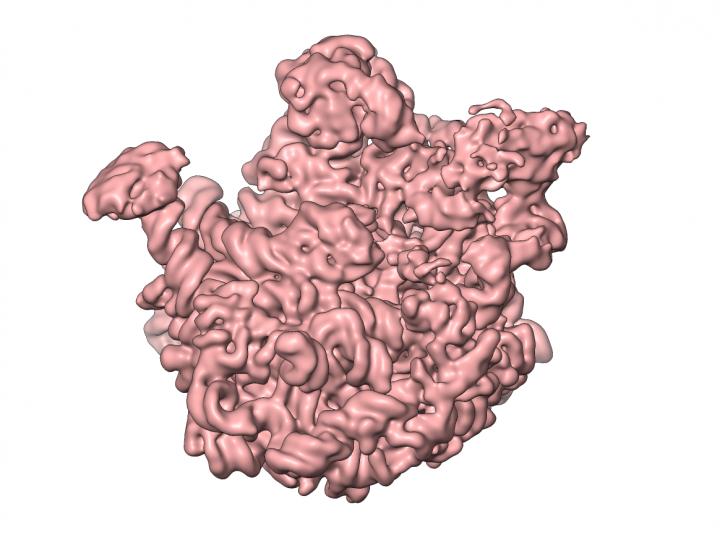
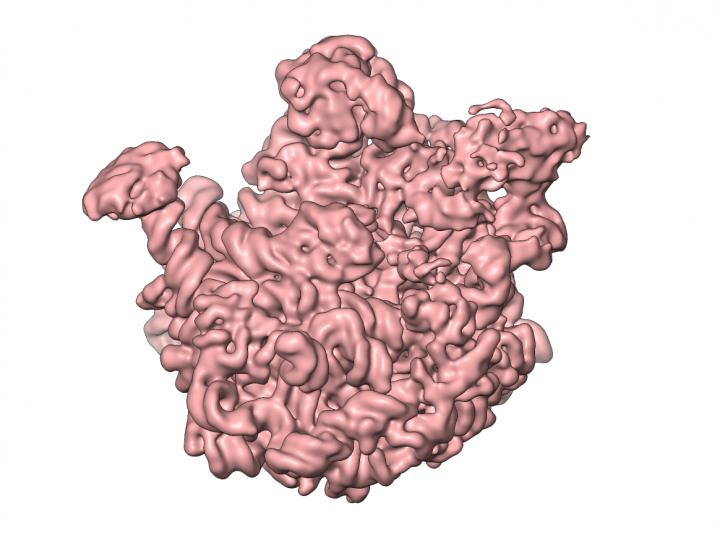
IMAGE

Credit: Charité/Nikolay

Berlin-based researchers have produced snapshots of the 'protein factories' of the cell. Their findings could set us on the path towards a new class of antibiotics. The study – a basic science study conducted by researchers from Charité – Universitätsmedizin Berlin and the Max Planck Institute for Molecular Genetics – has been published in Molecular Cell*.

Ribosomes are the 'protein factories' of the cell and are composed of two units: a larger 50S subunit, and a smaller 30S subunit. The larger 50S subunit in turn comprises 33 different proteins and 2 ribonucleic acid molecules. The aim of the study was to obtain detailed information about the way in which these numerous different molecules form 50S subunits in bacteria. In a process known as 'in vitro reconstitution', the individual components were first purified and then mixed together in the laboratory. The researchers then observed how the 50S subunit assembled from this mixture. Using 3D cryo-electron microscopy, a technology whose developers received the 2017 Nobel Prize in Chemistry, they were able to produce high-resolution snapshots of individual stages of the 50S subunit's assembly and maturation. This allowed them to identify, on a molecular level, the individual steps involved in its development.

Explaining the significance of this study, Dr. Rainer Nikolay, of Charité's Institute of Medical Physics and Biophysics, comments: "These results do not simply provide us with important insights into one of the essential processes taking part inside the cell. They also provide us with information on potential targets for new antibacterial drugs." These could potentially inhibit ribosome assembly, thereby paralyzing the bacterium's ability to synthesize proteins; these drugs could therefore be used to inhibit all bacterial growth.

Dr. Nikolay plans to conduct additional research to test whether the process of 50S subunit assembly inside the living cell is the same as that observed outside the cell. He explains: "Much of the information available in the literature suggests that 50S assembly in vivo follows a very similar course to that observed in vitro. To test this assumption, we are currently developing methods capable of analyzing the structure of 50S ribosomal subunit precursors, which we will obtain directly from cells."

###

*Nikolay R, Hilal T, Qin B, Mielke T, Bürger J, Loerke J, Textoris-Taube K, Nierhaus KH, Spahn CMT. Structural visualization of the formation and activation of the 50S ribosomal subunit during in vitro reconstitution. Molecular Cell 2018. DOI: 10.1016/j.molcel.2018.05.003.

Media Contact

Dr. Rainer Nikolay
[email protected]
49-304-505-24165

http://www.charite.de

Original Source

https://www.charite.de/en/service/press_reports/artikel/detail/proteinfabriken_der_zelle_bei_der_selbstorganisation_beobachten/ http://dx.doi.org/10.1016/j.molcel.2018.05


Share13Tweet8Share2ShareShareShare2

Related Posts

Evaluating Pediatric Emergency Care Quality in Ethiopia

February 7, 2026

TPMT Expression Predictions Linked to Azathioprine Side Effects

February 7, 2026

Improving Dementia Care with Enhanced Activity Kits

February 7, 2026

Decoding Prostate Cancer Origins via snFLARE-seq, mxFRIZNGRND

February 7, 2026
Please login to join discussion

POPULAR NEWS

  • Robotic Ureteral Reconstruction: A Novel Approach

    Robotic Ureteral Reconstruction: A Novel Approach

    82 shares
    Share 33 Tweet 21
  • Digital Privacy: Health Data Control in Incarceration

    63 shares
    Share 25 Tweet 16
  • Study Reveals Lipid Accumulation in ME/CFS Cells

    57 shares
    Share 23 Tweet 14
  • Breakthrough in RNA Research Accelerates Medical Innovations Timeline

    53 shares
    Share 21 Tweet 13

About

We bring you the latest biotechnology news from best research centers and universities around the world. Check our website.

Follow us

Recent News

Evaluating Pediatric Emergency Care Quality in Ethiopia

TPMT Expression Predictions Linked to Azathioprine Side Effects

Improving Dementia Care with Enhanced Activity Kits

Subscribe to Blog via Email

Enter your email address to subscribe to this blog and receive notifications of new posts by email.

Join 73 other subscribers
  • Contact Us

Bioengineer.org © Copyright 2023 All Rights Reserved.

Welcome Back!

Login to your account below

Forgotten Password?

Retrieve your password

Please enter your username or email address to reset your password.

Log In
No Result
View All Result
  • Homepages
    • Home Page 1
    • Home Page 2
  • News
  • National
  • Business
  • Health
  • Lifestyle
  • Science

Bioengineer.org © Copyright 2023 All Rights Reserved.
