

• HOME
  • NEWS
  • EXPLORE
    • CAREER
      • Companies
      • Jobs
    • EVENTS
    • iGEM
      • News
      • Team
    • PHOTOS
    • VIDEO
    • WIKI
  • BLOG
  • COMMUNITY
    • FACEBOOK
    • INSTAGRAM
    • TWITTER
Friday, April 3, 2026
BIOENGINEER.ORG
No Result
View All Result
  • Login
  • HOME
  • NEWS
  • EXPLORE
    • CAREER
      • Companies
      • Jobs
        • Lecturer
        • PhD Studentship
        • Postdoc
        • Research Assistant
    • EVENTS
    • iGEM
      • News
      • Team
    • PHOTOS
    • VIDEO
    • WIKI
  • BLOG
  • COMMUNITY
    • FACEBOOK
    • INSTAGRAM
    • TWITTER
  • HOME
  • NEWS
  • EXPLORE
    • CAREER
      • Companies
      • Jobs
        • Lecturer
        • PhD Studentship
        • Postdoc
        • Research Assistant
    • EVENTS
    • iGEM
      • News
      • Team
    • PHOTOS
    • VIDEO
    • WIKI
  • BLOG
  • COMMUNITY
    • FACEBOOK
    • INSTAGRAM
    • TWITTER
No Result
View All Result
Bioengineer.org
No Result
View All Result
Home NEWS Science News Health

Stem-cell niche for 10 billion colon cells a day

Bioengineer by Bioengineer
June 6, 2018
in Health
Reading Time: 2 mins read
0
Share on FacebookShare on TwitterShare on LinkedinShare on RedditShare on Telegram
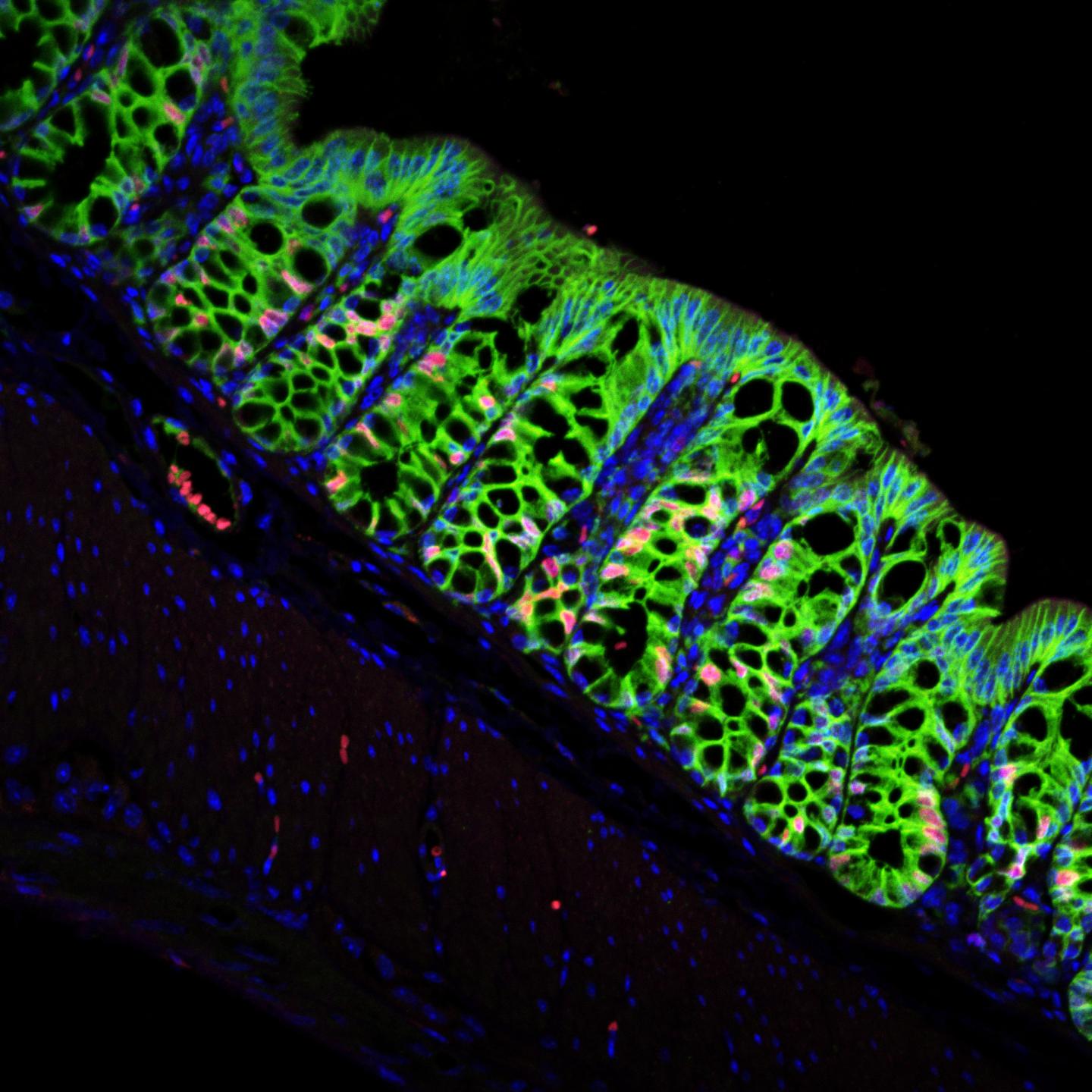
IMAGE

Credit: Bahar Degirmenci, UZH

The human intestine constantly renews itself. Alone in the colon – the last 1.5 meters of the gastrointestinal tract – 10 billion epithelial cells are replaced each day. The intestinal epithelium is the layer of cells that forms the lining of both the small and large intestine and is responsible for absorbing nutrients. The regeneration process is driven by stem cells that are found in small folds of the epithelium (crypts), where they are in contact with other cells that produce the signals needed to drive regeneration. The key activating signal that sustains the stem cells is called "Wnt".

Colon stem cells perish without signaling

A group of UZH researchers, including Konrad Basler from the Institute of Molecular Life Sciences, have now discovered the cells responsible for providing the activating signal to the stem cells. These so-called Gli1-positive cells surround the crypts in the epithelium and thereby form the stem-cell niche. The scientists performed studies in mice to demonstrate that these cells play an essential role in forming and repairing the intestinal epithelium. "If the Gli1-positive cells are eliminated or unable to secrete Wnt proteins, the activation signal is lost. Consequently the colon's stem cells as well as the epithelium will perish, and the organism dies," says Basler.

Long-term constant activation leads to colon cancer

Just how critical a well-balanced regulation of the intestinal epithelium is also becomes evident when stem cells are driven to constantly divide. If Wnt signaling is stimulated excessively, the stem cells divide in an uncontrolled manner. "Mice with mutations in the Wnt signaling pathways develop polyps, from which colon cancer later develops," adds the molecular biologist. This is also the case for humans.

Niche cells are also responsible for tissue repair

In further tests, the researchers examined the behavior of the cells in the stem-cell niche in response to inflammation of the colon. In this situation, many more epithelial cells are lost than in healthy animals. The need for new cells is therefore greater, since the tissue not only has to be maintained but also repaired. The researchers observed that the amount of Gli1-positive cells increased significantly in response to an inflamed colon. "The cells we've discovered are thus not only essential for healthy organisms, but are also essential when it comes to repairing a damaged intestinal epithelium," says Basler. The discovery and description of the colon's stem-cell niche therefore has relevance for a whole string of intestinal diseases, from inflammation to cancer.

###

Media Contact

Konrad Basler
[email protected]
41-446-353-110
@uzh_news

http://www.uzh.ch

Original Source

http://www.media.uzh.ch/en/Press-Releases/2018/colon-stem-cell-niche.html http://dx.doi.org/10.1038/s41586-018-0190-3

Share12Tweet8Share2ShareShareShare2

Related Posts

Four New Hydroxyl Fatty Acids Discovered in Shrimp

April 3, 2026

Linking Older Adults’ Frailty Perceptions to E-Frailty

April 3, 2026

Irisin Tackles Obesity Through IL-33 and T Cells

April 3, 2026

Health Promotion Boosts Leisure in 80+ Elderly

April 3, 2026
Please login to join discussion

POPULAR NEWS

  • blank

    Revolutionary AI Model Enhances Precision in Detecting Food Contamination

    96 shares
    Share 38 Tweet 24
  • Imagine a Social Media Feed That Challenges Your Views Instead of Reinforcing Them

    1007 shares
    Share 398 Tweet 249
  • Promising Outcomes from First Clinical Trials of Gene Regulation in Epilepsy

    51 shares
    Share 20 Tweet 13
  • Popular Anti-Aging Compound Linked to Damage in Corpus Callosum, Study Finds

    44 shares
    Share 18 Tweet 11

About

We bring you the latest biotechnology news from best research centers and universities around the world. Check our website.

Follow us

Recent News

Four New Hydroxyl Fatty Acids Discovered in Shrimp

Seed Dormancy Influences Gene Drive in Plants

Quasi-BIC Metasurfaces Boost Rapid Localized Singlet-Oxygen

Subscribe to Blog via Email

Enter your email address to subscribe to this blog and receive notifications of new posts by email.

Join 78 other subscribers
  • Contact Us

Bioengineer.org © Copyright 2023 All Rights Reserved.

Welcome Back!

Login to your account below

Forgotten Password?

Retrieve your password

Please enter your username or email address to reset your password.

Log In
No Result
View All Result
  • Homepages
    • Home Page 1
    • Home Page 2
  • News
  • National
  • Business
  • Health
  • Lifestyle
  • Science

Bioengineer.org © Copyright 2023 All Rights Reserved.
