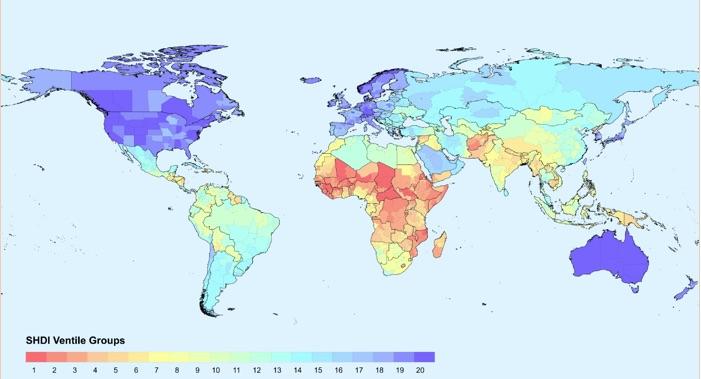
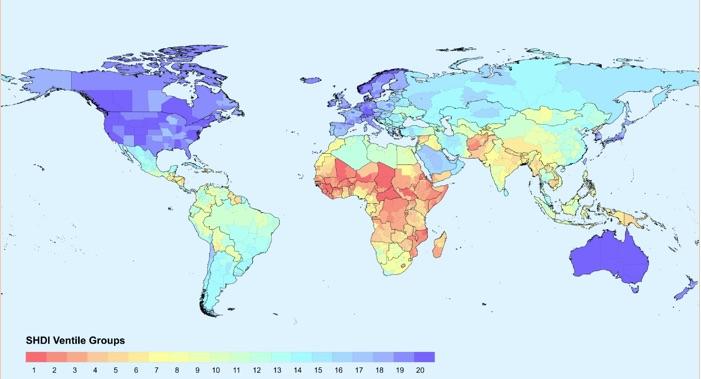
Credit: Smits-Permanyer 2018
The Human Development Index, published each year by the United Nations Development Program (UNDP), is the world's most famous indicator of the level of development of societies. It shows for almost all countries in the world how they fare with regard to three key aspects of development: education, health and standard of living.
A disadvantage of this index is however that only national values are available, whereas — particularly within poor countries — there is huge subnational variation in poverty rates and in the availability of health and educational facilities. The farther one moves from capital and big cities, the weaker the educational and health facilities and the less the economic opportunities.
Advantage of the SHDI
A key step towards addressing this problem has been recently introduced. In May 31st, a Sub-national Human Development Index (SHDI) has been launched in a joint collaborative effort between the Center for Demographic Studies in Universitat Autònoma de Barcelona and the Global Data Lab of Radboud University. This index shows for over 1600 regions within 160 countries how they have fared regarding human development between 1995 and 2015, the last year for which the UNDP has published the index.
The SHDI is based on data from statistical offices and the Database Developing World of the Global Data Lab, which is one of the largest databases for developing countries that currently exists. At the national level, the index is exactly the same as the national Human Development Index of the UNDP. Hence on the one hand it fits very well in the current development paradigm, while at the same time makes a big step towards refinement of this paradigm.
"The index we developed can be seen as a telescope for identifying problems with regard to human development that magnifies ten times as much as the earlier available instruments", according to the authors of the study. "We now can observe the areas within poor countries where poverty is highest and health and education facilities are weakest, so that policy efforts and resources can be more effectively directed to the places where they are mostly needed."
Sustainable Development Goals
In 2014, the global development community announced the Sustainable Development Goals (SDGs) for the period 2015-2030. These goals call for action by all countries of the world to promote prosperity and solve global problems regarding poverty, education, health and other key issues, while at the same time protecting the environment.
Monitoring progress regarding these goals is considered key to their successful achievement, but the required subnational indicators for effectively monitoring them are scarce. The SHDI is an answer to the call for such indicators and provides development organizations, policy makers and researchers with a free new instrument to study progress with regard to Goal 1 (eradicate poverty), Goal 3 (good health), 4 (quality education), 8 (economic growth) and 10 (reduce inequality within and among countries). Since the new indicator squares very well with the goals of the current global development agenda, the UNDP is greatly interested in the outcomes of the SHDI project.
More inequality in poorer countries
First analyses using the new index show that in countries at the middle and lower levels of development, the distribution of human development is particularly unequal. Inequality between regions is much lower within wealthy countries, where governments have more resources for establishing good quality health and educational facilities in more remote and poorer regions.
###
Media Contact
Sonia Perello
[email protected]
0034-935-814-053
@UAB_info
http://www.uab.es
Original Source
http://hdi.globaldatalab.org