Credit: The Dartmouth Institute via Health Affairs
Due to a change in federal regulation, from 2013-2017, the Centers for Medicare and Medicaid Services (CMS) redacted any health care encounter that included a diagnosis or procedure code related to substance abuse from the Medicare and Medicaid identifiable files. The result was difficult-to-identify gaps in claims data commonly used by researchers, policy analysts, clinicians, health care administrators, and others. To better understand the impact of the missing substance abuse data claims, a team of researchers from The Dartmouth Institute and the University of Michigan calculated the effect of redaction on prevalence estimates of common chronic conditions, such as hepatitis C and depression, as well as on inpatient use and spending.
"Even though access to this data was restored in 2017, it can be quite time consuming and costly to go back and fill in the gaps," says lead author and Dartmouth Institute research scientist Andrea Austin, PhD. "And, the reality is that redaction can and likely has affected a wide range of studies, beyond studies of addiction and opioid use disorder."
Using Medicare claims from 2012, the year before the redaction was implemented, the research team, created a new version of the 2012 cohort by removing any claim that included a substance abuse-related diagnosis or procedure code that was redacted in 2013. Then, to characterize how redaction might affect studies that utilized this data, they calculated the population rates of admission per 100 beneficiaries for selected diagnoses likely to be related to substance abuse, such as serious mental illness, depression, and hepatitis C. For comparison, they also calculated admission rates for diagnoses, such as diabetes, that are less likely be associated with substance-abuse (and thus less likely to be affected by redaction).
Among their findings recently reported in Health Affairs:
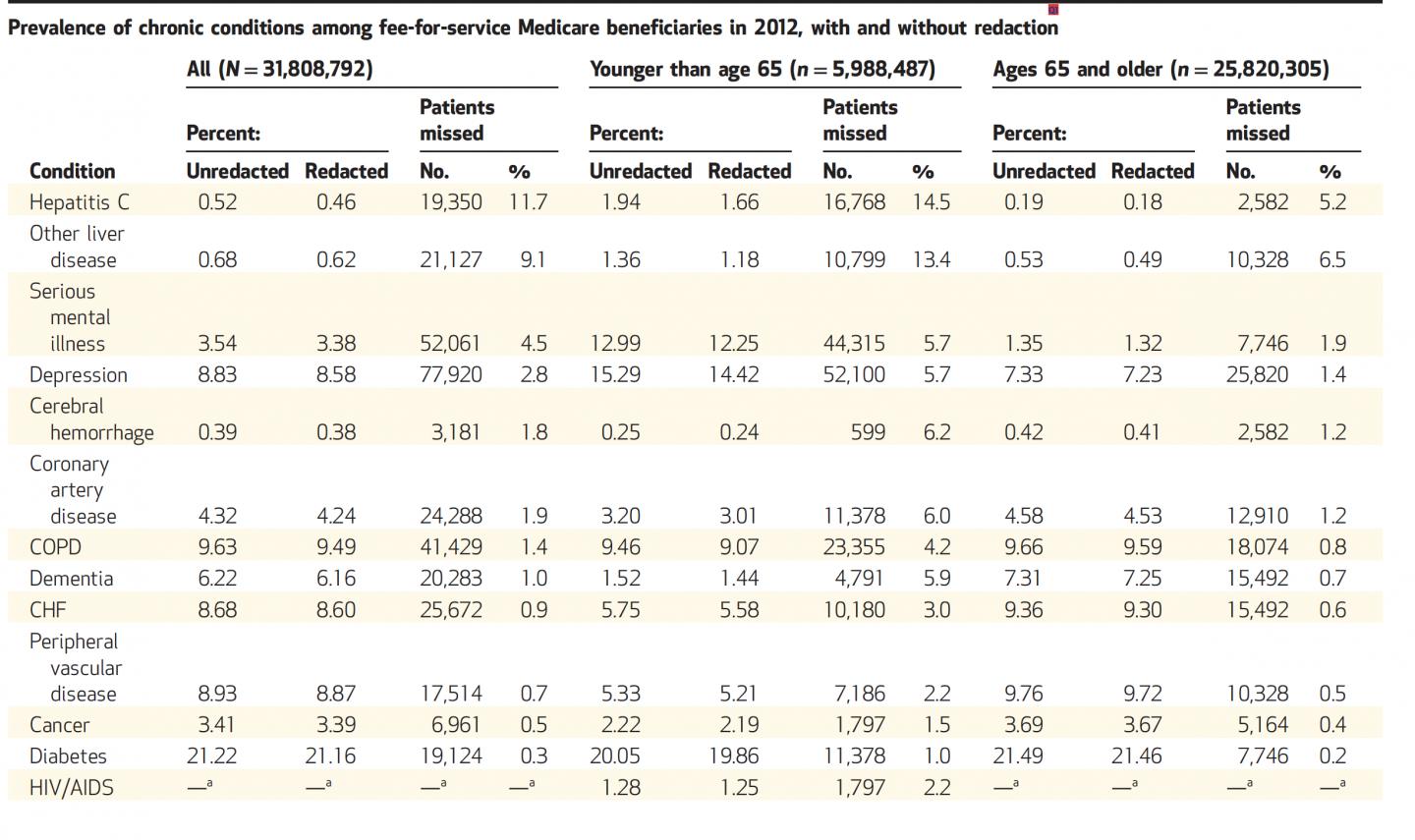
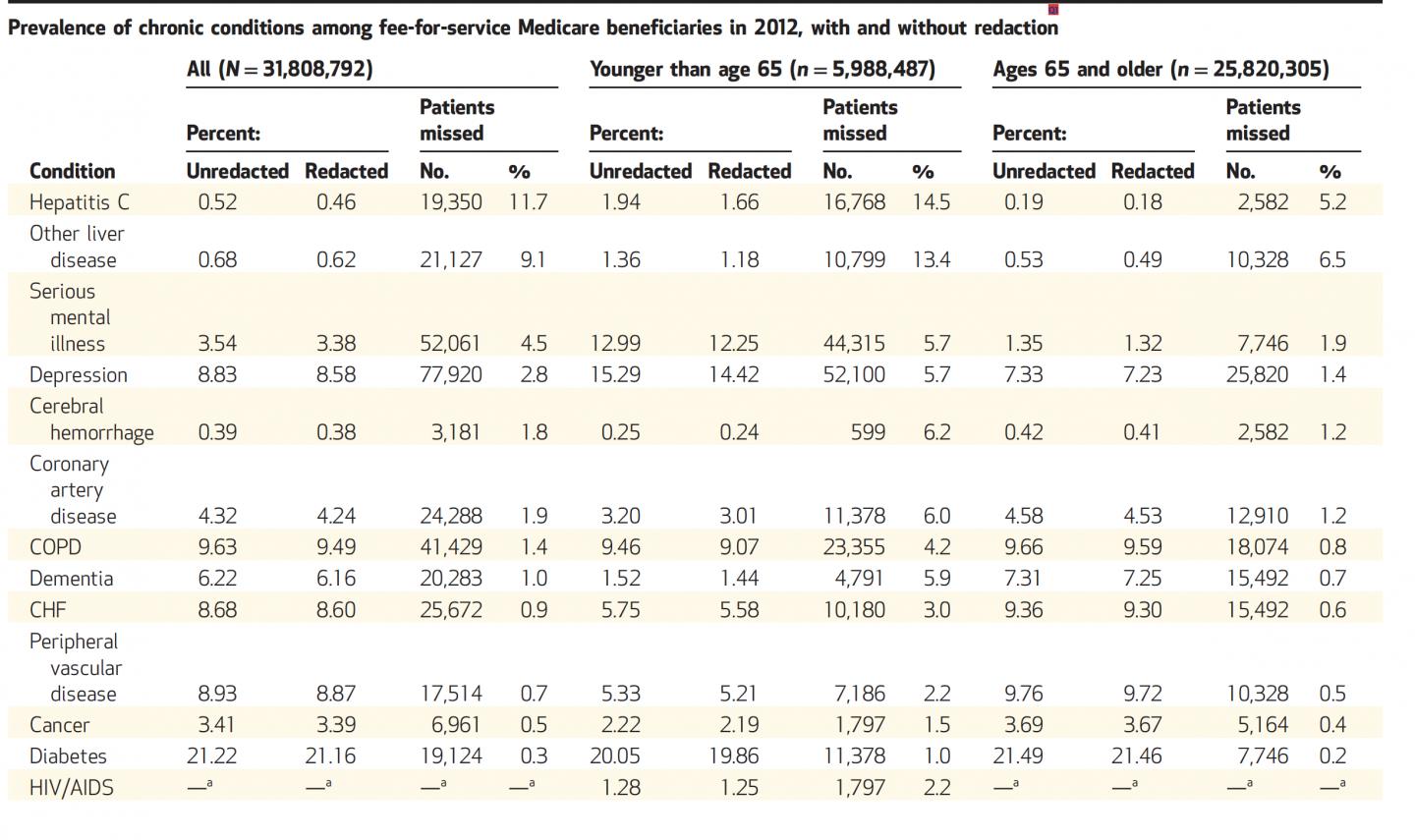
- Among all Medicare beneficiaries, the prevalence of chronic conditions related to substance abuse was lower with redaction. The prevalence of hepatitis C, for example, was underestimated by 11.7%.
- Underestimates of prevalence were greater for beneficiaries younger than age 65. Redaction removed 14.5% of the hepatitis C population, 13.4% of the population with other liver disease. It also removed 5.7% of the population with serious mental illness and the same share of patients with depression.
- Among the 6.3 million beneficiaries with in-patient claims (in-patient admission) 7.1% had at least one inpatient claim redacted. Inpatient admissions and spending were about 5% lower after redaction, resulting in a $6.8 billion underestimate of inpatient Medicare spending.
The research team says their findings suggest four important implications of the redaction of substance abuse claims:
- Estimated co-morbidity in the population age 65 and older will be minimally affected.
- Co-morbidity for in the population younger than 65 will be understated, particularly for hepatitis C and mental illness.
- Redaction could distort evidence on the treatment and outcomes of two important patient groups: those with hepatitis C who are taking new drugs such as Sofosbuvir and those at risk of overdose related to opioid use
- Research on inpatient use among Medicare beneficiaries younger than 65 will be limited.
To understand what effect redaction may have had on academic research, the team also searched PubMed and identified at least nine studies that used Medicare data released during the years when data were likely to be redacted (2012-2014), with several authors noting that redaction had limited their ability to examine substance abuse claims or co-morbidity.
"The redaction left a legacy that we very much need to be conscious of and continue to examine," Austin says, "particularly because it coincided with two monumental events in U.S. health care –implementation of the ACA and declining life expectancy."
###
Media Contact
Paige Stein
[email protected]
603-653-0850
@DartmouthInst
http://www.tdi.dartmouth.edu
Related Journal Article
http://dx.doi.org/10.1377/hlthaff.2017.1524