Credit: Kobe University
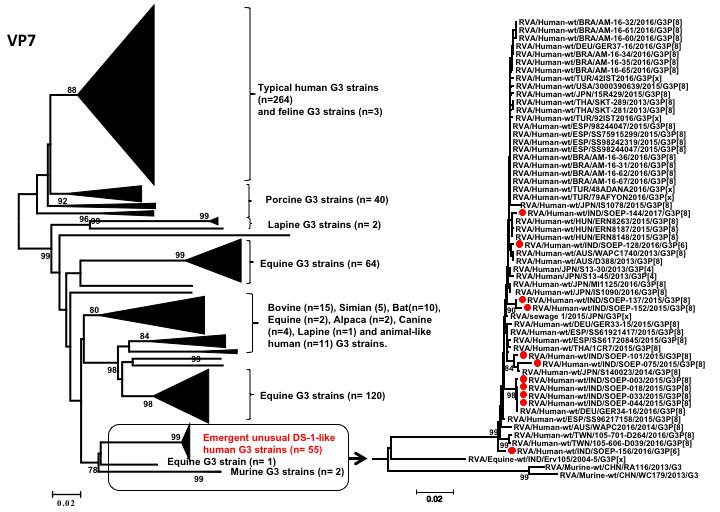
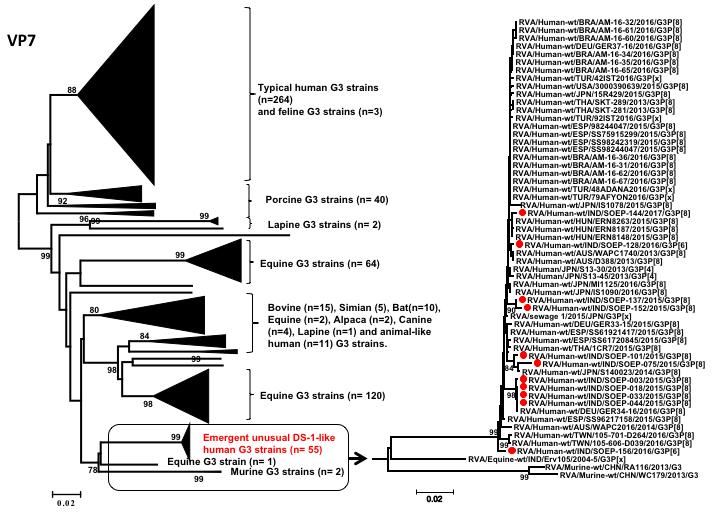
Rotavirus A causes acute diarrhea in young children, and infects both animals and humans worldwide. A Japanese research group has found that the acute gastroenteritis infecting children in Indonesia between 2015 and 2016 was caused by dominant strains of equine-like G3 rotavirus, genetically different from human strains of the virus. The findings could shed light on how the virus traveled to Indonesia from neighboring countries.
The research team was led by Professor Ikuo Shoji, Project Assistant Professor Takako Utsumi (both from Kobe University's Graduate School of Medicine) and Professor Kazuhiko Katayama (National Institute of Infectious Diseases, Japan). Their findings were published on March 27, 2018 in the online edition of Infection, Genetics and Evolution.
Rotavirus A (RVA) consists of 11 segmented genomes. This segmented nature means that genetic reassortment often occurs, and the virus can evolve into new versions. In 2006 a rotavirus vaccine was developed and used in many countries, but recently different countries have reported varying levels of effectiveness for the vaccine. This could partly be caused by different dominant strains of the virus.
The research team aimed to shed light on the genetic characteristics of rotavirus strains in Indonesia. They carried out molecular analysis of the rotavirus genome using stool samples from children in Indonesia infected with acute gastroenteritis. For one year from 2015 to 2016, the group collected stool samples from 134 children under 5 years old admitted to hospital in Surabaya. Using immunochromatography, they examined the children for rotavirus A, and found that 31.3% were RVA antigen-positive. They then discovered that the RVAs were the rare strains G3P[8] and G3P[6]. With further analysis of all 11 strains of the virus using next-generation sequencing, they determined that this was equine-like G3 rotavirus with a DS-1-like genetic backbone. This strain has also been reported in Australia, Hungary, Spain and Brazil.
"Our team now plans to analyze time-dependent changes in Indonesia's dominant rotavirus strains and clarify how they were transmitted to Indonesia from neighboring countries. We will also investigate their impact on infection in Japan" comments Professor Shoji. "We will examine samples collected from vaccinated patients, analyze the genetic information of strains that resist vaccine-based immunity, and establish a surveillance system to prevent these strains from entering Japan."
###
This study was supported by a grant from the Japan Initiative for Global Research Network on Infectious Diseases (J-GRID), part of the Japan Agency for Medical Research and Development (AMED). The research was carried out at the Institute of Tropical Disease in Airlangga University, Indonesia in collaboration with Kobe University Graduate School of Medicine and National Institute of Infectious Diseases, Japan.
Media Contact
Eleanor Wyllie
[email protected]
@KobeU_Global
http://www.kobe-u.ac.jp/en/
Original Source
http://www.kobe-u.ac.jp/research_at_kobe_en/NEWS/news/2018_05_31_01.html http://dx.doi.org/10.1016/j.meegid.2018.03.027