

• HOME
  • NEWS
  • EXPLORE
    • CAREER
      • Companies
      • Jobs
    • EVENTS
    • iGEM
      • News
      • Team
    • PHOTOS
    • VIDEO
    • WIKI
  • BLOG
  • COMMUNITY
    • FACEBOOK
    • INSTAGRAM
    • TWITTER
Friday, January 2, 2026
BIOENGINEER.ORG
No Result
View All Result
  • Login
  • HOME
  • NEWS
  • EXPLORE
    • CAREER
      • Companies
      • Jobs
        • Lecturer
        • PhD Studentship
        • Postdoc
        • Research Assistant
    • EVENTS
    • iGEM
      • News
      • Team
    • PHOTOS
    • VIDEO
    • WIKI
  • BLOG
  • COMMUNITY
    • FACEBOOK
    • INSTAGRAM
    • TWITTER
  • HOME
  • NEWS
  • EXPLORE
    • CAREER
      • Companies
      • Jobs
        • Lecturer
        • PhD Studentship
        • Postdoc
        • Research Assistant
    • EVENTS
    • iGEM
      • News
      • Team
    • PHOTOS
    • VIDEO
    • WIKI
  • BLOG
  • COMMUNITY
    • FACEBOOK
    • INSTAGRAM
    • TWITTER
No Result
View All Result
Bioengineer.org
No Result
View All Result
Home NEWS Science News Cancer

Why do we need one pair of genome?

Bioengineer by Bioengineer
May 25, 2018
in Cancer
Reading Time: 2 mins read
0
Share on FacebookShare on TwitterShare on LinkedinShare on RedditShare on Telegram
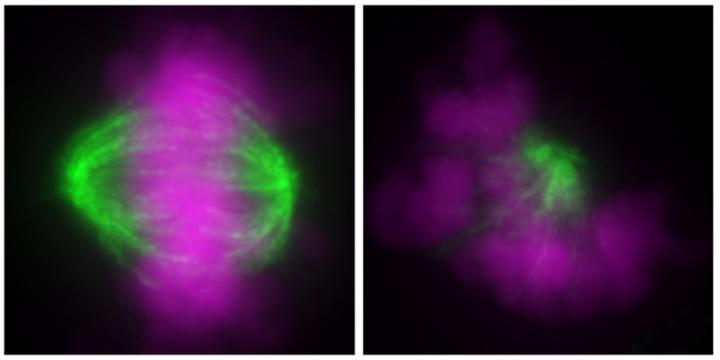
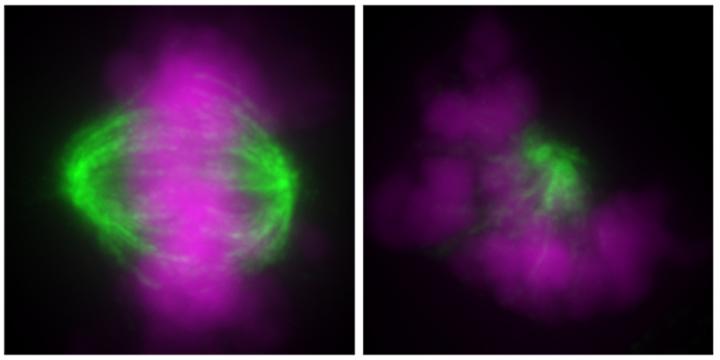
IMAGE

Credit: Yaguchi K., et al., Journal of Cell Biology, April 30, 2018

Scientists have unraveled how the cell replication process destabilizes when it has more, or less, than a pair of chromosome sets, each of which is called a genome — a major step toward understanding chromosome instability in cancer cells.

In mammals, including humans, cells which make up the body are diploids, which means that a cell contains a pair of each chromosome. A non-diploid state destabilizes the properties of the cells, triggering abnormalities, cancers and other serious diseases. In asexual reproduction and cancer development, haploid (one set of each chromosome) and tetraploid (four sets of each chromosome) cells are generated, causing chromosomes to become unstable. However, why this instability occurs when the cell is in a non-diploid state has remained unknown.

In the present study, the researchers used human cell lines with different ploidy states — haploid, diploid and tetraploid — to investigate the effect of the differences on the cell replication process.

In normal cells, there are two centrosomes, which are regulators of cell replication. The researchers observed gradual loss of centrosomes in haploid cells and frequent over-duplication of centrosomes in tetraploid cells, both of which triggered frequent abnormalities in the cell replication process.

In addition, researchers found that there were fewer cellular fibers, called microtubules, in haploid cells, and more in tetraploid cells. This was significant, as the number of these fibers was found to be a key factor that changes the efficiency of centrosome duplication, resulting in either centrosome loss or over-duplication. On the other hand, the efficiency of DNA replication, which is another important step in cell replication, remained constant, regardless of a cell's ploidy.

"Incompatibility between centrosome duplication and the DNA replication cycle could be the underlying cause of the instability in non-diploid cells in mammals," says Ryota Uehara. "Our findings could help understand chromosome instability in cancer cells, which are often in a non-diploid state, and lead to new cancer treatment strategies."

###

Media Contact

Naoki Namba
81-117-062-185
@hokkaido_uni

https://www.global.hokudai.ac.jp/

Original Source

https://www.global.hokudai.ac.jp/blog/why-do-we-need-one-pair-of-genome/ http://dx.doi.org/10.1083/jcb.201701151


Share12Tweet8Share2ShareShareShare2

Related Posts

Derazantinib Boosts Gemcitabine by Blocking MUC5AC

December 30, 2025

FOCUS Study Reveals Insights on Melphalan for Uveal Melanoma

December 29, 2025

Black Grape Anthocyanins Boost 5-FU Cancer Therapy

December 29, 2025

Girdin Silencing Boosts Mebendazole’s Ovarian Cancer Fight

December 29, 2025
Please login to join discussion

POPULAR NEWS

  • blank

    PTSD, Depression, Anxiety in Childhood Cancer Survivors, Parents

    115 shares
    Share 46 Tweet 29
  • NSF funds machine-learning research at UNO and UNL to study energy requirements of walking in older adults

    71 shares
    Share 28 Tweet 18
  • Exploring Audiology Accessibility in Johannesburg, South Africa

    52 shares
    Share 21 Tweet 13
  • SARS-CoV-2 Subvariants Affect Outcomes in Elderly Hip Fractures

    44 shares
    Share 18 Tweet 11

About

We bring you the latest biotechnology news from best research centers and universities around the world. Check our website.

Follow us

Recent News

Electrically Tunable 2D Excitonic Metasurface Modulation

OAM Multiplication Sparks Advanced Holographic Multiplexing

IL-10 Targeting LDL Lowers Vascular Inflammation in Atherosclerosis

Subscribe to Blog via Email

Enter your email address to subscribe to this blog and receive notifications of new posts by email.

Join 71 other subscribers
  • Contact Us

Bioengineer.org © Copyright 2023 All Rights Reserved.

Welcome Back!

Login to your account below

Forgotten Password?

Retrieve your password

Please enter your username or email address to reset your password.

Log In
No Result
View All Result
  • Homepages
    • Home Page 1
    • Home Page 2
  • News
  • National
  • Business
  • Health
  • Lifestyle
  • Science

Bioengineer.org © Copyright 2023 All Rights Reserved.
