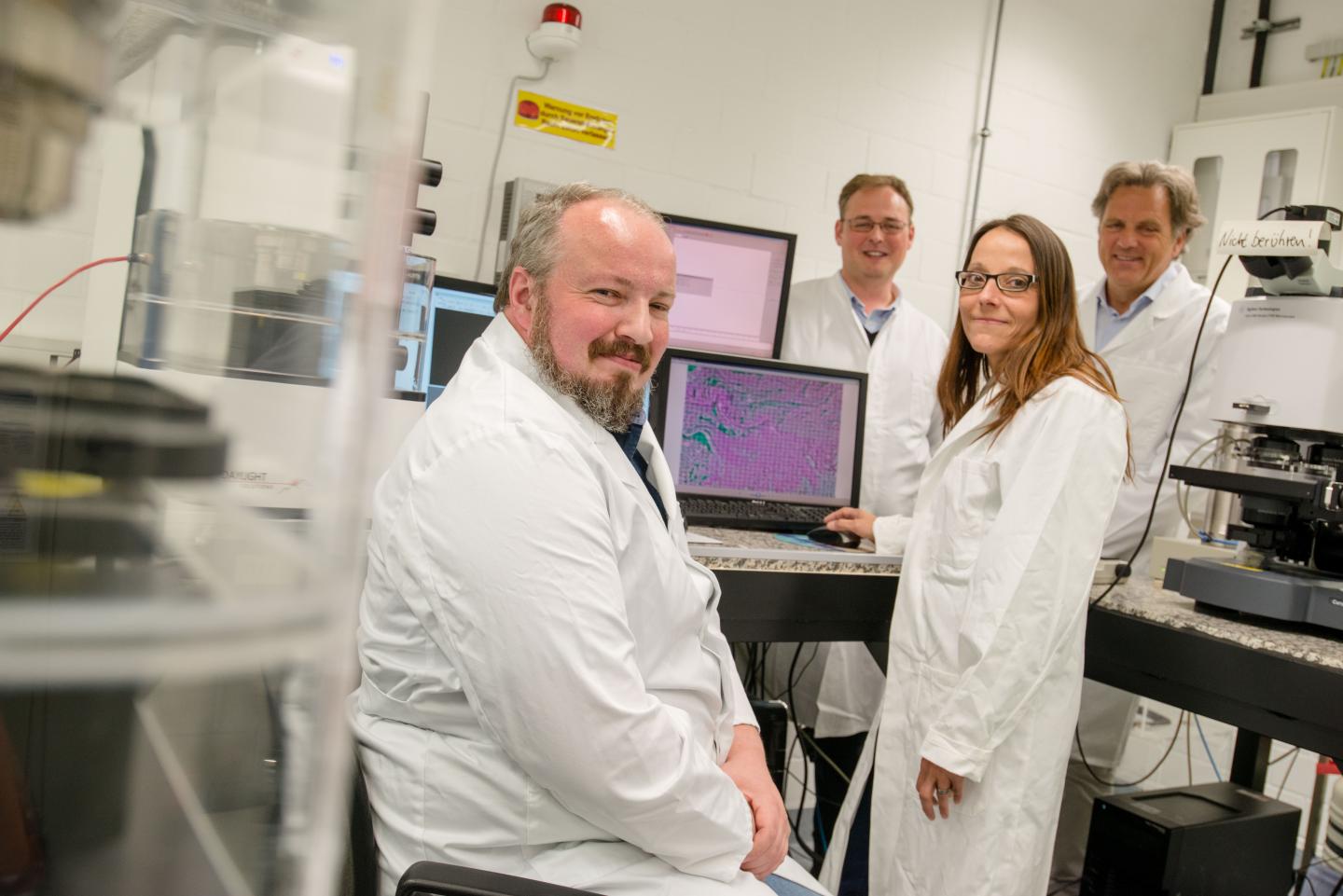
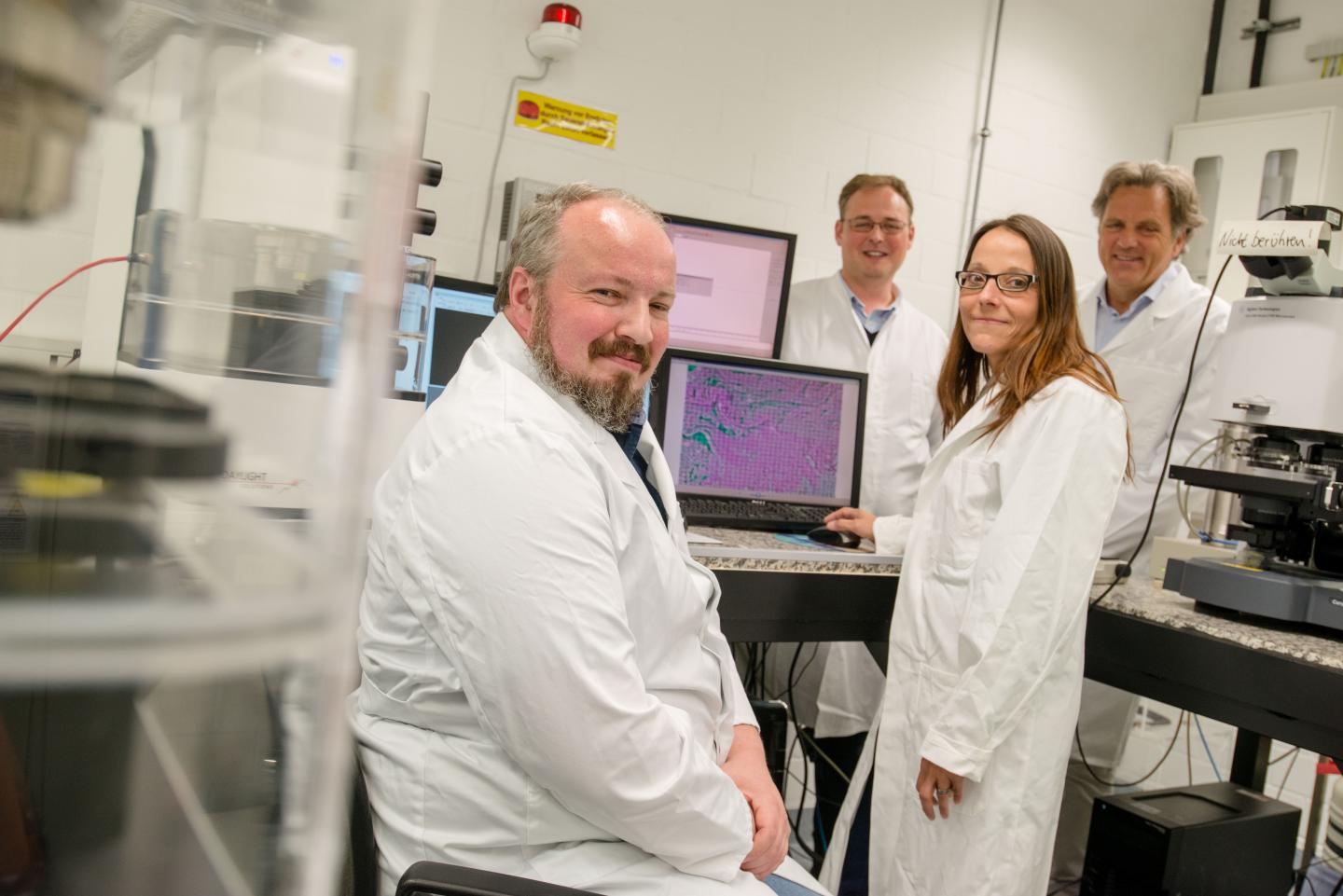
Credit: RUB, Marquard
Researchers at Ruhr-Universität Bochum have deployed a novel infrared (IR) microscope with quantum cascade lasers in order to analyse tissue samples taken during routine clinical procedures for colorectal cancer diagnosis. The FTIR (fourier transform infrared) microscope used to date had not yet established itself as a diagnostic tool in hospitals, as the analyses used to take too long. By utilising the new laser technology, the researchers reduced the time required for analysis from one day to a few minutes. Coupled with bioinformatical image analysis, the IR microscope performs label-free classification of cancer tissue and can be fully automated.
Bochum-based researchers under the auspices of Prof Dr Klaus Gerwert, Dr Angela Kallenbach-Thieltges, Dr Frederik Großerüschkamp and Claus Küpper from the Department of Biophysics published a report on the project in the Nature group journal Scientific Reports.
Rapid and reliable analysis
In previous studies, the biophysicists had already demonstrated the potential the FTIR microscope has in combination with bioinformatical image analysis (FTIR imaging for short) as a diagnostic tool for the classification of tissue. Unlike traditional clinical rapid diagnostic tests, which take approximately 20 minutes, FTIR imaging used to take a whole day. Now, the researchers have considerably simplified the measurement set-up and replaced FT technology by quantum cascade laser technology. Metaphorically speaking, they replaced a weak lightbulb that emits diffuse light with precisely bundled, intense laser light.
In collaboration with the Institute of Pathology at Ruhr-Universität, headed by Prof Dr Andrea Tannapfel, they used IR imaging to analyse 120 tissue samples taken from patients suffering from colorectal cancer. The analysis was based on algorithms developed by the biophysicists in-house that were used for colouring the IR images of tissue samples at the computer. The results corresponded to 97 per cent with traditional histopathological analyses. "We have thus reduced the measurement period by a factor of 160," describes Frederik Großerüschkamp.
As control, the measurements were carried out using two different pieces of equipment, and the analyses were performed by several users; this did not affect the results. "The method is now very fast, reliable and does not depend on a specific device or a specific user," says Angela Kallenbach-Thieltges. "This opens up new avenues for automated classification of tissue samples taken directly from the patient."
Not affected by the human factor
In future, the team intends to incorporate the method into clinical workflow. "Automated image analysis might be deployed as a time-saving diagnostic tool, which might possibly even be used in-situ," anticipates pathologist Andrea Tannapfel.
Colorectal cancer is one of the most common tumour diseases, and it is very treatable following early diagnosis. "The results of the study give rise to hope that highly precise therapy is within reach, which can be personalised for each individual patient and, consequently, will ultimately prove more successful than traditional approaches," concludes Klaus Gerwert.
###
Media Contact
Klaus Gerwert
[email protected]
49-234-322-4461
@ruhrunibochum
http://www.ruhr-uni-bochum.de
Original Source
http://news.rub.de/english/press-releases/2018-05-18-biophysics-label-free-method-rapid-cancer-diagnosis http://dx.doi.org/10.1038/s41598-018-26098-w