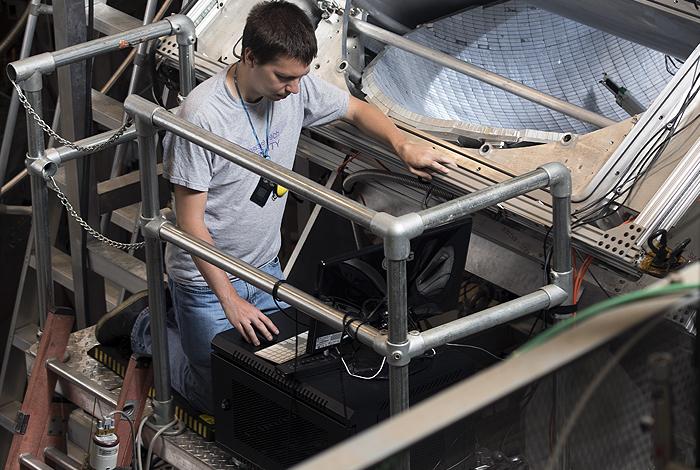
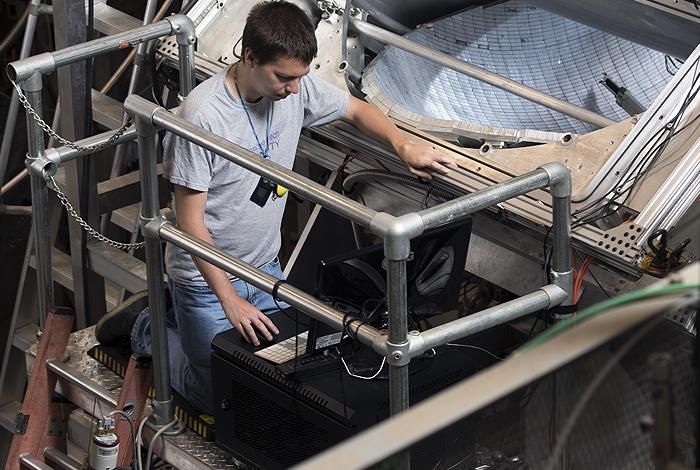
Credit: LANL
LOS ALAMOS, N.M., May 10, 2018–Being repulsive can have its advantages. In the case of an experiment at Los Alamos National Laboratory's linear accelerator, a repulsive magnetic field and a clever detector system are allowing ultracold neutrons to be levitated so their actual lifetimes can be more accurately measured. For the first time, the measurements are considered accurate enough that potential corrections are not larger than the uncertainties.
"Neutrons, when safely at home inside an atom, are not at risk for blinking out of existence. But on their own, their average lifespan is about 15 minutes," said Los Alamos physicist Steven Clayton, one of the authors of a new paper out today in the journal Science. "This matters in the larger science context because the average lifespan depends on fundamental parameters in the Standard Model of particle physics." A number of methods of containing the particles and measuring their lifespan have been tried over many years–oiled copper bottles, beams of neutrons surrounded by traps, all sorts of clever ways of determining exactly how long before the neutron decays into a proton. But there were always gaps in the timing from each method, which gave scientists doubts about both the Standard Model physics at playand the variations shown in the measurement methods. Now, by levitating polarized, ultracold neutrons above the surface of an asymmetric storage trap, they have been able to prevent the trapped neutrons from interacting with the trap walls, measure the neutrons with increased accuracy, and determine their lifespan without needing such large room for error.
Using an 800 MeV proton beam at the Los Alamos Neutron Science Center (LANSCE) to liberate the bound neutrons and then injecting them into a magnetic trap (closed with fields on the bottom and sides and by gravity on the top,) the team was able to capture a population of neutrons and hold them in place for up to an hour, until a detector was lowered into place. Neutrons whose kinetic energy was too great for the experiment were diverted out of the trap, and the neutrons that had not yet decayed struck the detector paddle's boron layer, where they were reabsorbed into matter and thus detected. Comparing the number of survivors after different storage times yielded the average neutron lifetime.
###
The team working on this, for some 10 years now, included scientists from Los Alamos, Indiana University, Triangle Universities Nuclear Laboratory, North Carolina State University, Oak Ridge National Laboratory, Virginia Polytechnic Institute and State University, West Point Military Academy, California Institute of Technology, Tennessee Technological University, DePauw University, and the Joint Institute for Nuclear Research, Dubna, Russia.
Publication: Publication: Measurement of the neutron lifetime using an asymmetric magneto- gravitational trap and in situ detection, Science,.
Authors: R. W. Pattie Jr., N. B. Callahan, C. Cude-Woods, E. R. Adamek, L. J. Broussard, S. M. Clayton, S. A. Currie, E. B. Dees, X. Ding, E. M. Enge, D. E. Fellers, W. Fox, K. P. Hickerson, M. A. Hoffbauer, A. T. Holley, A. Komives, C.-Y. Liu, S. W. T. MacDonald, M. Makela, C. L. Morris, J. D. Ortiz, J. Ramsey, D. J. Salvat, A. Saunders, S. J. Seestrom, E. I. Sharapov, S. K. Sjue, Z. Tang, J. Vanderwerp, B. Vogelaar, P. L. Walstrom, Z. Wang, W. Wei, H. L. Weaver, J. W. Wexler, T. L. Womack, A. R. Young, and B. A. Zeck
Funding: This work was supported by the Los Alamos Laboratory Directed Research and Development (LDRD) office, the LDRD Program of Oak Ridge National Laboratory, the National Science Foundation, NIST Precision Measurement Grant, IU Center for Space Time Symmetries, and the U.S. Department of Energy, Office of Science, Office of Nuclear Physics.
About Los Alamos National Laboratory
Los Alamos National Laboratory, a multidisciplinary research institution engaged in strategic science on behalf of national security, is operated by Los Alamos National Security, LLC, a team composed of Bechtel National, the University of California, BWX Technologies, Inc. and URS Corporation for the Department of Energy's National Nuclear Security Administration. Los Alamos enhances national security by ensuring the safety and reliability of the U.S. nuclear stockpile, developing technologies to reduce threats from weapons of mass destruction, and solving problems related to energy, environment, infrastructure, health and global security concerns.
Media Contact
Nancy Ambrosiano
[email protected]
505-667-0471
@LosAlamosNatLab
http://www.lanl.gov