• HOME
  • NEWS
  • EXPLORE
    • CAREER
      • Companies
      • Jobs
    • EVENTS
    • iGEM
      • News
      • Team
    • PHOTOS
    • VIDEO
    • WIKI
  • BLOG
  • COMMUNITY
    • FACEBOOK
    • INSTAGRAM
    • TWITTER
Saturday, February 7, 2026
BIOENGINEER.ORG
No Result
View All Result
  • Login
  • HOME
  • NEWS
  • EXPLORE
    • CAREER
      • Companies
      • Jobs
        • Lecturer
        • PhD Studentship
        • Postdoc
        • Research Assistant
    • EVENTS
    • iGEM
      • News
      • Team
    • PHOTOS
    • VIDEO
    • WIKI
  • BLOG
  • COMMUNITY
    • FACEBOOK
    • INSTAGRAM
    • TWITTER
  • HOME
  • NEWS
  • EXPLORE
    • CAREER
      • Companies
      • Jobs
        • Lecturer
        • PhD Studentship
        • Postdoc
        • Research Assistant
    • EVENTS
    • iGEM
      • News
      • Team
    • PHOTOS
    • VIDEO
    • WIKI
  • BLOG
  • COMMUNITY
    • FACEBOOK
    • INSTAGRAM
    • TWITTER
No Result
View All Result
Bioengineer.org
No Result
View All Result
Home NEWS Science News Health

High efficiency synthesis of insulin by self-assembly based organic chemistry

Bioengineer by Bioengineer
May 10, 2018
in Health
Reading Time: 2 mins read
0
Share on FacebookShare on TwitterShare on LinkedinShare on RedditShare on Telegram
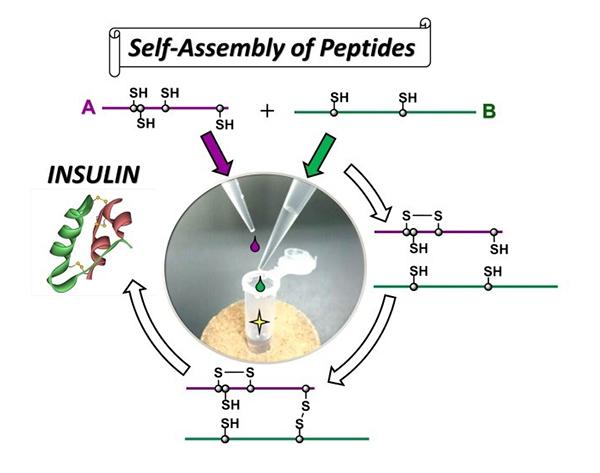
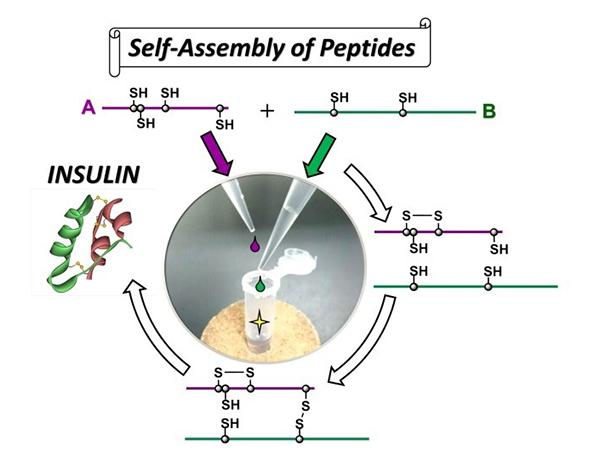
IMAGE

Credit: Michio Iwaoka

Researchers at Tokai, Osaka, Tohoku and Fukuoka Universities report in the journal Communications Chemistry on the synthesis of insulin based on the self-assembly of polypeptide chains at about 40% efficiency. This new approach is expected to enable flexibility in synthesizing order made insulin compounds that cannot be produced using conventional biological approaches based on genetic engineering.

Insulin is a hormone that acts to lower the rise in blood glucose level after meals and is used as a therapeutic agent for diabetes. Since insulin has a characteristic molecular structure in which two peptide chains (A and B chains) are connected by two disulfide bridges (SS bonds), chemical synthesis is considered difficult to achieve. Currently, insulin is manufactured by a genetic engineering process.

Michio Iwaoka at Tokai University, Japan, in collaboration with colleagues Hironobu Hojo at Osaka University Kenji Inaba at Tohoku University, and Setsuko Ando at Fukuoka University, report on their success in efficiently synthesizing insulin by using only chemical processes based on organic synthesis.

The research team has previously reported on the efficient chemical synthesis of insulin (seleno-insulin) in which selenocysteine was substituted for insulin containing cysteine to replace the SS bond between the peptide chains with a diselenide crosslink (SeSe bond Angew. Chem., Int. Ed., 2017, 56(20), 5522-5526).

In their most recent studies, improvements have been made on the previous synthesis method of seleno-insulin and natural insulin (bovine insulin) has been produced at a higher yield (approximately 40%) than seleno-insulin. By applying this new method, they have succeeded in the efficient chemical synthesis of insulin families such as human insulin and human type 2 relaxin.

The team first examined the process (oxidative folding pathway) by which insulin A chain and insulin B chain combine to form the structure of natural type insulin. Based on the pathway, they succeeded in optimizing folding conditions of bovine insulin and obtaining bovine insulin at high yield of about 40%.

The advantages of this synthesis method is that it does not require any large-scale production equipment because it does not use any genetic engineering technique and insulin can be produced by the simple process of mixing A chain and B chain–both of which can be synthesized by a solid phase peptide synthesis method using a resin.

"Using this 'self-assembly' approach it would be possible to modify the structure of insulin, such as introducing an unnatural amino acid into insulin," explains Iwaoka. "We expect that this method could be applied to the development of many types of insulin preparations such as long-acting and super quick-acting types."

###

Media Contact

Kenji Inaba
[email protected]
@TohokuUniPR

http://www.tohoku.ac.jp/en/

Original Source

https://www.tohoku.ac.jp/en/press/high_efficiency_synthesis_insulin.html http://dx.doi.org/10.1038/s42004-018-0024-0
Share12Tweet7Share2ShareShareShare1

Related Posts

Succinate Receptor 1 Limits Blood Cell Formation, Leukemia

February 7, 2026

Palmitoylation of Tfr1 Drives Platelet Ferroptosis and Exacerbates Liver Damage in Heat Stroke

February 7, 2026

Oxygen-Enhanced Dual-Section Microneedle Patch Improves Drug Delivery and Boosts Photodynamic and Anti-Inflammatory Treatment for Psoriasis

February 7, 2026

Scientists Identify SARS-CoV-2 PLpro and RIPK1 Inhibitors Showing Potent Synergistic Antiviral Effects in Mouse COVID-19 Model

February 7, 2026
Please login to join discussion

POPULAR NEWS

  • Robotic Ureteral Reconstruction: A Novel Approach

    Robotic Ureteral Reconstruction: A Novel Approach

    82 shares
    Share 33 Tweet 21
  • Digital Privacy: Health Data Control in Incarceration

    63 shares
    Share 25 Tweet 16
  • Study Reveals Lipid Accumulation in ME/CFS Cells

    57 shares
    Share 23 Tweet 14
  • Breakthrough in RNA Research Accelerates Medical Innovations Timeline

    53 shares
    Share 21 Tweet 13

About

We bring you the latest biotechnology news from best research centers and universities around the world. Check our website.

Follow us

Recent News

Succinate Receptor 1 Limits Blood Cell Formation, Leukemia

Palmitoylation of Tfr1 Drives Platelet Ferroptosis and Exacerbates Liver Damage in Heat Stroke

Oxygen-Enhanced Dual-Section Microneedle Patch Improves Drug Delivery and Boosts Photodynamic and Anti-Inflammatory Treatment for Psoriasis

Subscribe to Blog via Email

Enter your email address to subscribe to this blog and receive notifications of new posts by email.

Join 73 other subscribers
  • Contact Us

Bioengineer.org © Copyright 2023 All Rights Reserved.

Welcome Back!

Login to your account below

Forgotten Password?

Retrieve your password

Please enter your username or email address to reset your password.

Log In
No Result
View All Result
  • Homepages
    • Home Page 1
    • Home Page 2
  • News
  • National
  • Business
  • Health
  • Lifestyle
  • Science

Bioengineer.org © Copyright 2023 All Rights Reserved.