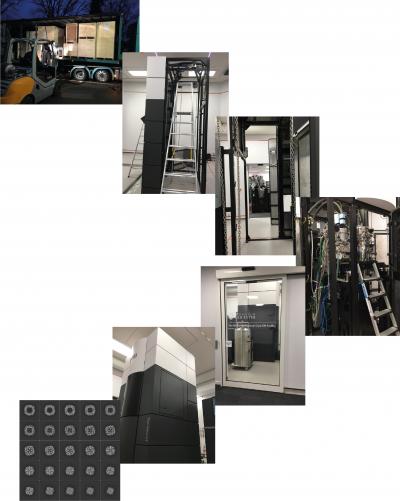
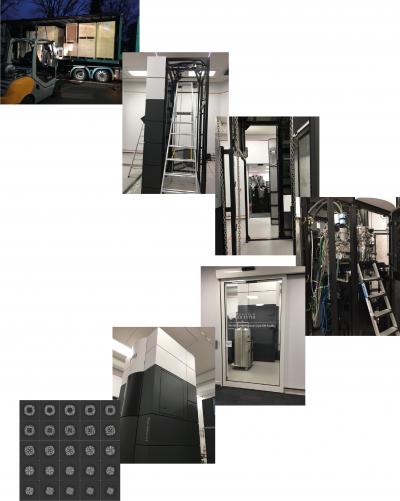
Credit: University of Leicester
A new state-of-the-art Cryo-EM facility that will advance the understanding of the processes of life is being officially opened at the University of Leicester.
The facility will be opened by Dr Richard Henderson, from the MRC Laboratory of Molecular Biology in Cambridge, who was one of three scientists to win the 2017 Nobel Prize in Chemistry "for developing cryo-electron microscopy for the high-resolution structure determination of biomolecules in solution." He will launch the Midlands Regional Cryo-Electron Microscope (Cryo-EM) Facility – hosted at the Leicester Institute of Structural and Chemical Biology – on Tuesday 10 April at the University.
The Cryo-EM facility brings cutting-edge research technologies to the Midlands and represents another successful collaboration within the Midlands Innovation partnership. The University of Leicester led the successful bid, in collaboration with the Universities of Warwick, Nottingham and Birmingham, to establish the facility.
The total investment exceeds £6M with £3.7M from the Medical Research Council (MRC). The four partner Universities provided the remaining funds with a major contribution from the University of Leicester (£1.8M).
Professor John Schwabe, Director of the Leicester Institute of Structural and Chemical Biology, led the region-wide bid to the Wellcome Trust-MRC initiative to establish the new facility at Leicester. He said: "There is currently a revolution in using Cryo-EM for research in structural biology. It is very exciting to be opening this facility which will keep the Leicester Institute of Structural and Chemical Biology at the forefront of the field. The timescale for the project was extremely tight but it is a testament to all those involved from across the University (scientist, estates, contractors etc.) that this flagship facility has been delivered on time and we are launching today."
The revolution in Cryo-Electron Microscopy has been driven by developments in the microscopes themselves, the camera systems, and in the computational methods used to process the images. This has allowed the latest generation of Cryo-EMs, such as the one in Leicester, to generate 3 dimensional structures of bio-molecules in exquisite detail. This enables scientist to understand the mechanisms through which molecular machines in our cells perform the key functions of life fit. This can lead to understanding disease processes and how best to address them.
The facility is centred around a state-of-the-art 300kV cryo-electron microscope, with the latest generation of direct electron-detecting cameras. Alongside this is the High Performance Image Processing Facility which boasts the state of the art computational infrastructure (based around powerful GPU's) necessary to process the very large (>1TB /day) amounts of data generated by these instruments. A second "feeder" microscope is based at the University of Warwick.
Professor Paul Boyle, President and Vice-Chancellor of the University of Leicester, said: "The University of Leicester is delighted to see the success of this exciting collaborative project with our Midlands Innovation partners. Such developments exemplify the University's strategic ambitions."
Professor Iain Gillespie, Pro-Vice-Chancellor for Research & Enterprise at the University of Leicester, said: "The Leicester Institute of Structural and Chemical Biology is one of our flagship Research Institutes. The opening of this facility is testament to the strength of the Institute and the University's investment in this area."
This regional facility will establish a Midlands Cryo-EM 'ecosystem' that will enable the sharing of equipment and expertise and will help to strengthen existing and establish new scientific collaborations across the region.
Professor Philip Baker, Pro-Vice-Chancellor and Head of the College of Medicine, Biological Sciences and Psychology at the University of Leicester, said: "The College has a long history of research strength in structural biology and this new technology will enable our researchers to accelerate their study of medically important protein complexes."
Dr Nathan Richardson, Head of Molecular and Cellular Medicine at the MRC, said: "This investment in new cryo-EM facilities – awarded to the universities of Leicester, Glasgow, and Oxford – is an important commitment, showing our full support for structural biology during this technological revolution. We're delighted to be able to provide this investment to the University of Leicester, supporting their exciting plans to use this cutting-edge technology to tackle the important biological questions that will help advance human health."
Over the past four decades, European researchers – including MRC-funded researchers in the UK – have played a pivotal role in developing increasingly sophisticated and super-powerful cryo-electron microscopes. This microscope is one of several that was announced in July 2017, as part of £11.3m government funding to boost structural and cell biology research.
###
More information on the facility here: https://www2.le.ac.uk/institutes/liscb/facilities-1/facilities-2/copy_of_electron-microscopy/history-and-development-of-the-microscope
Notes to editors:
The Leicester Institute of Structural and Chemical Biology (LISCB) is a cross-disciplinary entity that brings together internationally renowned research in structural biology and chemical biology at the University of Leicester into a single world-leading unit.
For more information contact Prof John Schwabe (email [email protected]) or Dr Peter Watson from the Leicester Institute for Structural and Chemical Biology (email [email protected])
Midlands Innovation is a world-class research and innovation partnership, combining the collective excellence of eight leading universities in the heart of the UK – Aston, Birmingham, Cranfield, Keele, Leicester, Loughborough, Nottingham and Warwick. It unites the power of university research with the unique strengths of Midlands industry to drive cutting-edge research, innovation and skills development. Midlands Innovation has had a long-standing focus on equipment sharing and research efficiency establishing the first regional equipment database. For more information contact Dr Helen Turner, Midlands Innovation Director (email: [email protected])
Media Contact
John Schwabe
[email protected]
@UoLNewsCentre
http://www.leicester.ac.uk