Credit: Phil Jones, Senior Photographer, Augusta University
AUGUSTA, Ga. (Mar. 19, 2018) – A newly designed three-part molecule could be the one answer patients with a certain form of breast cancer are looking for, scientists report.
This chimera, created by a team at the Georgia Cancer Center, has the ability to simultaneously decrease the expression of three growth factors that are over-expressed in some cancers.
The growth factors are human epidermal growth factor receptor 2 (HER2), human epidermal growth factor receptor 3 (HER3), and epidermal growth factor receptor (EGFR). The new chimera interferes with HER2 and HER3 signaling and ultimately leads to cancer cell death, as shown in the group's recent publication in Molecular Therapy: Nucleic Acids.
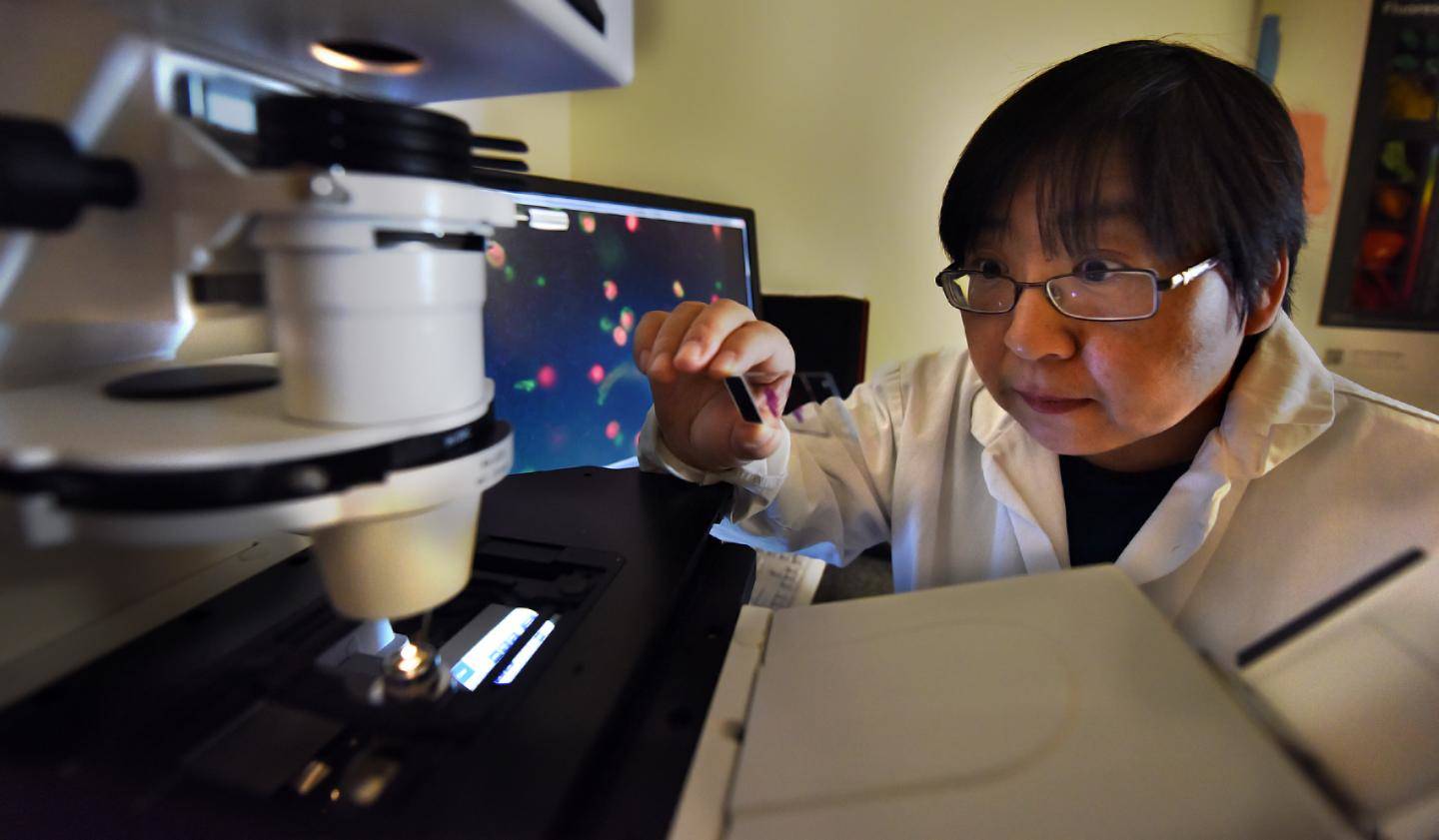
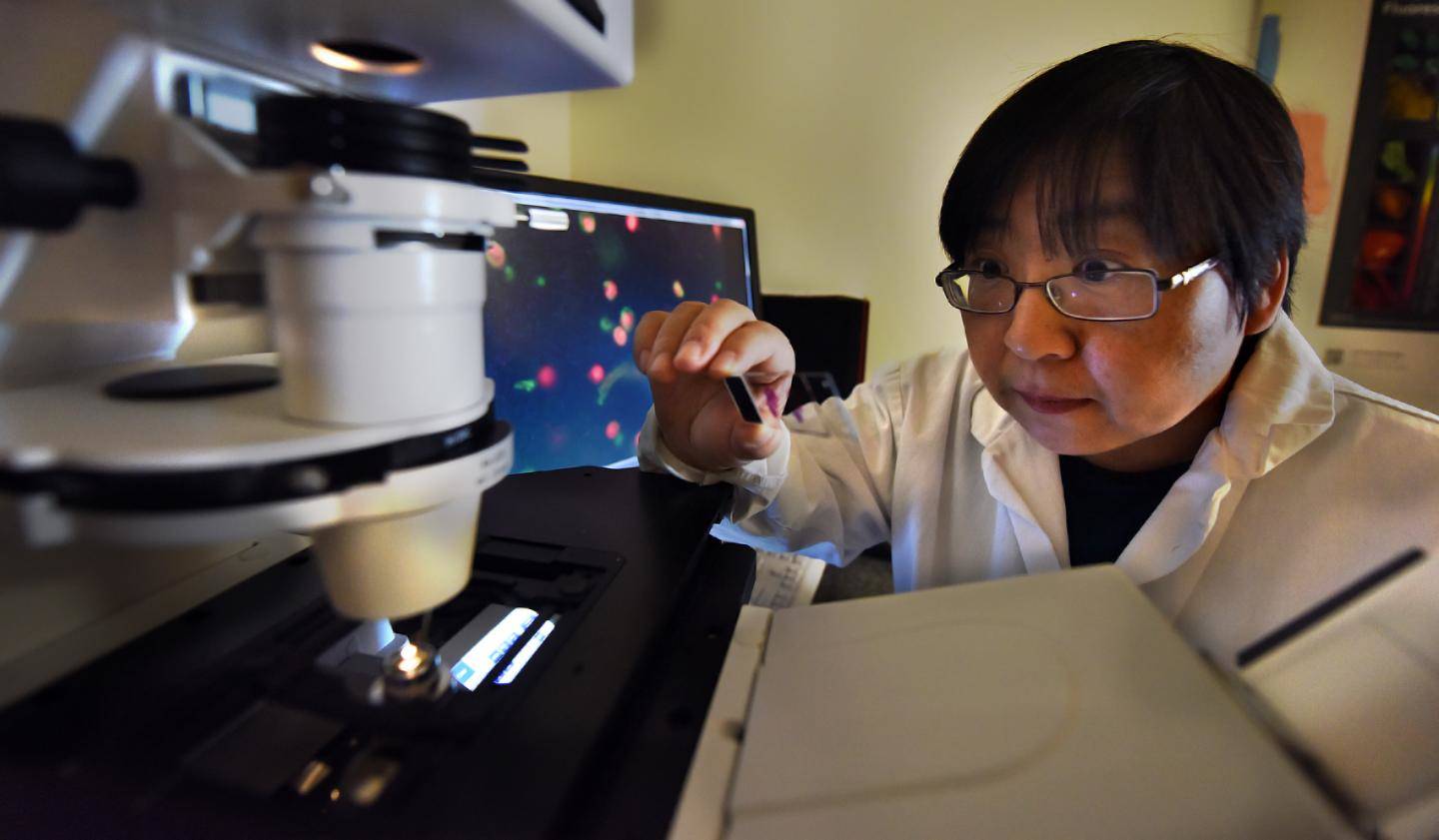
"When HER2 is expressed in a cell, you'll usually find high expression of HER3, too," said Dr. Hongyan Liu, bioengineer at the Georgia Cancer Center at Augusta University and the Center for Biotechnology and Genomic Medicine at the Medical College of Georgia at Augusta University.
Extensive studies have found that 20% to 30% of breast cancers are characterized by over-expression of HER2, which makes the cancer cells grow and divide faster, leading to a cancer that's more aggressive and more likely to be resistant to the standard of care. Patients with this type of breast cancer tend to have a poorer prognosis.
"As a bioengineer, I am developing the materials for cancer-targeted treatment," Liu said. "I have experience building multifunctional chimeras to target different types of genes associated with cancer cells."
Liu and her team created their molecule to target HER family receptors EGFR, HER2, and HER3 all at once, since it is well-known that another HER family member can compensate for one that is blocked by a drug having a single target.
Each component of this tripartite molecule has potent anti-tumor activity. The molecule was designed such that the EGFR-targeting component is sandwiched between the HER2- and HER3-targeting components in what is known as a HER2 aptamer-EGFR siRNA-HER3 aptamer chimera. This construction enables the EGFR component to reach its target within HER2- and HER3-expressing cells. Compared to individual components, the chimera is large enough to avoid renal depletion, resulting in a prolonged circulation time and increased efficiency.
The newly crafted molecule is non-toxic, simple to produce, and cost-effective compared to the production of alternate treatment strategies, such as antibodies and small molecule inhibitors.
Liu's ongoing studies are testing the ability of the three-in-one chimera to treat breast cancers that are resistant to Herceptin, a drug that targets HER2. This work is being done in collaboration with Dr. Hasan Korkaya, assistant professor, Biochemistry and Molecular Biology at the Medical College of Georgia, who has developed drug-resistant cell lines, and with breast cancer clinicians.
"We need to prove that this molecule will work on Herceptin-resistant breast cancer patients," Liu said.
Since other cancers, such as lung and head and neck, proliferate due to HER family over-expression, Liu anticipates that the chimera's utility will not be limited to breast cancers alone.
###
Media Contact
Chris Curry
[email protected]
706-799-8841
@MCG_AUG
http://www.augusta.edu/mcg/
Related Journal Article
http://dx.doi.org/10.1016/j.omtn.2017.12.015