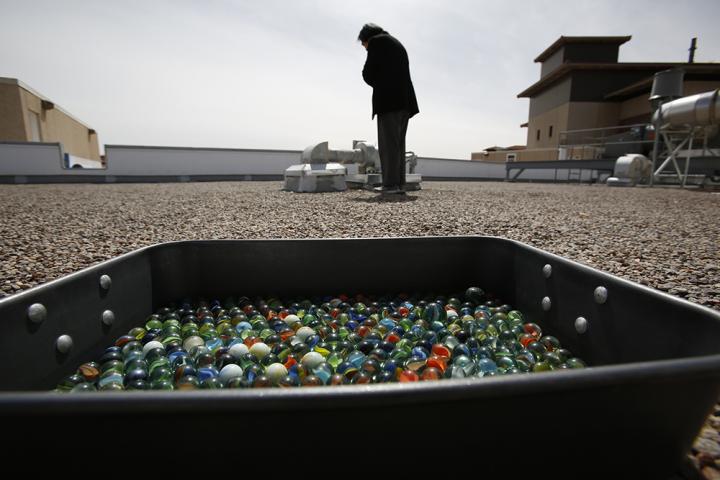
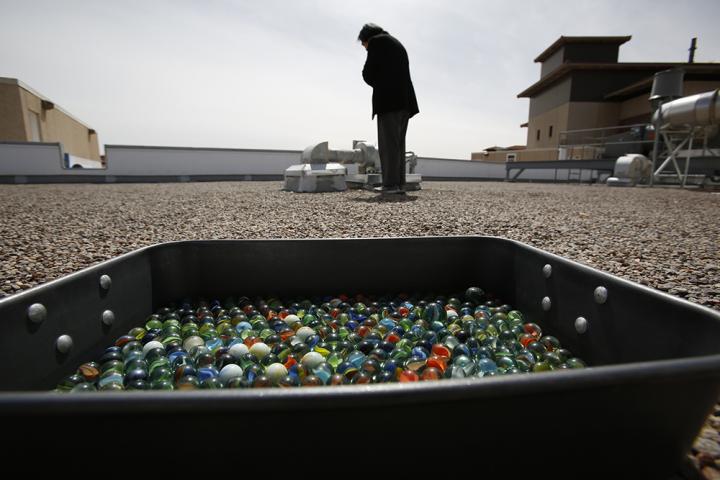
Credit: UTEP Communications
The work of faculty and students from The University of Texas at El Paso (UTEP) has yielded the first evidence of how waterborne microinvertebrates move across vast expanses of arid desert.
An article published March 13, 2018 in Limnology and Oceanography Letters, a publication of the Association for the Sciences of Limnology and Oceanography, details for the first time how high desert winds disperse small invertebrates and how they colonize hydrologically disconnected basins throughout the region.
"These novel findings might have large implications for freshwater systems," said Elizabeth J. Walsh, Ph.D., professor in UTEP's Department of Biological Sciences and director of the doctoral program in Ecology and Evolutionary Biology. "As climate changes and water patterns shift, our work might help others understand the intricacies of the wind-aided dispersal of freshwater organisms. It's important because these organisms are the base of the food web. How they move will affect the movement of the biological communities that are built up around them."
Walsh added that the impetus for the research grew out of a previous five-year study of Chihuahuan Desert aquatic environments funded by the National Science Foundation. Part of that project involved characterizing the biodiversity of microinvertebrates at 300 sites. Researchers wanted to better understand how organisms were colonizing these bodies of water that were separated by vast distances of desert and not tied together by hydrological links such as drainage routes.
"If they weren't being moved by water, and they weren't being moved by other animals, then the next thing we thought is, 'It has to be the wind,'" Walsh said.
Enter Thomas E. Gill, Ph.D., UTEP professor in the Department of Geological Sciences and Environmental Science and Engineering Program, who while conducting concurrent studies on Chihuahuan Desert wind storms, pondered, "What kinds of living things are being carried along with the dust?"
What followed was a multi-year interdisciplinary research effort that collected dust samples; confirming those samples contained microinvertebrates in dormant, developmental stages; rehydrating them in laboratory settings; and utilizing next-generation sequencing to determine which organisms were present in the dust.
The last step involved moving the dust through a simulated storm to determine if the organisms could survive being blasted through the air across lengthy distances. Doctoral student Jose A. Rivas Jr. and Gill worked with Scott Van Pelt, Ph.D., a soil science researcher with the U.S. Department of Agriculture, to conduct such a test at the USDA Agricultural Research Service's wind tunnel facility in Big Spring, Texas.
"We basically simulated a wind storm," Gill said. "We took the clean desert soil, in which we mixed microinvertebrates, and blew it into the air. After this energetic, turbulent journey through the wind tunnel, our team showed that those organisms, which are about the size of grains of sand in their dormant stage in their development, survived getting sandblasted into the air. They can fly through the atmosphere, maybe hundreds of miles in viable conditions, and still wake up."
Gill said the group's findings will help inspire further research on the movement of organisms. He added that the effort that took place at UTEP was a successful collaboration because of support from the UTEP Interdisciplinary Research (IDR) program, the National Institutes of Health, the National Science Foundation and the National Oceanic and Atmospheric Administration Center for Atmospheric Sciences (NCAS). He also said the work conducted by doctoral students Rivas and Jon Mohl – who served as the study's lead and second authors – was vital to the effort.
"It's a very exciting and unique project," said Rivas, who was the study's lead author. "Dust storms are a huge part of the Southwest. We interact with them every spring. What's interesting is not only learning about dust storms but finding out what exactly is being transported, what's in the dust? This is especially important in understanding the diversity of our Chihuahuan Desert ecosystem. Learning how small, aquatic animals are transported and colonize new areas will lead to insights into how communities in tem
###
The article was co-authored by Walsh; Gill; Ming-Ying Leung, Ph.D., professor and director of the UTEP Border Biomedical Research Center's Bioinformatics Core; Robert L. Wallace, Ph.D., the Patricia and Philip McCullough Professor in Biology, Ripon College; Mohl; Rivas; and Van Pelt.
Media Contact
Elizabeth Ashby
[email protected]
915-747-5038
@UTEP_Research
http://www.utep.edu
Original Source
https://www.utep.edu/newsfeed/campus/UTEP-Team-Finds-How-Wind-Moves-Microinvertebrates-Across-Desert.html http://dx.doi.org/10.1002/lol2.10072/full