

• HOME
  • NEWS
  • EXPLORE
    • CAREER
      • Companies
      • Jobs
    • EVENTS
    • iGEM
      • News
      • Team
    • PHOTOS
    • VIDEO
    • WIKI
  • BLOG
  • COMMUNITY
    • FACEBOOK
    • INSTAGRAM
    • TWITTER
Saturday, February 7, 2026
BIOENGINEER.ORG
No Result
View All Result
  • Login
  • HOME
  • NEWS
  • EXPLORE
    • CAREER
      • Companies
      • Jobs
        • Lecturer
        • PhD Studentship
        • Postdoc
        • Research Assistant
    • EVENTS
    • iGEM
      • News
      • Team
    • PHOTOS
    • VIDEO
    • WIKI
  • BLOG
  • COMMUNITY
    • FACEBOOK
    • INSTAGRAM
    • TWITTER
  • HOME
  • NEWS
  • EXPLORE
    • CAREER
      • Companies
      • Jobs
        • Lecturer
        • PhD Studentship
        • Postdoc
        • Research Assistant
    • EVENTS
    • iGEM
      • News
      • Team
    • PHOTOS
    • VIDEO
    • WIKI
  • BLOG
  • COMMUNITY
    • FACEBOOK
    • INSTAGRAM
    • TWITTER
No Result
View All Result
Bioengineer.org
No Result
View All Result
Home NEWS Science News Health

Near infrared chemical imaging can help maintain the safety of pharmaceutical tablets

Bioengineer by Bioengineer
March 12, 2018
in Health
Reading Time: 2 mins read
0
Share on FacebookShare on TwitterShare on LinkedinShare on RedditShare on Telegram
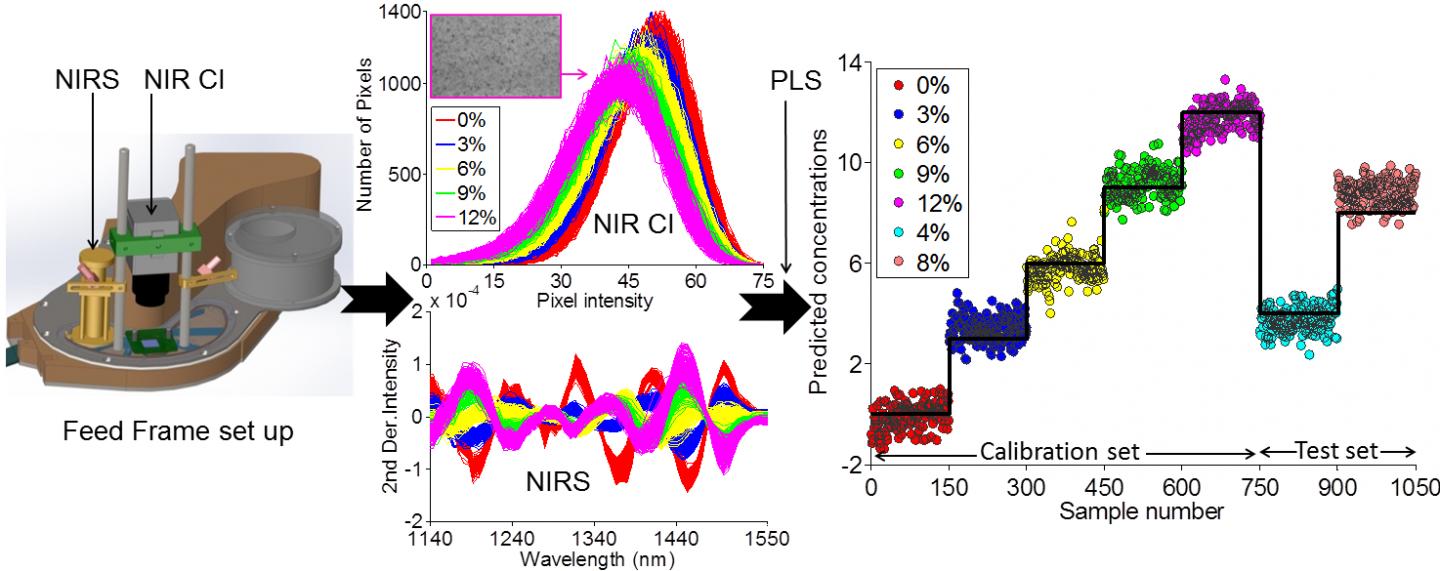
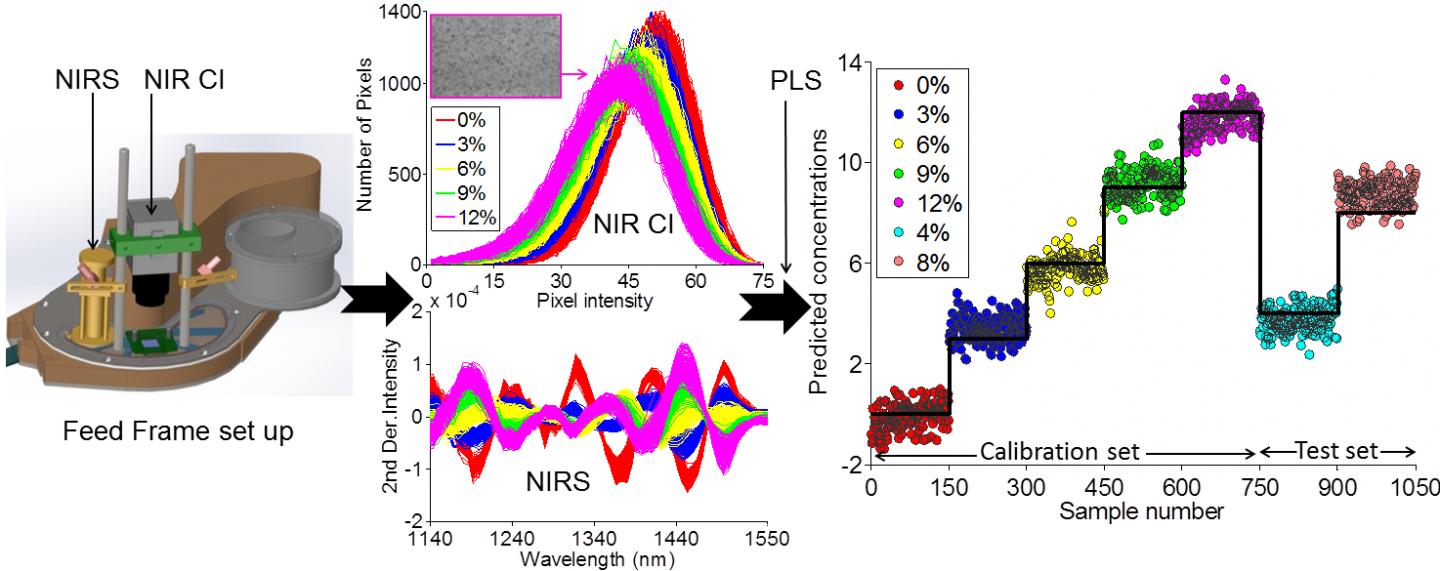
IMAGE

Credit: Credit: Himmat Dalvi, Clémence Fauteux-Lefebvre, Jean-Maxime Guay, Nicolas Abatzoglou and Ryan Gosselin

Process Analytical Technology (PAT) has been of great value to pharmaceutical manufacturing, enabling testing throughout the manufacturing process and allowing the real-time release of the finished product. Often, the final step in the production is tableting. In this, a die used to compress the tablet is filled with powder via a feed frame, that ensures a constant supply of material. The powder contains the active pharmaceutical ingredient (API) as well as other material required for the production of the tablet. Subject to the mechanical processes within the feed frame, the consistency of the powder varies due to density variations and segmentation. Such inconsistencies can lead to differences in concentrations of the API in individual tablets. Too much or too little API in a tablet are each dangerous for the patient taking the medicine.

These variations in powder flow phenomena in pharmaceutical manufacturing feed frames have previously been investigated with near infrared (NIR) spectroscopy. However, whilst this has provided useful information, due to the comparatively small area analysed with this technique, areas of segregation can be missed. In a paper published in the Open Access, peer-reviewed journal Journal of Spectral Imaging, the authors report on the use of NIR chemical imaging for in-line feed frame monitoring. They show that NIR chemical imaging based predictions of concentration in a feed frame may prove to be more representative, since they gather information from a comparatively larger sample area compared to NIR spectroscopy.

According to Ryan Gosselin, Associate Professor in the Department of Chemical Engineering and Biotechnology Engineering of the Université de Sherbrooke, Québec, Canada, "concentration predictions with NIR chemical imaging were found to be similar to those of the NIR spectroscopy model. However, NIR chemical imaging is better positioned to view concentration modifications over larger sample areas, and different image sections can be analysed separately in the event of localised concentration changes."

###

Details of the paper

Himmat Dalvi, Clémence Fauteux-Lefebvre, Jean-Maxime Guay, Nicolas Abatzoglou and Ryan Gosselin, "Concentration monitoring with near infrared chemical imaging in a tableting press", Journal of Spectral Imaging 7, a5 (2018). doi: https://doi.org/10.1255/jsi.2018.a5

Media Contact

Ian Michael
[email protected]
44-124-381-1334
@impjsi

http://www.impublications.com

Original Source

https://www.impopen.com/pr/near-infrared-chemical-imaging-can-help-maintain-safety-pharmaceutical-tablets http://dx.doi.org/10.1255/jsi.2018.a5


Share12Tweet8Share2ShareShareShare2

Related Posts

Evaluating Pediatric Emergency Care Quality in Ethiopia

February 7, 2026

TPMT Expression Predictions Linked to Azathioprine Side Effects

February 7, 2026

Improving Dementia Care with Enhanced Activity Kits

February 7, 2026

Decoding Prostate Cancer Origins via snFLARE-seq, mxFRIZNGRND

February 7, 2026
Please login to join discussion

POPULAR NEWS

  • Robotic Ureteral Reconstruction: A Novel Approach

    Robotic Ureteral Reconstruction: A Novel Approach

    82 shares
    Share 33 Tweet 21
  • Digital Privacy: Health Data Control in Incarceration

    63 shares
    Share 25 Tweet 16
  • Study Reveals Lipid Accumulation in ME/CFS Cells

    57 shares
    Share 23 Tweet 14
  • Breakthrough in RNA Research Accelerates Medical Innovations Timeline

    53 shares
    Share 21 Tweet 13

About

We bring you the latest biotechnology news from best research centers and universities around the world. Check our website.

Follow us

Recent News

Evaluating Pediatric Emergency Care Quality in Ethiopia

TPMT Expression Predictions Linked to Azathioprine Side Effects

Improving Dementia Care with Enhanced Activity Kits

Subscribe to Blog via Email

Success! An email was just sent to confirm your subscription. Please find the email now and click 'Confirm' to start subscribing.

Join 73 other subscribers
  • Contact Us

Bioengineer.org © Copyright 2023 All Rights Reserved.

Welcome Back!

Login to your account below

Forgotten Password?

Retrieve your password

Please enter your username or email address to reset your password.

Log In
No Result
View All Result
  • Homepages
    • Home Page 1
    • Home Page 2
  • News
  • National
  • Business
  • Health
  • Lifestyle
  • Science

Bioengineer.org © Copyright 2023 All Rights Reserved.
