• HOME
  • NEWS
  • EXPLORE
    • CAREER
      • Companies
      • Jobs
    • EVENTS
    • iGEM
      • News
      • Team
    • PHOTOS
    • VIDEO
    • WIKI
  • BLOG
  • COMMUNITY
    • FACEBOOK
    • INSTAGRAM
    • TWITTER
Wednesday, April 1, 2026
BIOENGINEER.ORG
No Result
View All Result
  • Login
  • HOME
  • NEWS
  • EXPLORE
    • CAREER
      • Companies
      • Jobs
        • Lecturer
        • PhD Studentship
        • Postdoc
        • Research Assistant
    • EVENTS
    • iGEM
      • News
      • Team
    • PHOTOS
    • VIDEO
    • WIKI
  • BLOG
  • COMMUNITY
    • FACEBOOK
    • INSTAGRAM
    • TWITTER
  • HOME
  • NEWS
  • EXPLORE
    • CAREER
      • Companies
      • Jobs
        • Lecturer
        • PhD Studentship
        • Postdoc
        • Research Assistant
    • EVENTS
    • iGEM
      • News
      • Team
    • PHOTOS
    • VIDEO
    • WIKI
  • BLOG
  • COMMUNITY
    • FACEBOOK
    • INSTAGRAM
    • TWITTER
No Result
View All Result
Bioengineer.org
No Result
View All Result
Home NEWS Science News Biology

Early-killed rye shows promise in edamame

Bioengineer by Bioengineer
March 8, 2018
in Biology
Reading Time: 2 mins read
0
Share on FacebookShare on TwitterShare on LinkedinShare on RedditShare on Telegram
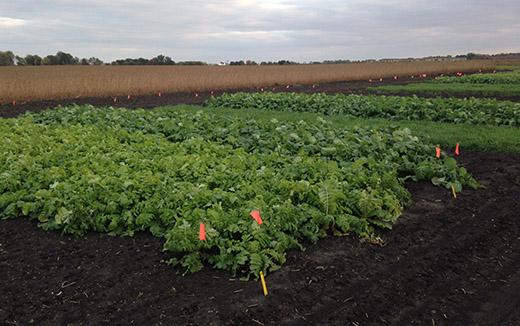
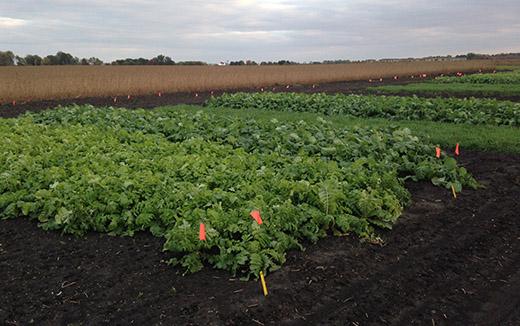
IMAGE

Credit: Marty Williams, University of Illinois

URBANA, Ill. – With the rise of herbicide-resistant weeds in most grain and vegetable crops, farmers are looking for alternatives to herbicides to control weeds. Cover crops offer one potential weed management tool. Their use in specialty crops is limited, and no testing has been done so far in edamame. However, a new University of Illinois study reports that early-killed cereal rye shows promise for edamame growers.

"Early-killed rye reduced weed density by 20 percent and suppressed early-season weed growth 85 percent," says Marty Williams, an ecologist with the Department of Crop Sciences at U of I and the USDA Agricultural Research Service.

Edamame is notoriously hard to get started. The soybean variety's large seeds make them good for eating – edamame seeds are consumed at an immature stage, when they're firm and green – but the crop can suffer from low seedling emergence in the field. Williams wasn't sure that asking them to struggle through a layer of cover crop residue would work.

"The question was: Can we find a cover crop management system that provides some amount of weed suppression without causing a problem for the crop? Edamame is far more sensitive to soil conditions during emergence than grain-type soybean," he says.

Williams and his research team conducted a three-year field experiment testing 11 edamame cultivars and multiple fall-seeded cover crops: oilseed radish, winter canola, and cereal rye. Radish was killed by winter temperatures, and the researchers applied early (April) or late (May) burndown herbicide treatments to kill canola and rye at different growth stages. For all of the cover crop types, the researchers were looking for edamame emergence and weed suppression.

Only early-killed rye offered the right combination of conditions to suppress weeds and allow edamame to emerge easily. Others allowed emergence but didn't control weeds, or suppressed both weeds and edamame.

"Early-killed rye resulted in a relatively thin layer of cover crop residue. With thicker layers of residue, you start to have problems with crop emergence. But with no cover crop residue, there's no weed control benefit. Early-killed rye provided the sweet spot," Williams says.

Williams acknowledges that early-killed rye alone won't be a silver bullet for weed control in edamame. "Clearly, this work doesn't mean we can grow edamame without other weed management tools. Cover crops are just one of many little hammers. By reducing weed density and weed growth, we know we're headed the right direction."

###

The article, "An early-killed rye (Secale cereale) cover crop has potential for weed management in edamame (Glycine max)," is published in Weed Science. Williams' co-authors include Laura Crawford and Sam Wortman, both affiliated with U of I at the time of the study. The work was supported by the USDA Agricultural Research Service.

Media Contact

Lauren Quinn
[email protected]
217-300-2435
@ACESIllinois

http://aces.illinois.edu/

Related Journal Article

http://dx.doi.org/10.1017/wsc.2018.5

Share12Tweet8Share2ShareShareShare2

Related Posts

Do Your Genes Influence How Lifestyle Choices Affect Aging?

Do Your Genes Influence How Lifestyle Choices Affect Aging?

April 1, 2026
Combining Single-Cell Multiomics Unlocks Precise Identification of Rare Cell Types and States

Combining Single-Cell Multiomics Unlocks Precise Identification of Rare Cell Types and States

March 31, 2026

Genetically Engineered Marmosets Pave the Way for Advancements in Human Deafness Research

March 31, 2026

How Great Hammerhead Sharks Outsmart Ocean Temperature Swings: Insights from FIU Researchers

March 31, 2026
Please login to join discussion

POPULAR NEWS

  • blank

    Revolutionary AI Model Enhances Precision in Detecting Food Contamination

    96 shares
    Share 38 Tweet 24
  • Imagine a Social Media Feed That Challenges Your Views Instead of Reinforcing Them

    1006 shares
    Share 398 Tweet 249
  • Promising Outcomes from First Clinical Trials of Gene Regulation in Epilepsy

    51 shares
    Share 20 Tweet 13
  • Popular Anti-Aging Compound Linked to Damage in Corpus Callosum, Study Finds

    43 shares
    Share 17 Tweet 11

About

We bring you the latest biotechnology news from best research centers and universities around the world. Check our website.

Follow us

Recent News

NCCN 2026 Annual Conference Equips Cancer Care Providers Globally to Embrace Holistic Patient Healing

Tracking Research on Adult Outcomes After Complex Perinatal History

Unveiling the Biological Pathways Linking Pesticides to Cancer Risk: New Study Sheds Light on Environmental Health Impacts

Subscribe to Blog via Email

Enter your email address to subscribe to this blog and receive notifications of new posts by email.

Join 78 other subscribers
  • Contact Us

Bioengineer.org © Copyright 2023 All Rights Reserved.

Welcome Back!

Login to your account below

Forgotten Password?

Retrieve your password

Please enter your username or email address to reset your password.

Log In
No Result
View All Result
  • Homepages
    • Home Page 1
    • Home Page 2
  • News
  • National
  • Business
  • Health
  • Lifestyle
  • Science

Bioengineer.org © Copyright 2023 All Rights Reserved.