Credit: © KAUST
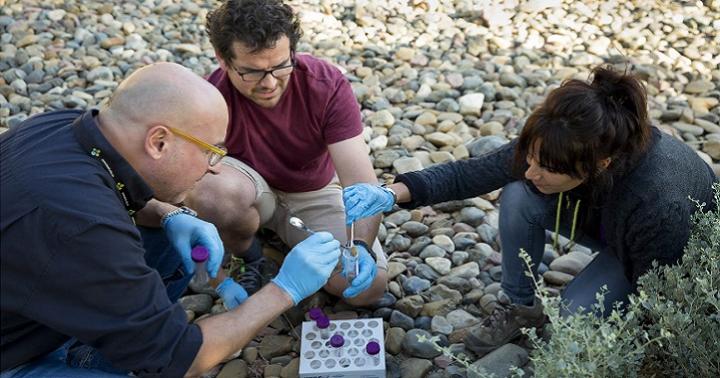
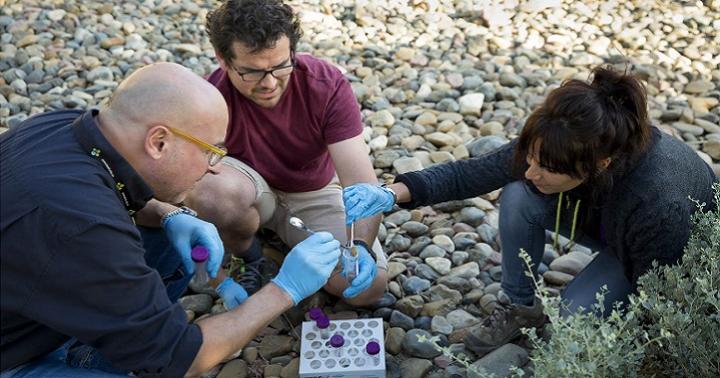
Researchers at KAUST, with colleagues in Italy and Greece, analyzed the bacterial content of the soil forming behind the receding Midtre Lovénbreen Arctic glacier in the island of Svalbard, Norway, one of the world's northernmost inhabited areas.
"Microbes are the major factor responsible for soil formation as they are the only form of life able to live under extreme conditions where water and nutrients are scarce," explains Marco Fusi, a postdoc at KAUST and one of the study's co-authors. "Their adaptation to such conditions triggers the mechanisms that form soil, allowing mosses, and plants to settle. Receding glaciers offer a unique model to study how soil is formed from bedrock," he says.
The team sampled the soil from seven sites exposed by the receding glacier from eight to more than 1,900 years ago. At each site, samples were taken from the 'rhizosphere' soil that holds tightly onto the roots of the purple saxifrage plant and from 'bulk' soil not in contact with the roots of any visible plant.
The researchers also categorized the soil samples according to their stage of development: 'barren soil' represented the sites that were up to 43 years old, 'developing soil' was from sites 66 and 106 years old, and mature soil came from the two sites that were 156 and more than 1,900 years old.
"We showed that the formation of soil is not a linear process that goes along with time," says Fusi. "Instead, it progresses through steps that are triggered by changes mediated by microorganisms."
The microbial content of the soil varied widely depending on its developmental stage and between bulk and rhizosphere soils within each stage. Bacteria associated with soil fertility became increasingly enriched in the rhizosphere as the soil became more developed. Bacterial communities in bulk soils were more complex in their early development stages.
"Microbes enhance the soil structure that determines an improved water retention and nutrient availability. In this way, they act like bio-conditioners that contribute to the establishment and survival of plants," says Fusi. "Microbes colonizing these arid developing soils could represent a promising tool to protect agriculture and rehabilitation projects in arid environments," he says.
"The Svalbard glacier moraines represent a unique environment where all the stages involved in soil formation coexist at the same time in a limited space," says Ramona Marasco, also a KAUST postdoc and co-author.
"Despite the very different temperature regime of Svalbard compared to the Middle East, these two environments deal with similar dynamics and processes that are ruled by water scarcity and poor water retention," adds Marasco. "Our team, led by Professor Daniele Daffonchio, aims to investigate the ecological processes and functional mechanisms that microorganisms implement to retain water in soil and favor plant establishment. This could provide clues for understanding the processes occurring during desertification in hot arid environments," she says.
The team is now examining the roles of microorganisms in the hot, arid soils of Saudi Arabia and Africa, including their influence on desert-adapted crop plants, such as the date palm. They are also studying microorganisms that contribute to the ability of soil to retain water and of plant root systems to tolerate drought.
###
Media Contact
Carolyn Unck
[email protected]
http://kaust.edu.sa/
Original Source
https://discovery.kaust.edu.sa/en/article/473/glaciers-provide-clues-to-combat-desertification http://dx.doi.org/10.1038/s41396-017-0026-4