Credit: WCS
- Recent evidence suggests that there may be between 4,678 and 8,745 snow leopards in only 44 percent of their global range; this estimate is higher than previous estimates for the entire range.
- Data appears in huge new book on snow leopards, just published by Elsevier Press, and is the single most comprehensive reference ever on snow leopard research, status, biology, behavior, threats, and conservation actions.
New York (July 5, 2016) – The snow leopard has long been one of the least studied – and therefore poorly understood – of the large cats. No longer.
Scientists studying snow leopards now say the big cats may be more common than previously thought. New estimates focused on areas described as 'Snow Leopard Conservation Units,' covering only 44 percent of the snow leopard's extensive range (which extends over roughly 3 million km2 or 1,158,306 square miles) suggests that there may be between 4,678 and 8,745 snow leopards just in these units. This is higher than previous estimates for the entire global population, which had previously been thought to be only between 3,920 and 7,500.
The new census information appears in Snow Leopards, published by Elsevier Press and edited by Dr. Tom McCarthy and Dr. David Mallon, world-renowned snow leopard experts. The book is an astonishingly comprehensive work on the biology, behavior and conservation status of these previously mysterious and enigmatic large carnivores. The book brings together the most current scientific knowledge, documents the most pressing conservation issues, and shares success stories in alleviating the broad threats that now jeopardize the long-term survival of this species.
The snow leopard (Panthera uncia) lives across the great mountain ranges of Asia, occurring in the highland regions of Afghanistan, Pakistan, Bhutan, China, India, Kazakhstan, Kyrgyz Republic, Tajikistan, Uzbekistan, Mongolia, Nepal, and Russia. The snow leopard is perfectly adapted for these high mountains with its powerful legs for jumping, thick fur for warmth, grayish-white color pattern for camouflage, and long tail for balance.
However, because of their remote and difficult habitat, shy behavior, and cryptic coloration, studying snow leopards has been extremely difficult.
"Only in recent years have advances such as satellite telemetry and compact camera traps capable of taking high-quality night shots while surviving extreme low temperatures allowed scientists to begin to unravel the mysteries behind the snow leopard's life," said WCS scientist and veterinarian Dr. Stephane Ostrowski.
Said Peter Zahler, Coordinator for the Wildlife Conservation Society's Snow Leopard Program: "This is an incredibly important book. It has collected virtually all the most recent research and information from all 12 range states, covering biology, behavior, threats, and conservation activities for this mysterious and elusive big cat and for the 'mountain monarchs' – Asia's wild mountain goats and sheep – that are their main prey. This book will serve as the go-to reference work on snow leopards for decades to come."
WCS affiliates and staff authored or co-authored nine chapters in the book, covering such topics as biogeography and status; community governance; transboundary initiatives; disease; resource extraction and linear infrastructure; rescue, rehabilitation, translocation, reintroduction, and captive rearing; the role of snow leopards as zoo ambassadors; status and conservation in Afghanistan; and global strategies for snow leopard conservation.
WCS authors included Peter Zahler, Richard Paley, Stephane Ostrowski, Dale Miquelle, Patrick Thomas, Eric Sanderson, Kim Fisher, Zalmai Moheb, Anthony Simms, and Martin Gilbert, as well as a forward by WCS Senior Conservationist George Schaller.
Despite the good news about snow leopard numbers, the species still faces multiple pressures.
Said Richard Paley, Director of the WCS Afghanistan Program: "Snow leopards are still regularly poached for their beautiful fur. They are also killed in retaliation for taking herder's livestock. With the decline in their wild prey from overhunting, snow leopards may find themselves forced to take more livestock, which leads to a vicious cycle that snow leopards often lose."
Said Dale Miquelle, WCS Big Cat expert: "We have lost over 90 percent of the world's wild tigers in the last 100 years, and we have lost over 40 percent of African lions in the last 20 years. Big cats around the world are in danger of extinction. While it is great news to discover that there are more snow leopards than we thought, there is also a good chance that this situation might not last."
"The protection of snow leopards, their prey, and their unique high-mountain landscapes must continue to be a priority for the global community," said Zahler. "Because of the low human density in these mountains there is still extensive habitat for snow leopards. But with growing pressures – hunting, mining, roads, and even climate change – our window for ensuring long-term protection of these big cats will close fast."
WCS has long been a global leader in snow leopard conservation, beginning with Dr. Schaller's seminal research on the mysterious big cats in Pakistan in the 1970s. WCS supported the first radio telemetry study of snow leopards in Mongolia in the 1990s, and has more recently supported snow leopard conservation projects and programs in Pakistan, Afghanistan, China, and Uzbekistan.
###
WCS (Wildlife Conservation Society)
MISSION: WCS saves wildlife and wild places worldwide through science, conservation action, education, and inspiring people to value nature. To achieve our mission, WCS, based at the Bronx Zoo, harnesses the power of its Global Conservation Program in nearly 60 nations and in all the world's oceans and its five wildlife parks in New York City, visited by 4 million people annually. WCS combines its expertise in the field, zoos, and aquarium to achieve its conservation mission. Visit: newsroom.wcs.org. Follow: @WCSNewsroom. For more information: 347-840-1242.
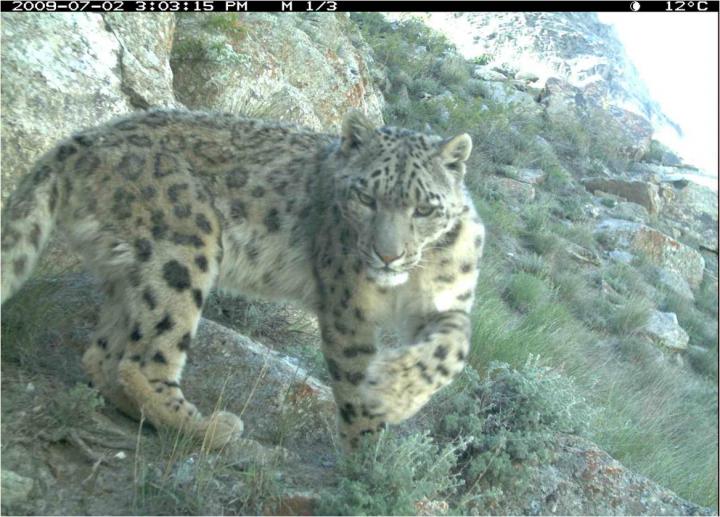
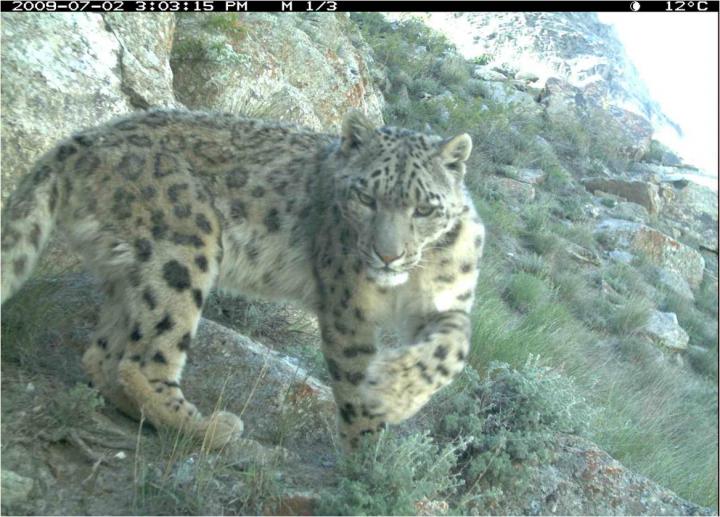
Camera Trap Image of Snow leopard Courtesy WCS
Twitter: https://twitter.com/WCSNewsroom/status/750403075484024832
Media Contact
Stephen Sautner
[email protected]
718-220-3682
@TheWCS
http://www.wcs.org