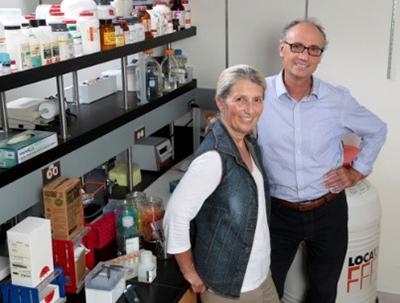
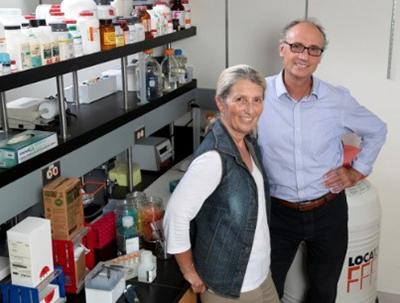
Credit: University of Arizona Cancer Center
A University of Arizona Cancer Center research team is engaged in a series of studies to investigate how genistein, a component of soy foods, might suppress the development of breast cancer.
The team's most recent study, published in Current Developments in Nutrition, suggests genistein can protect BRCA1, a gene that plays a pivotal role in thwarting tumor development in breast tissue. The team is led by Donato F. Romagnolo, PhD, professor of nutritional and cancer biology, and Ornella I. Selmin, PhD, associate research professor.
Targeting Tumors
A normally functioning breast cell has estrogen receptors, into which the body's natural estrogens fit like a key into a lock, regulating cell growth. Doctors can exploit these receptors by using drugs that attach to them, delivering chemotherapy to cancerous cells with drugs like tamoxifen. In many breast tumors, however, this receptor is missing, rendering tamoxifen ineffective.
Cells without estrogen receptors might be treated with drugs that target two other receptors. Cells that lack all three receptors are called "triple-negative" breast cancers.
"In triple-negative breast cancers, no targeted chemotherapy is available," says Dr. Romagnolo, pointing to the need for alternative drug targets.
Silencing BRCA1, Suppressing Estrogen Receptors
BRCA1 is a tumor-suppressor gene. When working normally, it helps keep DNA stable, protecting against genetic diseases like cancer; when BRCA1 is performing abnormally, the body's defenses against breast cancer are impaired. Although a small percentage of breast cancers are caused by mutations in BRCA1, many other breast cancer patients have normal copies, but the genes have been "methylated" — wrapped in strands of carbon-based molecules that render them unreadable. A BRCA1 gene "silenced" in this manner is unable to do its job as a tumor suppressor.
One receptor, the aromatic hydrocarbon receptor (AhR), activated by environmental carcinogens like dioxins, tobacco smoke, products of UV light exposure and some fatty acid metabolites, is of particular interest to the UA Cancer Center team. AhR silences BRCA1, triggering a cascade of undesirable effects. When BRCA1 is unable to carry out its duties as a tumor suppressor, cancerous cells can proliferate.
Dr. Romagnolo explains that a "molecular link" exists between BRCA1 and a type of estrogen receptor called ER-alpha. When AhR silences BRCA1, ER-alpha is lost and cancer cells cannot be treated by ER-alpha-targeting drugs like tamoxifen. If AhR can be disabled by a drug, BRCA1 will be "unsilenced."
Soy to the Rescue
One weapon that may be used to target AhR is found in soy, a protein-packed legume that is a major source of compounds called isoflavones.
"Lifetime intake of soy in Asian women has been linked to reduced risk of breast cancer," says Dr. Romagnolo. "Genistein is the predominant isoflavone found in soy and it may actually block DNA methylation" — the silencing of the BRCA1 gene.
The UA Cancer Center team is the first to show that AhR can be targeted by genistein. The team hopes this discovery will lead to a genistein-based therapy that can block the harmful actions of AhR. If successful, such a therapy might "unsilence" the BRCA1 gene, which would have the dual benefit of enabling the gene to resume its role as a tumor suppressor, as well as allowing the re-expression of ER-alpha, making cancer cells treatable with tamoxifen.
The experiments used cells from human breast tumors — including one cell line that originally was derived from a UA Cancer Center patient. With successful cell experiments behind them, the team is immersed in studies using mice specialized for breast cancer research. If their next wave of experiments support their hypothesis, the team could move on to clinical studies in humans.
Other questions include what types of soy foods, how much and at what stage of life soy might be optimal for human health. The team especially is interested in discovering whether exposure to soy genistein during gestation can affect a developing fetus and confer protective benefits throughout the lifetime of the offspring.
###
The team includes Micah Donovan, MS, who contributed to this work as a master's degree student in nutritional sciences and now is pursuing a PhD in cancer biology; Tom Doetschman, PhD, who provides expertise with genetic models; and Andreas Papoutsis, PhD, of Novartis. The team's work is supported by a grant from the U.S. Department of Defense Breast Cancer Program.
About the University of Arizona Cancer Center
The University of Arizona Cancer Center is the only National Cancer Institute-designated Comprehensive Cancer Center headquartered in Arizona. The Center is supported by NCI Cancer Center Support Grant No. CA023074. With primary locations at the University of Arizona in Tucson and at St. Joseph's Hospital and Medical Center in Phoenix, the Center has more than a dozen research and education offices in Phoenix and throughout the state and 300 physician and scientist members who work together to prevent and cure cancer. For more information: uacc.arizona.edu (Follow us: Facebook | Twitter | YouTube)
Media Contact
Anna C. Christensen
[email protected]
520-626-6401
http://uahs.arizona.edu/
Original Source
http://uahs.arizona.edu/news/ua-cancer-center-research-team-explores-anti-breast-cancer-properties-soy