• HOME
  • NEWS
  • EXPLORE
    • CAREER
      • Companies
      • Jobs
    • EVENTS
    • iGEM
      • News
      • Team
    • PHOTOS
    • VIDEO
    • WIKI
  • BLOG
  • COMMUNITY
    • FACEBOOK
    • INSTAGRAM
    • TWITTER
Thursday, April 2, 2026
BIOENGINEER.ORG
No Result
View All Result
  • Login
  • HOME
  • NEWS
  • EXPLORE
    • CAREER
      • Companies
      • Jobs
        • Lecturer
        • PhD Studentship
        • Postdoc
        • Research Assistant
    • EVENTS
    • iGEM
      • News
      • Team
    • PHOTOS
    • VIDEO
    • WIKI
  • BLOG
  • COMMUNITY
    • FACEBOOK
    • INSTAGRAM
    • TWITTER
  • HOME
  • NEWS
  • EXPLORE
    • CAREER
      • Companies
      • Jobs
        • Lecturer
        • PhD Studentship
        • Postdoc
        • Research Assistant
    • EVENTS
    • iGEM
      • News
      • Team
    • PHOTOS
    • VIDEO
    • WIKI
  • BLOG
  • COMMUNITY
    • FACEBOOK
    • INSTAGRAM
    • TWITTER
No Result
View All Result
Bioengineer.org
No Result
View All Result
Home NEWS Science News Biology

New butterfly species discovered in Russia with an unusual set of 46…

Bioengineer by Bioengineer
February 13, 2018
in Biology
Reading Time: 2 mins read
0
Share on FacebookShare on TwitterShare on LinkedinShare on RedditShare on Telegram
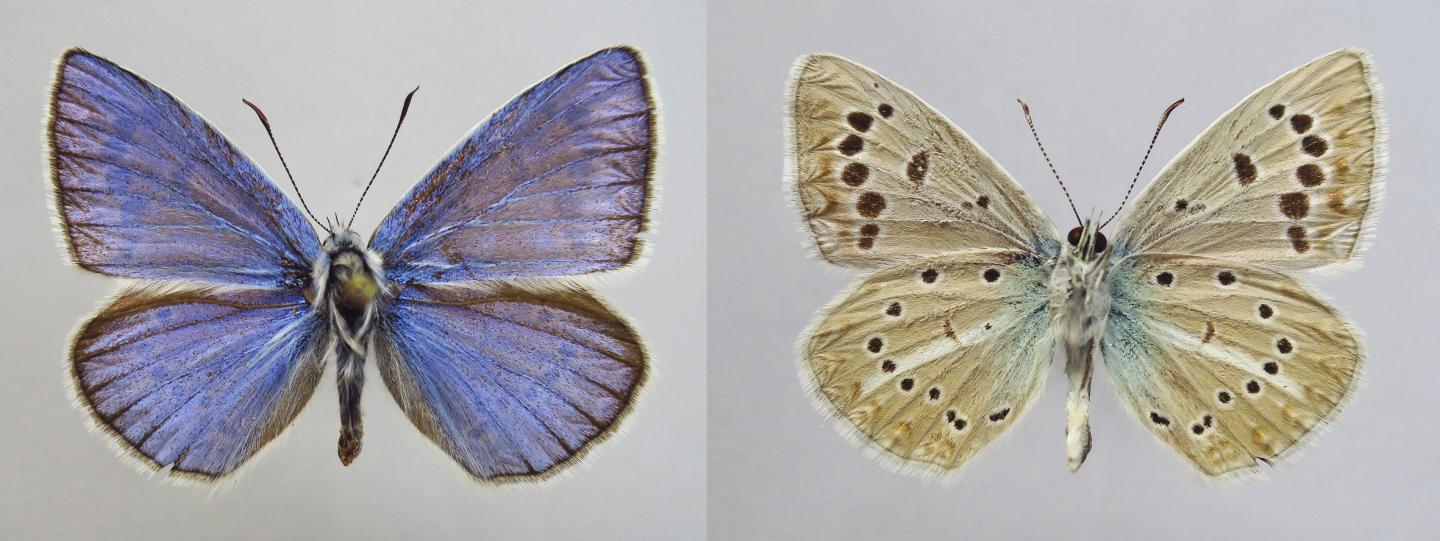
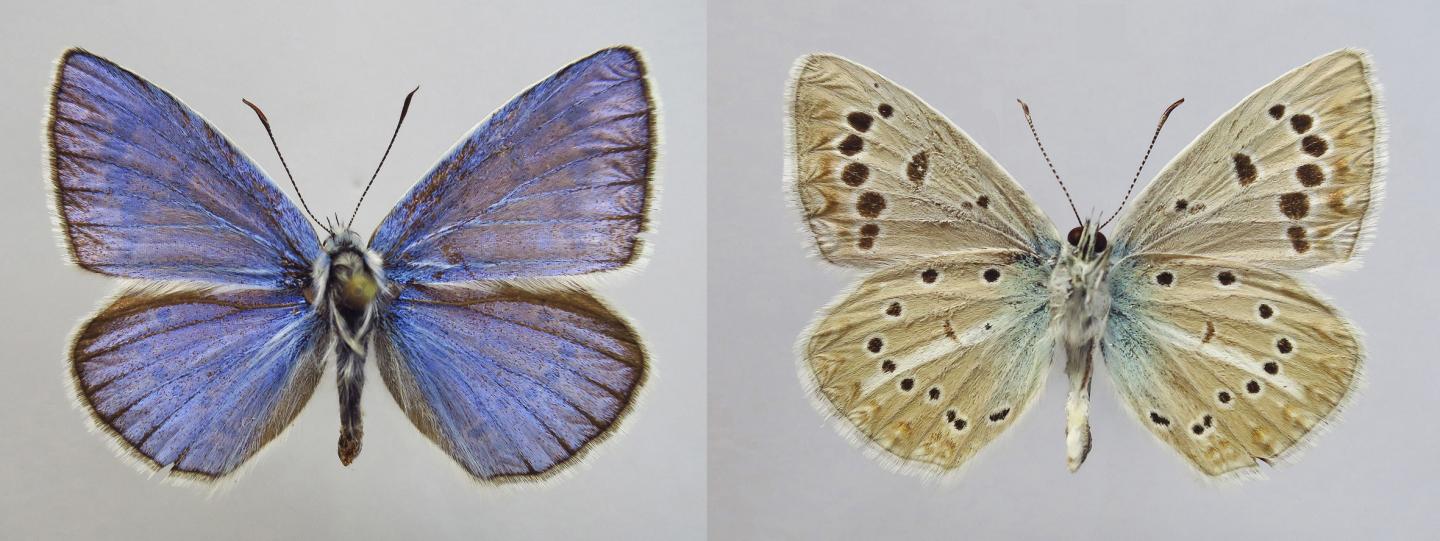
IMAGE

Credit: Vladimir Lukhtanov

What looked like a population of a common butterfly species turned out to be a whole new organism, and, moreover – one with a very peculiar genome organisation.

Discovered by Vladimir Lukhtanov, entomologist and evolutionary biologist at the Zoological Institute in St. Petersburg, Russia, and Alexander Dantchenko, entomologist and chemist at the Moscow State University, the startling discovery was named South-Russian blue (Polyommatus australorossicus). It was found flying over the northern slopes of the Caucasus mountains in southern Russia. The study is published in the open access journal Comparative Cytogenetics.

"This publication is the long-awaited completion of a twenty-year history," says Vladimir Lukhtanov.

In the mid-nineties, Vladimir Lukhtanov, together with his students and collaborators, started an exhaustive study of Russian butterflies using an array of modern and traditional research techniques. In 1997, Alexander Dantchenko who was mostly focused on butterfly ecology, sampled a few blue butterfly specimens from northern slopes of the Caucasus mountains. These blues looked typical at first glance and were identified as Azerbaijani blue (Polyommatus aserbeidschanus).

However, when the scientists looked at them under a microscope, it became clear that they had 46 chromosomes – a very unusual number for this group of the blue butterflies and exactly the same count as in humans.

Having spent twenty years studying the chromosomes of more than a hundred blue butterfly species and sequencing DNA from all closely related species, the researchers were ready to ascertain the uniqueness of the discovered butterfly and its chromosome set.

Throughout the years of investigation, it has become clear that caterpillars of genetically related species in the studied butterfly group feed on different, but similar plants. This discovery enables entomologists to not only discover new butterfly species with the help of botanic information, but also protect them.

"We are proud of our research," says Vladimir Lukhtanov. "It contributes greatly to both the study of biodiversity and understanding the mechanisms of biological evolution."

###

Original source:

Lukhtanov VA, Dantchenko AV (2017) A new butterfly species from south Russia revealed through chromosomal and molecular analysis of the Polyommatus (Agrodiaetus) damonides complex (Lepidoptera, Lycaenidae). Comparative Cytogenetics 11(4): 769-795. https://doi.org/10.3897/CompCytogen.v11i4.20072

Media Contact

Vladimir Lukhtanov
[email protected]
@Pensoft

http://www.pensoft.net

Related Journal Article

http://dx.doi.org/10.3897/CompCytogen.v11i4.20072

Share12Tweet8Share2ShareShareShare2

Related Posts

Newly Discovered Chronic Pain Circuit Unveils Potential Avenues for Innovative Treatments

Newly Discovered Chronic Pain Circuit Unveils Potential Avenues for Innovative Treatments

April 2, 2026
DNA Transforms from Blueprint to Active Field Agent

DNA Transforms from Blueprint to Active Field Agent

April 2, 2026

UBC Okanagan Study Reveals How Trees Visually Signal Their Spring Rehydration

April 1, 2026

Rising Temperatures from Climate Change Associated with Reduced Newborn Size

April 1, 2026
Please login to join discussion

POPULAR NEWS

  • blank

    Revolutionary AI Model Enhances Precision in Detecting Food Contamination

    96 shares
    Share 38 Tweet 24
  • Imagine a Social Media Feed That Challenges Your Views Instead of Reinforcing Them

    1007 shares
    Share 398 Tweet 249
  • Promising Outcomes from First Clinical Trials of Gene Regulation in Epilepsy

    51 shares
    Share 20 Tweet 13
  • Popular Anti-Aging Compound Linked to Damage in Corpus Callosum, Study Finds

    44 shares
    Share 18 Tweet 11

About

We bring you the latest biotechnology news from best research centers and universities around the world. Check our website.

Follow us

Recent News

Cysteine Sulfenylation of p-GSK-3β Drives Liver Insulin Resistance

Transonic Safe Mode Empowers Next-Gen Wind Turbines

First Human Trial of Implant for Brain Pressure Monitoring

Subscribe to Blog via Email

Enter your email address to subscribe to this blog and receive notifications of new posts by email.

Join 78 other subscribers
  • Contact Us

Bioengineer.org © Copyright 2023 All Rights Reserved.

Welcome Back!

Login to your account below

Forgotten Password?

Retrieve your password

Please enter your username or email address to reset your password.

Log In
No Result
View All Result
  • Homepages
    • Home Page 1
    • Home Page 2
  • News
  • National
  • Business
  • Health
  • Lifestyle
  • Science

Bioengineer.org © Copyright 2023 All Rights Reserved.